


Money doesn’t usually break all at once.
It slows, then gets stuck.
And when capital stops moving, the system doesn’t collapse immediately; it begins to fracture from within.
It hesitates at the edges. It gets caught in the plumbing. It starts taking longer to arrive, costs more to move, and demands more trust from institutions that increasingly trust each other less. By the time the public notices, the underlying problem has already spread through the system.
That is where we are now.
We are watching a global monetary order under strain. Central banks are accumulating gold at speed. Liquidity is becoming more selective. Cross-border finance is more politically sensitive, more expensive, and more fragile than most people realise.
The system still works.
But it works like something that hasn’t been redesigned in decades.
Central planners set the tune; we all dance to it.
One of the key instruments is already being wired into that rhythm beneath the surface of global finance.
Gold is the constant in the background, even as everything else is being rebuilt.
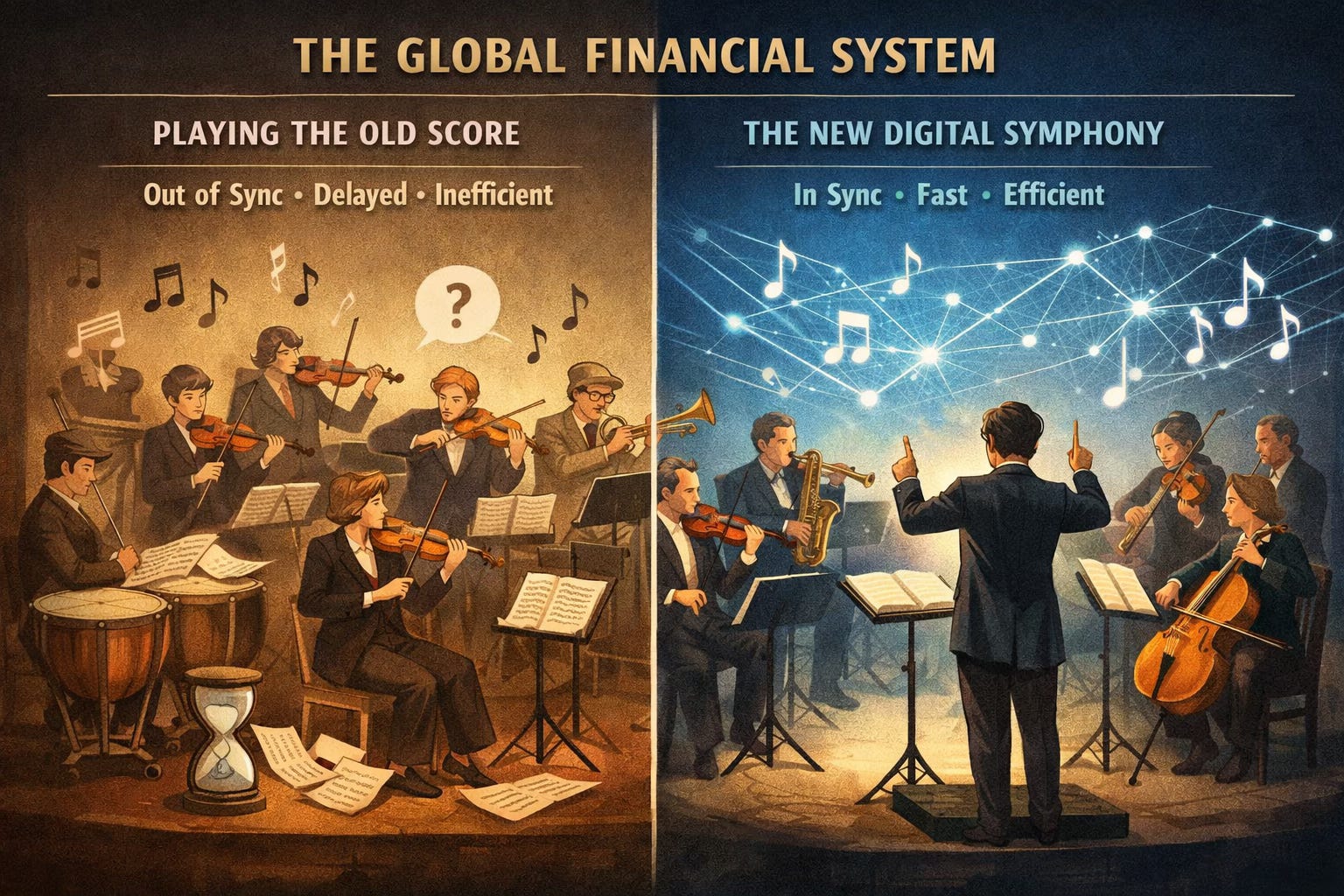
The global financial system is like an orchestra playing from an old score. The tempo drags, sections come in at different times, and entire movements rely on musicians waiting for their cue just to keep the performance together. It still works, but it is inefficient by design, and rewriting the score without throwing the whole performance into chaos has always been the challenge.
The Problem Isn’t Liquidity — It’s Movement
What people think is happening:
Payments are getting faster.
Technology is improving.
Crypto is finally finding use cases.
What’s actually happening:
Liquidity is fragmenting.
Capital is becoming trapped inside systems that were never designed for this level of global stress and political complexity.
And beneath the surface, the rails that move value are being quietly rebuilt.
Why it happens:
The current system depends on friction.
SWIFT relies on pre-funded accounts. Banks park capital across borders to ensure settlement can occur. Money moves through layers of intermediaries, each adding delay, cost, and counterparty exposure.
When liquidity is abundant, that inefficiency is hidden.
When liquidity tightens, it becomes a constraint.
And right now that constraint is growing.
Which means the system doesn’t just need more liquidity.
It needs better movement of liquidity.
That’s where this starts to shift from theory to structure.
