


Between 1963 and 1966, France undertook one of the most audacious financial manoeuvres of the 20th century. Under the direction of President Charles de Gaulle, a secret operation codenamed Vide-Gousset brought home 3,313 tonnes of French gold stored in the vaults of the Federal Reserve in New York and the Bank of England in London. De Gaulle’s concern was clear: America’s persistent trade deficits threatened the stability of the Bretton Woods system and could trigger a sharp devaluation of the dollar relative to gold.
Rather than leave these reserves abroad, France converted its entire dollar stockpile into gold and arranged for its transport over three years. The logistics were formidable, involving 44 maritime shipments and 129 flights to return the metal to the Banque de France in Paris. This strategic foresight proved wise. From 1968 to 1980, the dollar price of gold skyrocketed from $35 to $800 per ounce, eroding 96 percent of the greenback’s value. Nations that had continued to hold large dollar reserves suffered significant losses.
In the aftermath of the 2008 financial crisis, history echoed itself. The Banque de France repatriated another 211 tonnes of gold, modernized its holdings to current standards, overhauled vault facilities, and reestablished Paris as a trading hub for institutional investors. France’s strategy once again positioned it advantageously at the outset of a gold bull market.

The Birth of Bretton Woods
In July 1944, representatives from 44 Allied nations convened in Bretton Woods, New Hampshire, to design a new global monetary framework. They established fixed exchange rates and agreed to a system tying national currencies to the U.S. dollar, which was itself convertible to gold at a fixed rate of $35 per ounce. Foreign central banks were expected to maintain their currency values within a defined range relative to the dollar.
The U.S. dollar quickly became the linchpin of the system. It was regarded as “as good as gold” because central banks could, in theory, redeem it for actual gold at the Fed. In practice, most international reserves were held in dollars, effectively creating a gold-exchange standard. The International Monetary Fund, newly established, oversaw the system and provided temporary reserve support to countries experiencing balance of payments deficits. In extreme cases, the IMF allowed countries to adjust their currency values to restore equilibrium.
France Questions the System
By 1959, Charles de Gaulle, drawing on the advice of economist Jacques Rueff, began to question the integrity of Bretton Woods. France objected to what they called America’s “exorbitant privilege.” The system allowed the U.S. to run persistent deficits, effectively paying for imports with newly printed dollars. Foreign central banks could redeem these dollars for gold, but only with the Fed’s consent. This arrangement transferred inflationary pressures abroad while providing the United States with a de facto interest-free loan.
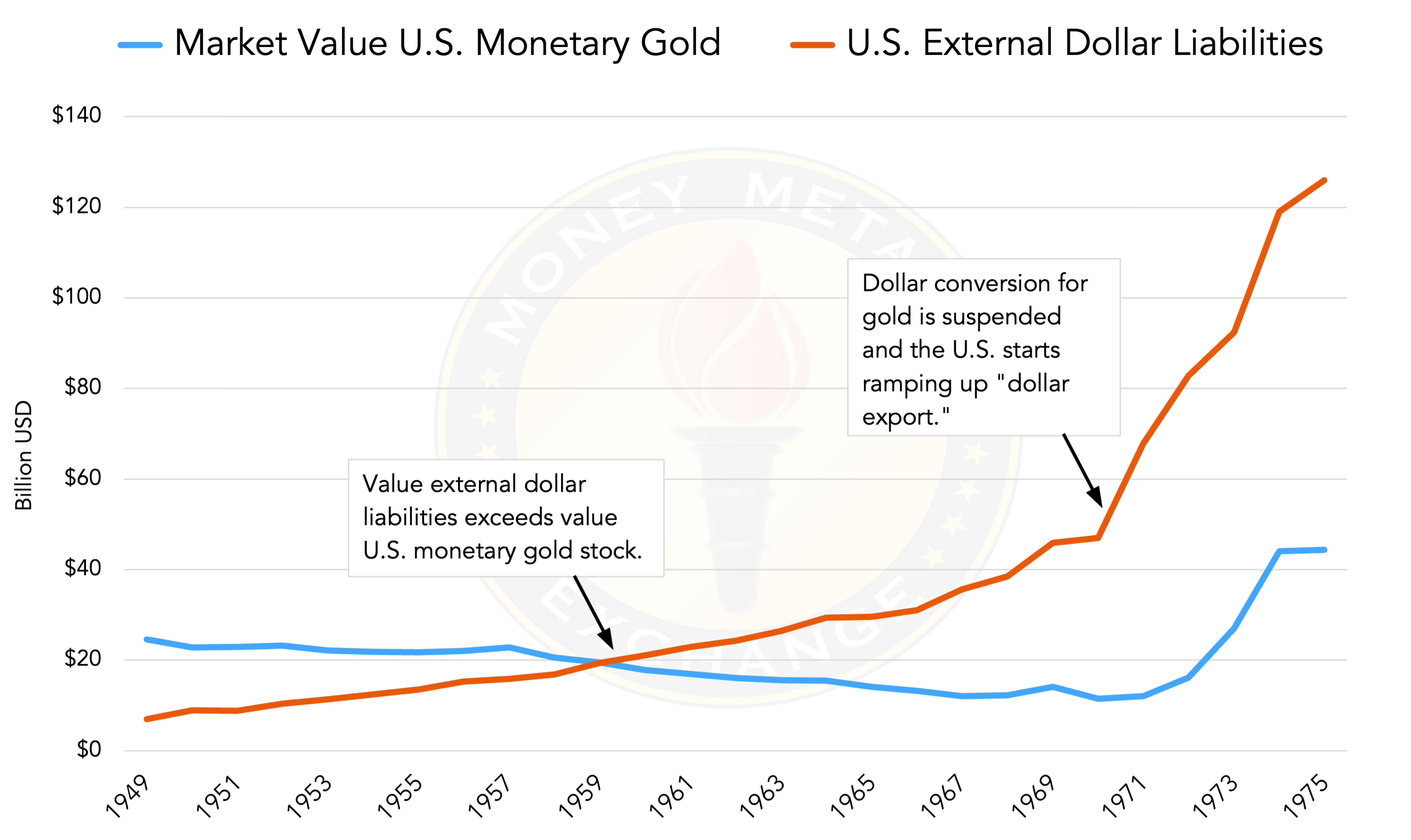
By the early 1960s, the U.S. gold stockpile was declining as deficits accumulated. When dollar liabilities exceeded the country’s gold reserves, the system’s credibility came under scrutiny. France, which had experienced robust economic growth and accumulated a surplus, foresaw a crisis. Rueff warned that foreign central banks would eventually refuse to hoard dollars, forcing a revaluation of gold or a suspension of convertibility. De Gaulle recalled Britain’s 1931 sterling devaluation, which had cost the Banque de France heavily and required taxpayer intervention. The lesson was clear: reliance on foreign currency reserves carried risk.
France Builds Its Gold Position
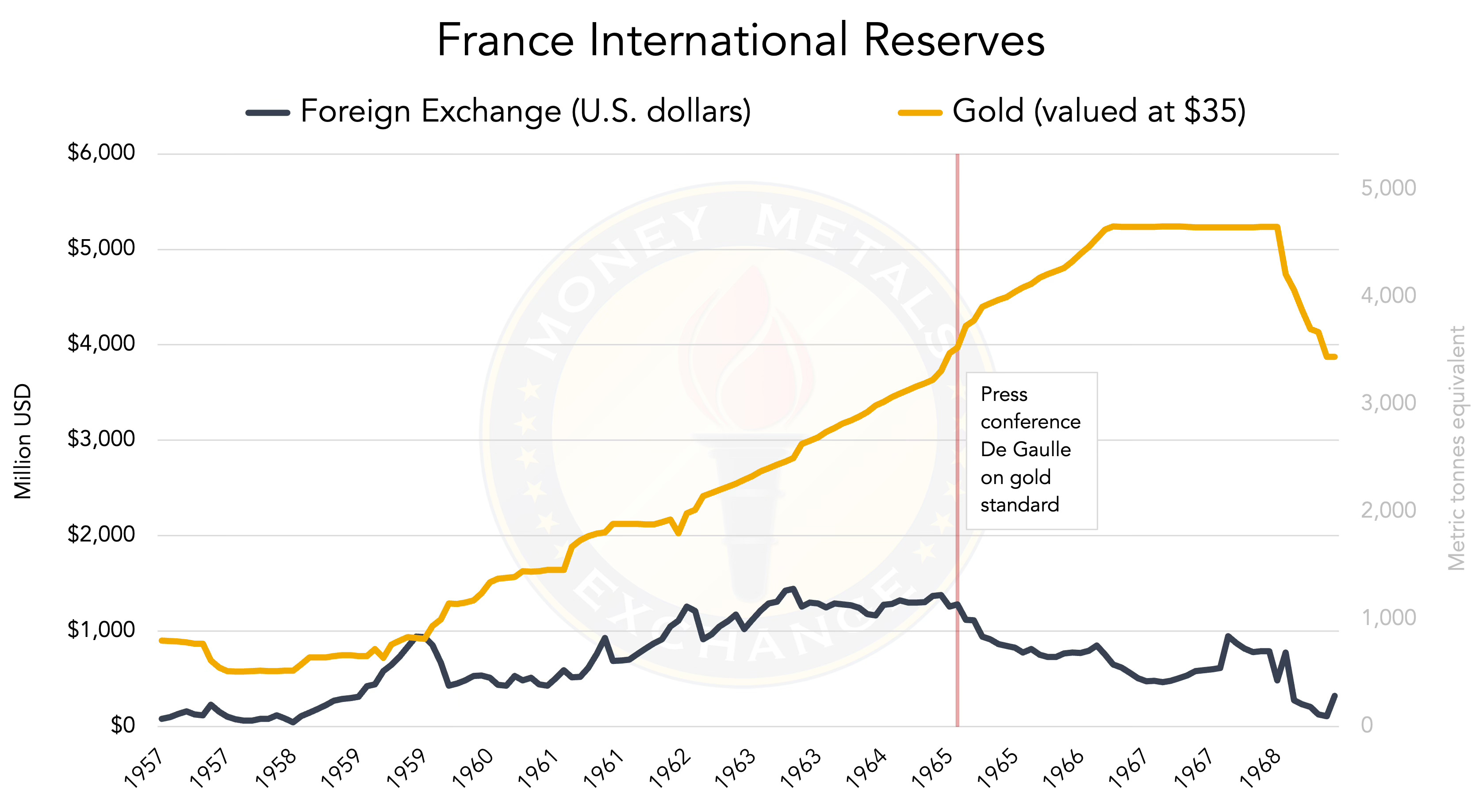
In the early 1960s, French gold reserves were spread across New York, London, and Paris. Initially, this distribution seemed ideal. But after observing the U.S. and U.K.’s economic vulnerabilities, France began quietly converting dollars into gold at the Fed, gradually increasing holdings in New York.
The “Gold Pool,” established in 1961 by the Fed and European central banks, aimed to stabilize the gold price at $35 per ounce through coordinated buying and selling in London. France participated only on the condition that the U.S. would address its balance of payments deficit. While publicly cooperating, the Banque de France quietly continued to convert dollars into gold, reducing exposure to U.S. and U.K. financial instability.
Vide-Gousset: Repatriating the Treasure
For De Gaulle, gold was not merely wealth; it was leverage against what he saw as American financial dominance. In January 1963, he expressed concern that Western Europe had become an American protectorate, with subtle but pervasive control over national economies. To counter this, he ordered the repatriation of French gold.
Operation Vide-Gousset commenced in September 1963, initially moving 400 tonnes from New York by sea. The French Treasury considered using naval vessels but rejected this for diplomatic reasons. Instead, ocean liners capable of transporting 25 tonnes per trip were employed. Subsequent transfers from London began in December 1964 via Air France aircraft, each carrying roughly 30 tonnes. The operation combined secrecy with careful logistics to mitigate risks and avoid international tension.
Public announcements were staggered to signal France’s concerns while preserving strategic advantage. In January 1965, BdF declared a $300 million dollar conversion into gold. Shortly thereafter, De Gaulle addressed the press, advocating a return to a gold-based settlement system and critiquing the dollar’s dominance. He argued that international trade should rely on an objective, indisputable monetary base rather than the currency of a single nation.
By the end of 1966, France had successfully repatriated 3,313 tonnes of gold. Operations involved 24 boat trips and 35 air flights from the U.S., and 94 flights from London, consolidating one of the largest transfers of bullion in history.
The Aftermath: Collapse, Then Confirmation
France’s strategic foresight in the 1960s was ultimately vindicated. Mounting imbalances forced Paris to withdraw from the London Gold Pool in 1967. Soon after, the pound was devalued, pressure shifted to the dollar, and the system began to fracture. By 1968, the gold market itself had split into official and free-market pricing, exposing the artificiality of the $35 peg.
The final break came in 1971, when the United States suspended dollar convertibility into gold. Bretton Woods collapsed, and gold entered a prolonged bull market, rising from $35 to $800 per ounce over the following decade. Nations holding dollar reserves saw their purchasing power eroded, while France, having already converted and repatriated much of its holdings, avoided the worst of the damage.
What began as a controversial political decision proved to be a decisive monetary advantage.
France Today: History Repeating, With Subtle Differences
Six decades later, France appears to be following a remarkably similar playbook, although in a more understated form.
In 2025 and early 2026, the Banque de France completed the sale of the last portion of its gold previously held in New York, amounting to roughly 129 tonnes, or about 5 percent of its total reserves. The proceeds were used to acquire newly refined, internationally compliant bullion, bringing the entirety of France’s gold reserves back under domestic control.
Officially, the move was framed as a technical upgrade. Older, non-standard bars, which varied in size and purity, were replaced with London Bullion Market Association compliant bars suitable for modern reserve management and international settlement. From an operational standpoint, selling the metal in New York and purchasing new bars in Europe was more efficient than transporting and refining legacy stock.
Yet the parallel with the 1960s is difficult to ignore.
Just as under De Gaulle, France has once again reduced its exposure to foreign custodianship, particularly within the United States, while maintaining its overall gold position. The difference today is not in direction, but in presentation. What was once an overt geopolitical signal is now communicated as a balance sheet adjustment.
At the same time, the financial outcome was significant. By replacing legacy holdings acquired at much lower historical prices, the Banque de France realised a substantial gain, reportedly in the tens of billions, further strengthening its reserve position without increasing total holdings.

Beyond France: A Broader Shift in Monetary Trust
France is not acting in isolation.
Across Europe and beyond, questions are resurfacing about the wisdom of holding strategic reserves abroad. During the Cold War, storing gold in New York made geopolitical sense. Today, that logic is being reconsidered.
The increasing use of financial infrastructure as a geopolitical tool, particularly the freezing of foreign reserves in recent years, has prompted central banks to reassess counterparty risk. Surveys indicate a growing preference for domestic custody, with many nations either repatriating gold or planning to do so.
Even in traditionally aligned countries, debate is emerging. Calls within Germany to bring home its remaining gold reserves reflect a broader concern that access, not just ownership, matters in times of stress.
In this context, France’s latest move appears less like an isolated technical adjustment and more like part of a wider structural shift.
