


In March 2021, the Ever Given became lodged across the Suez Canal, blocking one of the world’s most important shipping routes. For six days, hundreds of vessels carrying crude oil, LNG, semiconductors and consumer goods accumulated at either end of the canal. Global supply chains slowed. Commodity prices moved. Manufacturers recalculated inventories. A single ship briefly became one of the world’s most important macroeconomic variables.
The lesson extended well beyond maritime logistics.
Modern economies are not usually constrained by their largest industries. They are constrained by the narrow points through which those industries must all pass. Those bottlenecks often attract remarkably little attention until they fail.
Artificial intelligence, semiconductors, hyperscale data centres, solar power and electric vehicles are generally analysed as separate investment themes, each with its own forecasts, valuations and specialist research. Yet they increasingly depend upon the same industrial foundation. Every one requires reliable electrical transmission. Every one depends upon increasingly sophisticated electronic systems. Every one ultimately draws upon a surprisingly small group of materials whose physical properties remain exceptionally difficult to substitute.
Technology has advanced rapidly.
The periodic table has not.
That distinction matters because investors continue to view gold and silver primarily through a monetary lens. Gold remains synonymous with wealth preservation and central-bank demand. Silver is still discussed as a hybrid between precious and industrial metals. Those classifications describe where demand has historically come from. They say far less about where incremental demand is now emerging.
The global economy is undertaking one of the largest industrial build-outs in modern history. Artificial intelligence alone is reshaping electricity demand, semiconductor production and digital infrastructure at a pace few expected only a handful of years ago. What appears to be a software revolution is simultaneously becoming one of the largest physical construction programmes of the century.
The technologies attracting the greatest pools of capital increasingly depend upon materials whose supply expands slowly, whose extraction becomes more complex and whose importance is measured less by volume than by consequence.
When the Ever Given ran aground, the bottleneck was a shipping lane.
The next one may lie much further upstream.

Why Engineers Still Choose Gold
Gold’s industrial role is often overlooked because investors instinctively think in ounces and tonnes. Engineers think rather differently. They begin with the consequences of failure.
The quantity of gold inside a modern semiconductor is almost insignificant. Microscopic bonding wires connecting the silicon die to its package, together with thin coatings applied to contacts and connectors, may amount to only a few milligrams. Yet those few milligrams are expected to conduct electricity for years while resisting corrosion, oxidation and repeated thermal stress. In applications where reliability carries a measurable economic value, the price of the metal quickly becomes a secondary consideration.
That is why manufacturers continue to use gold despite decades of efforts to reduce material costs. Consumer electronics can tolerate compromise. High-performance computing infrastructure cannot. Saving a fraction of a penny on a connector has little appeal if the cost is measured in downtime rather than metal.
Artificial intelligence makes that trade-off increasingly difficult to ignore.
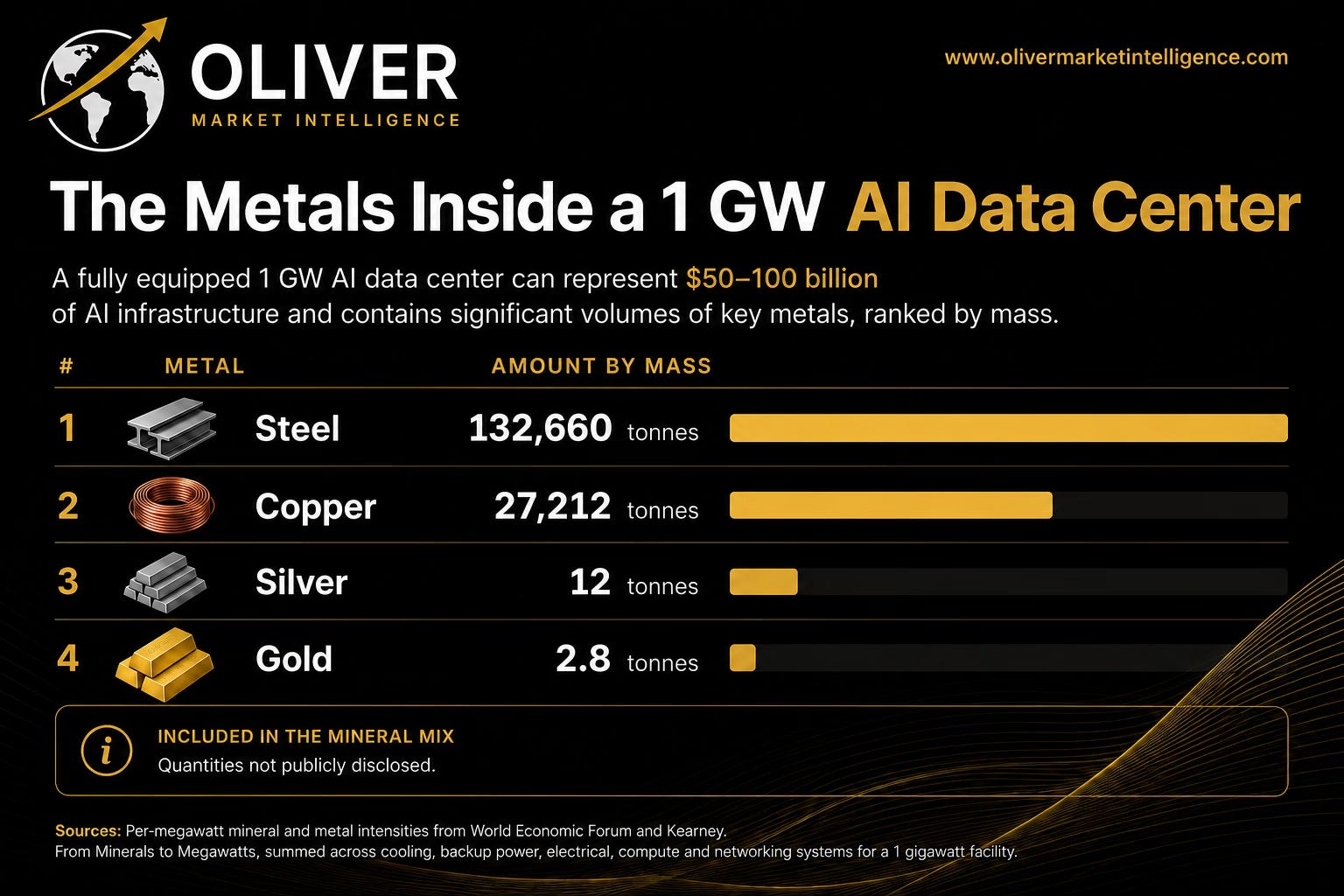
Public discussion still treats AI as though it exists primarily in software. In reality, every large language model depends upon an expanding physical estate of processors, memory modules, networking equipment and power systems operating continuously inside hyperscale data centres. Gold remains embedded throughout that infrastructure because oxidation has not become any more forgiving as computing power has increased. Connector pins, processor contacts and high-speed networking components continue to rely upon its properties for one simple reason: uninterrupted performance remains worth more than marginal reductions in material cost.
No individual processor contains very much gold. Neither does a single server. Judged one unit at a time, the quantities appear too small to influence anything beyond an engineering specification.
The picture changes when those same components are deployed by the tens of thousands inside a single campus, then replicated across hundreds of campuses worldwide.
Markets understandably devote most of their attention to the companies building artificial intelligence. Far less attention is paid to the physical infrastructure accumulating beneath those valuations. Yet the digital economy increasingly depends upon hardware whose reliability rests, in part, on a metal many investors continue to regard almost exclusively as a monetary asset.
Gold has not changed.
The economy choosing to use it has.
Following the Electrons
Silver solves a different engineering problem.
If gold earns its place by refusing to fail, silver earns its place because nothing conducts electricity more effectively.
That single property places it inside almost every technology expected to define the coming decade.
Every photovoltaic cell relies on conductive silver paste printed into microscopic pathways that collect the electricity generated by sunlight before transferring it through the module. Remove those pathways and the panel becomes little more than an expensive sheet of silicon and glass. The discussion surrounding solar usually revolves around installation costs, government subsidies or generating capacity. The conductive material quietly performing the essential work receives remarkably little attention.
For years, markets assumed engineering would gradually solve this dependency. Manufacturers certainly reduced silver loadings through thinner conductive lines and improved production techniques. Yet technological progress has produced an unexpected consequence. Cheaper panels encouraged faster deployment, and faster deployment consumed more silver overall. Newer, higher-efficiency cell technologies continue requiring meaningful quantities because electrical performance remains constrained by physics rather than optimism.
As adoption accelerates, yesterday’s secondary input quietly becomes tomorrow’s strategic bottleneck.
One Supply Chain
Artificial intelligence and solar are rarely discussed together.
AI data centres consume astonishing quantities of power, forcing technology companies to think less like software developers and more like utility operators. Microsoft, Amazon, Google and Meta are securing long-term electricity supplies years before the computing capacity itself comes online. Nuclear has returned to the conversation. Gas-fired generation is being extended. Solar continues expanding because it remains one of the fastest sources of new capacity.
Markets classify them as separate sectors. The physical economy treats them as one supply chain.
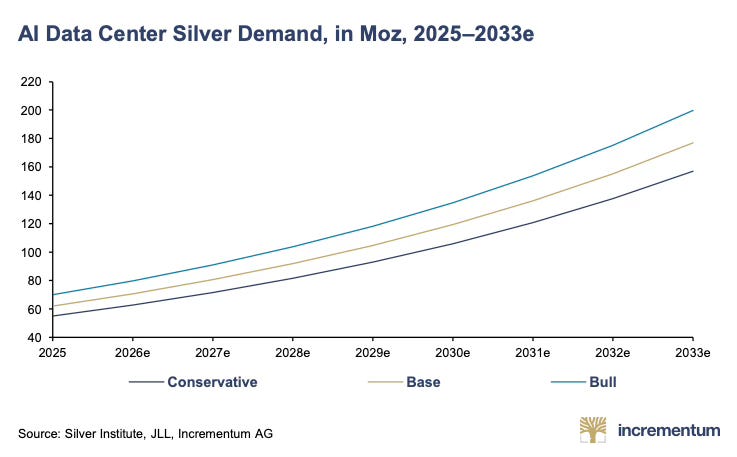
Every new AI campus requires more electricity. Every additional gigawatt of generation requires more electrical infrastructure. Solar remains one of the principal beneficiaries, and every expansion in photovoltaic capacity quietly increases demand for silver embedded inside each module. At the same time, the servers housed within those facilities continue drawing on gold-bearing processors, connectors and networking equipment, while silver reappears throughout switches, relays, power-distribution units and cooling systems.
The fashionable narrative is that artificial intelligence will dematerialise the economy.
The opposite is happening.
The digital economy is becoming increasingly dependent upon physical infrastructure.
The cloud has acquired weight.
The Constraint Nobody Models
Markets have never struggled to recognise a new source of demand. They have been far less successful at estimating the scale it eventually reaches. Railways required more steel than early planners imagined. Electrification consumed more copper than contemporary forecasts anticipated. Smartphones introduced entirely new categories of material demand that scarcely featured in analysts’ models a decade earlier. The pattern repeats because markets generally understand where an industrial revolution is heading long before they understand everything it will require along the way.
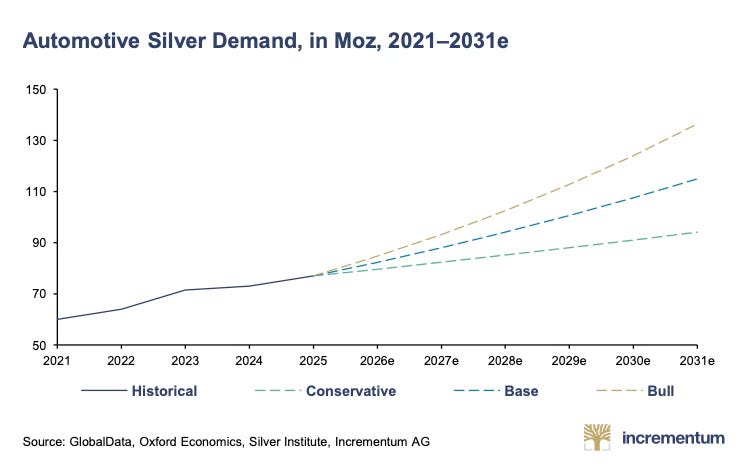
Electric vehicles offer a useful illustration. Discussion usually centres on lithium, nickel and battery chemistry. Yet a modern battery electric vehicle also contains roughly 25 to 50 grams of silver together with around 0.5 to 1 gram of gold, distributed throughout power electronics, sensors, control modules and switching systems rather than the battery itself. None of those quantities appears especially significant in isolation. The same is true of the few milligrams inside a semiconductor, the silver embedded within a photovoltaic module or the fractions of a gram found inside an advanced processor. Judged one product at a time, they barely register. Viewed across millions of products manufactured every year, they begin to describe an entirely different demand profile.
That is how structural demand develops. It rarely arrives through a single transformative application. It emerges as thousands of ordinary applications expand simultaneously until a material once regarded as peripheral becomes increasingly difficult to substitute.
Gold remains every bit as much a monetary asset as it was a decade ago. Silver retains the monetary characteristics that have accompanied it for centuries. What has changed is not the metals themselves, but the range of industries now prepared to pay a premium for their unique properties.
Supply moves to a different timetable.
Software scales in months. Mines scale in decades.
New discoveries become progressively harder to make. Ore grades continue to decline. Environmental permitting stretches across years, sometimes longer. Much of the world’s silver still arrives as a by-product of copper, lead and zinc mining, meaning even materially higher prices do not necessarily produce materially higher output. The technologies consuming these metals can expand exponentially. Their supply cannot.
The Ever Given never mattered because of the value of the ship itself. It mattered because it exposed a bottleneck hidden inside a system most people assumed would always function. Artificial intelligence, cloud computing and electrification appear to represent a decisive break from the industrial age, yet they remain subject to the same physical constraints that governed every industrial revolution before them. Before a processor is manufactured, its constituent materials must be refined. Before they are refined, they must first be supplied.
The next decade will be filled with debates over which companies dominate artificial intelligence.
The more enduring investment question is simpler.
Who will supply the materials that make the entire system possible?
Software may define the digital economy.
Material supply still determines the weight of the digital economy.
If you are thinking about how to protect your wealth in this environment, you can explore physical gold and silver through www.goldwise.com, where the focus is on ownership, security and transparency.
Goldwise and Oliver Market Intelligence are committed to producing educational content that helps investors better understand the macroeconomic forces shaping financial markets. If there are topics you would like us to explore in future editions, we welcome your feedback.
Disclosure: Mr. Matthew Oliver, Oliver Market Intelligence, is a Goldwise shareholder. Any opinions, analysis and views expressed in this publication are solely those of Mr. Matthew Oliver and Oliver Market Intelligence and are provided independently unless expressly stated otherwise.
This publication is provided for informational and educational purposes only and does not constitute financial, investment or other professional advice. References to Goldwise are for informational purposes and should not be construed as a recommendation to purchase any product or service. Investments can fall as well as rise in value, and readers should conduct their own research and, where appropriate, seek advice from a qualified financial adviser before making any financial decisions.