



When historians write about wars, they usually begin with armies.
Battles, generals and political decisions dominate the narrative. Maps fill with arrows. Casualties are counted. Victories and defeats become fixed points in history.
The factories are often reduced to a footnote.
Yet wars have always been fought twice. Once on the battlefield, and again hundreds of miles away inside steel mills, refineries, machine shops and mines. The first contest determines who wins today. The second determines who can still fight tomorrow.
The battlefield consumes. Industry replaces.
Every prolonged conflict eventually reaches the point where those two forces collide. Stockpiles shrink faster than production. Supply chains that once appeared limitless begin to fray. Governments discover that armies move only as fast as industry allows.
The Second World War offered countless examples of this quiet arithmetic, but one stands apart.
In 1942, engineers working on the Manhattan Project requested copper for the enormous electromagnetic coils needed to separate uranium isotopes. Washington declined. Copper had already been committed elsewhere, flowing into ships, aircraft, communications equipment and ammunition destined for a world at war.
The Treasury offered silver instead.
Around 146 million ounces were removed from government vaults, fabricated into massive coils at Oak Ridge, and quietly returned after the war had ended. The story has become familiar among precious metals investors. It is usually told as evidence of silver’s strategic importance.
The episode deserves a different reading.
The scientists did not receive silver because it was superior. They received it because copper had become indispensable somewhere else.
Wars have a peculiar way of reordering value. Materials that appear abundant in peacetime suddenly become impossible to spare. Others inherit roles nobody had anticipated. The lesson was never about silver alone. It was about the industrial system beneath every conflict, and how the pressure of war exposes the parts of that system we rarely notice until they begin to fail.
Wars Are Won Twice
The scientists never wanted silver. They wanted copper. Silver became the answer because copper had become more valuable somewhere else. The decision was not driven by chemistry or scarcity. It was driven by production.
Wars rarely expose shortages on the first day. They expose them six months later, when factories begin replacing what battlefields have already consumed. The opening campaign belongs to the army that prepared best. The campaigns that follow belong to the nation capable of producing faster than it destroys.
The Second World War is often remembered as a triumph of industrial capacity. That remains true today, although the factories no longer produce the same machines.
The assembly lines have changed.
The principle has not.
The Arsenal Has Changed
For three decades Western defence planning rested on an assumption that now feels strangely optimistic. Conflicts would be brief. Precision weapons would reduce the need for mass production. Inventories could become lean because industry could always respond if required.
Ukraine has dismantled that assumption.
Missiles measured in years of production have disappeared in weeks. Air defence systems have become exercises in arithmetic. Every interceptor launched creates another order book that stretches further into the future. Governments across Europe and North America are discovering that factories cannot be expanded as quickly as armies.
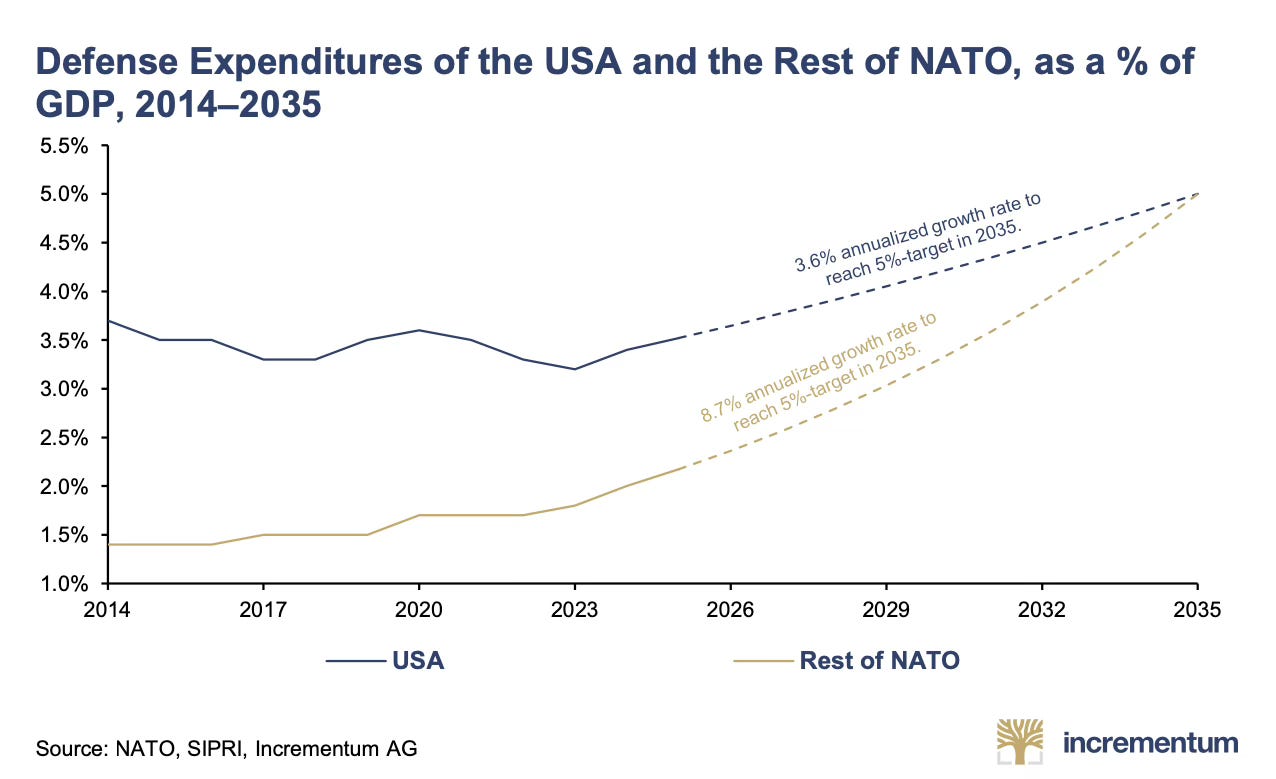
The United States is responding accordingly. In July 2026, the House approved a National Defense Authorization Act authorising roughly $1.15 trillion for fiscal year 2027. While the legislation must still complete the Senate and reconciliation process before becoming law, it points clearly in one direction. Defence spending is rising once again, with additional funding proposed for procurement, research and development, and the industrial capacity needed to sustain a larger arsenal.
That expansion would come on top of a federal debt that already stood at approximately $39.5 trillion at the end of June 2026. Whether financed through higher borrowing or higher taxation, rebuilding military capacity will demand resources from an economy already carrying one of the largest debt burdens in its history.
This is not simply rearmament.
It is re-industrialisation.
Rebuilding that industrial base is unlikely to come cheaply. As governments compete for manufacturing capacity, skilled labour and specialised components, the cost of producing advanced weapons is likely to rise alongside demand. Rearmament therefore increases demand not only for military equipment itself, but also for the industrial inputs needed to manufacture it.
The market still talks about military power as though it were measured by the number of tanks, aircraft and missiles already sitting inside warehouses. Governments increasingly understand that inventories are temporary. Production capacity is permanent.
The Quiet Materials
Steel still defines the silhouette of modern weapons. Aluminium still shapes aircraft. Titanium still withstands extraordinary temperatures.
Yet none of those materials explain why modern defence budgets have begun to resemble technology budgets.
The expensive part now sits beneath the casing.
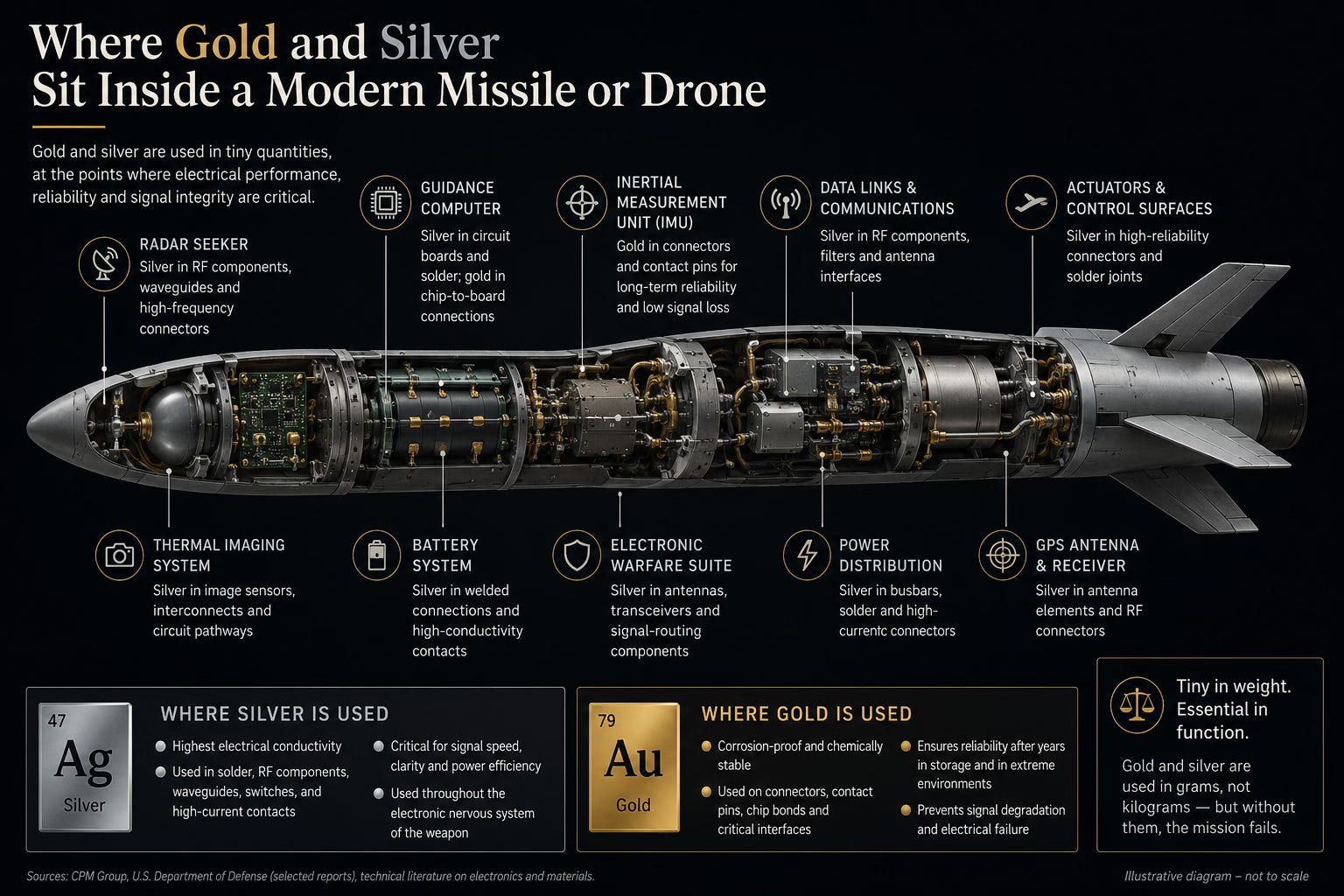
A cruise missile carries processors, navigation systems, antennas, sensors, batteries and communications hardware. A military drone carries processors, navigation systems, encrypted communications, sensors and batteries. Increasingly, it is electronics wrapped in an airframe. Radar systems depend upon transmitting and receiving extraordinarily weak electrical signals with almost no margin for failure.
Gold and silver rarely appear in defence procurement headlines because they represent only a tiny fraction of a weapon’s weight. They account for almost none of the weight and much of the performance.
Silver remains the most electrically conductive metal available. Gold is slightly less conductive than silver, but it offers something engineers value even more. It does not corrode. Years in storage, violent temperature swings and hostile operating environments matter very little to a metal that refuses to oxidise.
Engineers rarely choose precious metals because they are precious.
They choose them because failure is expensive.
Inside the Machine
A Tomahawk cruise missile contains around 10 to 15 ounces of silver. That sounds almost insignificant against a weapon weighing more than a tonne.
Weight, however, is the wrong measure.
The value of silver lies in where it sits rather than how much is used. Modern weapons move information before they move explosives. Every radar pulse, encrypted transmission, thermal image and guidance correction begins as an electrical signal. Lose the signal and the missile becomes little more than an expensive piece of metal.
Physics leaves remarkably little room for compromise.
Silver remains the most electrically conductive metal known. At the frequencies used by radar, communications and electronic warfare systems, electrical current travels almost entirely across the surface of a conductor. Engineers refer to this as the skin effect. Surface conductivity becomes far more valuable than the bulk material beneath it, which is why silver plating appears throughout waveguides, antennas and high-frequency components.
What makes these metals unusual is not the quantity required, but the precision of the job they perform. A modern cruise missile contains thousands of electrical connections linking sensors, processors, antennas and control systems. Most use only microscopic layers of precious metals, often invisible to the naked eye. Collectively, they form the pathways through which every instruction travels. Guidance systems cannot adjust course without clean signals. Radar cannot distinguish its target if electrical losses distort the returning pulse. Success or failure is often decided long before the explosive reaches its destination.
The same principle extends well beyond a single missile. Military electronics are built around reliability rather than substitution. Engineers rarely ask whether gold or silver are expensive. They ask whether another material can perform as consistently after years of storage, violent acceleration and extreme environmental stress. In critical systems, the answer is often no. The cost of failure is measured not in ounces of metal, but in missions that never reach their objective.
Gold solves a different problem.
Military equipment may spend years in storage before it is ever deployed. Copper oxidises. Oxidation increases resistance. Resistance weakens signals. Gold does none of those things. Its value lies less in conductivity than permanence. A connector assembled today must still perform flawlessly after years of vibration, humidity, salt air and repeated temperature cycles. That certainty is worth paying for.
The Industrial Contest
Drones rely on silver within circuit boards, RF components, thermal management systems and optical assemblies. Fighter aircraft use silver-plated conductors inside advanced radar systems, while gold protects mission-critical connectors from degradation. Satellites follow the same philosophy because once they leave the launch pad there is no maintenance schedule, only reliability.
The modern arsenal increasingly resembles the semiconductor industry.
Factories once measured output in tonnes of armour plate. Today they measure wafer capacity, precision machining, advanced electronics and specialised materials. Steel remains visible because it forms the shell. Electronics matter because they determine whether the shell reaches its destination.
Artificial intelligence infrastructure, data centres, electric vehicles, advanced medical equipment and modern weapons increasingly compete for the same family of materials. Increasingly, they are drawing from the same industrial ecosystem. One serves commercial demand. The other serves national security. Their supply chains overlap far more than most investors appreciate.
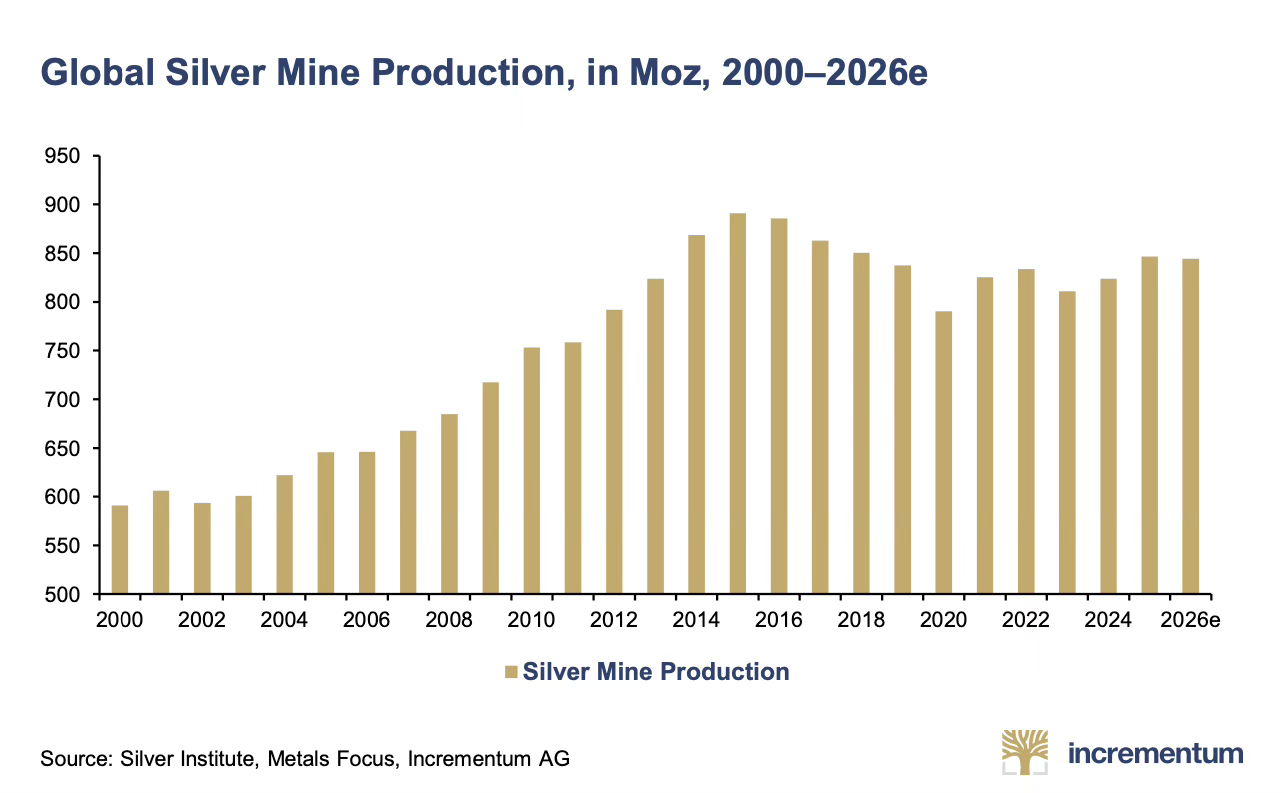
Silver has never been treated as a strategic metal in the same way as rare earths or uranium. It is mined across dozens of countries, supported by large above-ground inventories and available in sufficient quantities that governments have never needed to ration its use.
Investors often search for a dramatic catalyst. A shortage. A government stockpile. A wartime panic.
History points somewhere quieter.
The scientists at Oak Ridge did not receive silver because it was irreplaceable. They received it because copper had become indispensable somewhere else. The metal that solved yesterday’s bottleneck was simply the one still available.
Wars are remembered for their battles. They are decided by the factories that never stopped building. And sometimes the most revealing question is not how many missiles remain in the arsenal, but which material the next factory can no longer afford to spare.
If you are thinking about how to protect your wealth in this environment, you can explore physical gold and silver through www.goldwise.com, where the focus is on ownership, security and transparency.
Goldwise are committed to producing educational content that helps investors better understand the macroeconomic forces shaping financial markets. If there are topics you would like us to explore in future editions, we welcome your feedback.
Disclosure: Mr. Matthew Oliver, Oliver Market Intelligence, is a shareholder in Goldwise. Any opinions, analysis and views expressed in this publication are solely those of Mr. Matthew Oliver and Oliver Market Intelligence and are provided independently unless expressly stated otherwise.
This publication is provided for informational and educational purposes only and does not constitute financial, investment or other professional advice. References to Goldwise are for informational purposes and should not be construed as a recommendation to purchase any product or service. Investments can fall as well as rise in value, and readers should conduct their own research and, where appropriate, seek advice from a qualified financial adviser before making any financial decisions.