


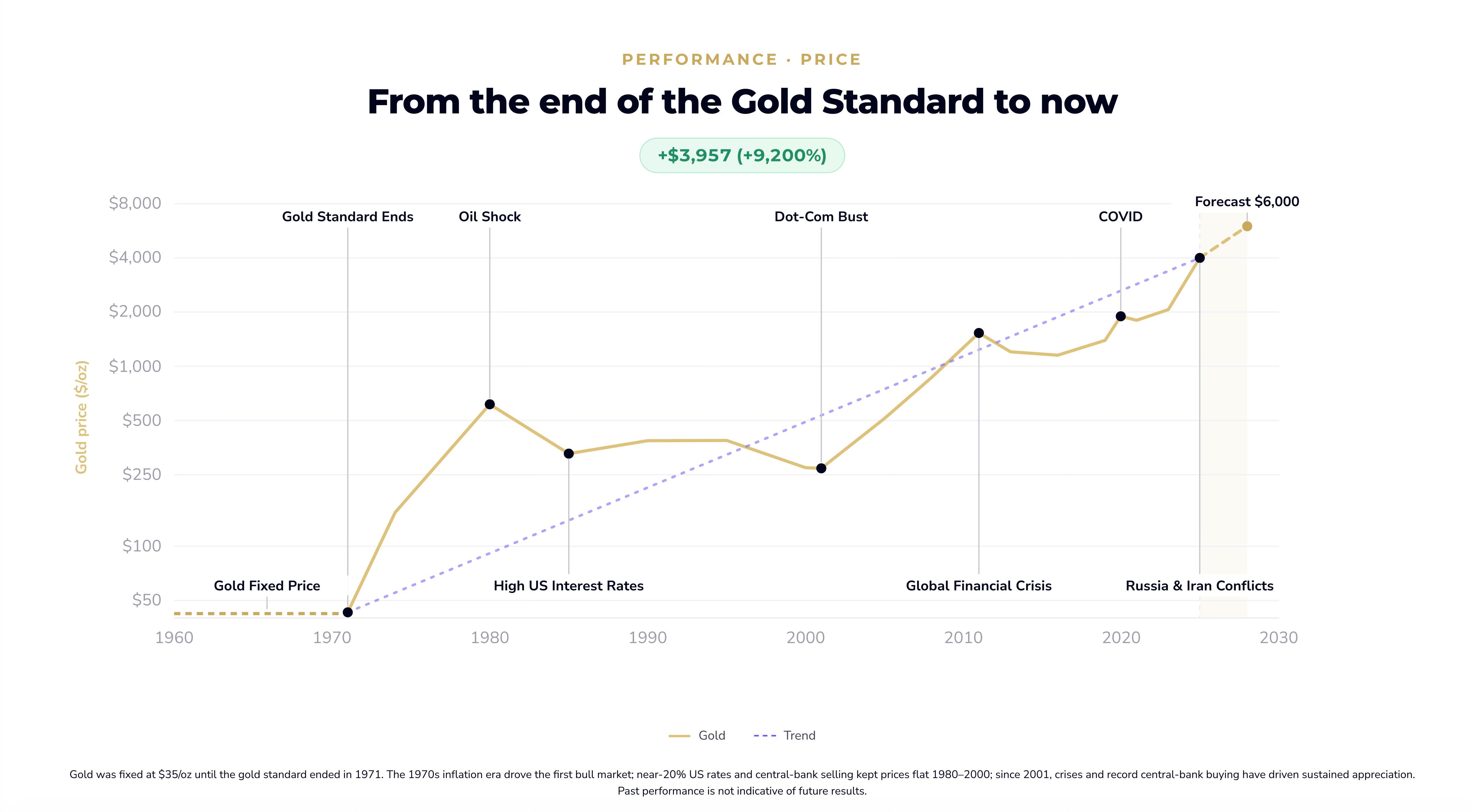
In August 1971, Richard Nixon appeared on American television on a Sunday evening and told the country he was temporarily suspending the dollar’s convertibility into gold. The language was deliberately reassuring. There would be no great monetary rupture, merely a technical adjustment designed to protect the dollar from international speculators.
The temporary suspension never ended.
Foreign governments holding dollars could no longer exchange them for American gold. The Bretton Woods monetary system effectively died that evening, although the dollar survived and eventually became more dominant than before. What disappeared was the constraint beneath it. Money had become a promise backed primarily by confidence in the United States.
More than half a century later, that promise remains the foundation of global finance. Yet the behaviour of governments suggests they are becoming less comfortable relying upon it indefinitely.
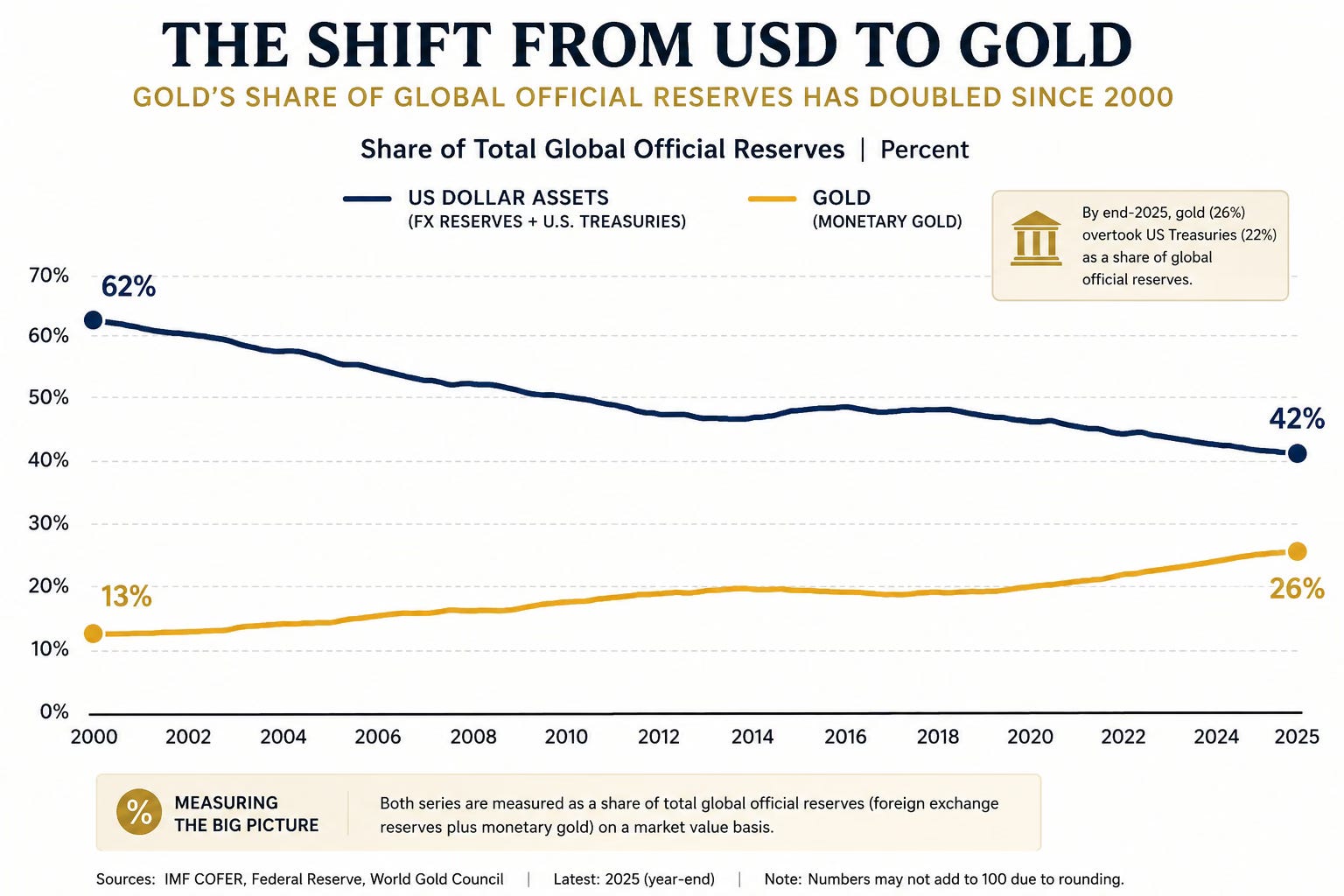
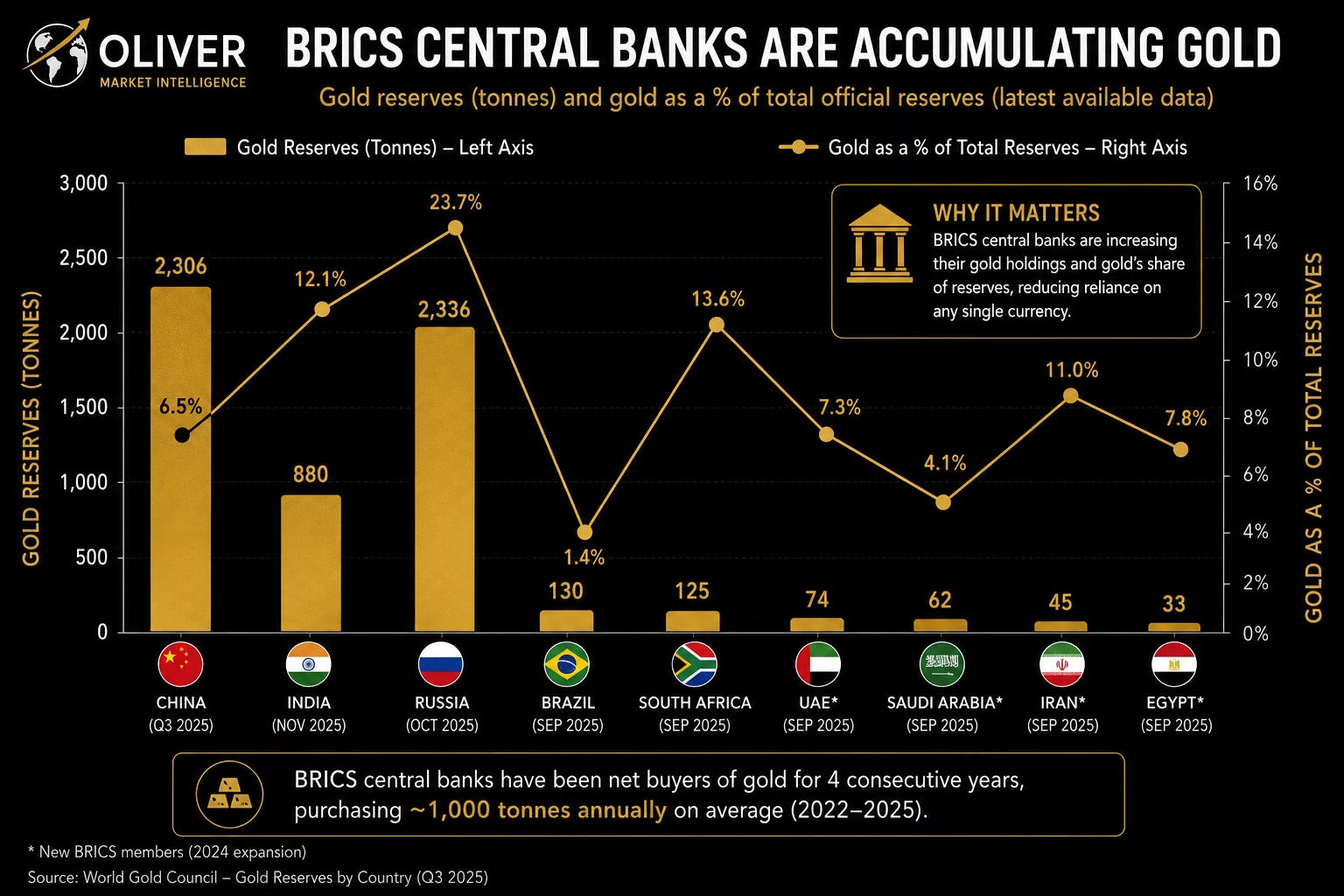
Central banks have been accumulating gold at historically elevated rates. China has spent years reducing its relative exposure to US Treasuries while increasing its official gold reserves. BRICS governments openly discuss conducting more trade outside the dollar. Across emerging markets, the question is no longer whether the dollar disappears tomorrow. It is whether a monetary system built overwhelmingly around one country’s liabilities still makes sense in a world becoming progressively less American.
Ray Dalio has spent years arguing that these moments are not unusual. They are cyclical.
And America is entering the uncomfortable part.
The Arithmetic of a Late Empire
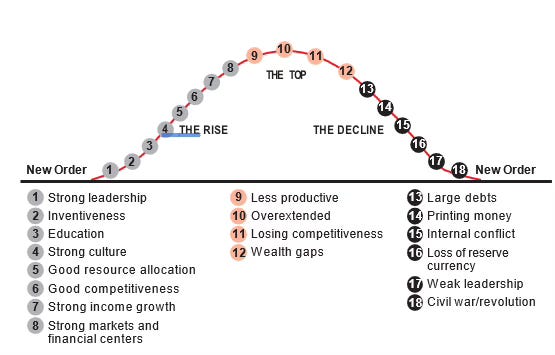
Dalio’s framework is built around what he calls the Big Cycle. Powerful nations tend to rise through similar forces: education, innovation, competitiveness, productive investment, military strength, expanding trade and increasingly sophisticated financial markets.
Eventually their currency becomes desirable enough to function internationally.
Reserve currency status is an extraordinary privilege. Foreigners need your money to trade, save and settle debts. They consequently purchase your financial assets. Borrowing becomes easier. Consumption can exceed production for far longer than would otherwise be possible.
Success gradually creates its own weakness.
Debt rises. Wealth gaps expand. Financial speculation becomes more rewarding than productive investment. Maintaining domestic living standards and overseas commitments becomes increasingly expensive. Political divisions deepen as different groups fight over a system producing less broadly distributed prosperity.
Dalio places the United States well into this mature phase.
The difficulty is visible in Washington’s finances. America is running persistent fiscal deficits despite possessing one of the wealthiest and most productive economies in history. Interest costs increasingly compete with major government programmes. Treasury issuance continues because the political alternatives, spending cuts or materially higher taxation, are less attractive to voters.
Debt itself begins constraining policy.
A government facing enormous refinancing requirements cannot remain indifferent to interest rates forever. Higher yields increase debt-servicing costs, which increase deficits, which require greater issuance. Eventually monetary and fiscal policy become uncomfortable neighbours sharing the same increasingly expensive house.
Gold thrives around precisely this kind of discomfort.
The Dollar Does Not Need a Funeral
Predictions of an imminent dollar collapse have existed for decades and repeatedly failed. America still possesses enormous structural advantages. US capital markets are exceptionally deep. Treasury securities remain central to global markets. International trade, debt issuance and foreign exchange transactions continue to rely heavily on dollars.
China cannot simply announce the renminbi as its replacement.
Reserve currencies require trust, convertibility and enormous pools of freely accessible financial assets. Beijing maintains capital controls precisely because surrendering control over capital movement would expose China to forces its political system has historically preferred to manage.
The more interesting possibility is therefore not the dollar suddenly becoming worthless.
It is dilution.
Imagine global monetary reserves as a portfolio rather than a throne. The dollar can remain its largest component while gradually surrendering weight to gold, regional currencies and alternative settlement systems. No dramatic announcement is required.
That process has already begun at the margins.
This matters enormously for gold because gold does not need another currency to defeat the dollar. It simply benefits when governments decide they would rather hold fewer promises issued by somebody else.
China Is Building Something Different
Dalio’s analysis becomes more interesting when America is viewed beside China.
China carries serious problems of its own. Its property model has cracked. Local government debt is substantial. Demographics are deteriorating. Domestic consumption remains weaker than Beijing would like, while years of investment-led growth have produced diminishing returns in parts of the economy.
Rising powers do not move upwards in straight lines.
Yet China has spent decades constructing many of the characteristics Dalio associates with an ascending power: manufacturing capacity, infrastructure, technological capability, international trade relationships and military strength.
The Belt and Road Initiative belongs inside this story.
Ports, railways, power projects and lending arrangements across Asia, Africa and other emerging regions are usually discussed as infrastructure policy. Viewed through Dalio’s framework, they also resemble the economic architecture historically constructed by rising powers around their expanding trade networks.
Trade creates financial relationships. Financial relationships create political influence. Political influence eventually affects which currencies and assets countries choose to hold.
China does not need every Belt and Road participant to abandon the dollar. It benefits whenever another transaction can occur without passing through the American monetary system.
That is a much slower revolution than the dramatic predictions surrounding de-dollarisation.
It may also be considerably more plausible.
The Alternative Does Not Need a Currency
BRICS governments increasingly speak the language of monetary diversification. Members have encouraged greater use of national currencies in trade and are exploring payment infrastructure that would allow more transactions to occur outside the dollar system.
The more interesting development may be happening around BRICS rather than formally within it. The UNIT project proposes a cross-border settlement system backed by a reserve basket consisting of 40 per cent gold and 60 per cent currencies convertible into gold. It is not an official BRICS currency, and member governments have repeatedly made clear that no common currency has been agreed.
That may be precisely why gold keeps appearing around these discussions.
BRICS is not a monetary union. Its members have different economies, political systems and strategic interests, and there is little reason to assume that India, Brazil or the Gulf states would want simply to exchange dependence on the dollar for dependence on the renminbi. A BRICS currency would require its members to place enormous trust in one another, or in institutions that do not yet exist.
Gold requires much less trust.
No BRICS government issues it. None can create more of it to finance a deficit, freeze another country’s holdings through its domestic banking system or alter its value by changing monetary policy. For countries whose common objective is greater monetary autonomy rather than political integration, those characteristics are unusually useful.
This is why I suspect the more plausible path is not the creation of a dramatic new BRICS currency, but the gradual construction of a monetary system in which gold plays a larger role alongside national currencies. Local-currency trade reduces the need for dollars at the point of settlement. Independent payment networks reduce dependence on Western financial infrastructure. Gold provides a reserve asset sitting outside the political claims of any one member.
Two Cycles, One Metal
The strange feature of the present monetary system is that the pressures facing America and China can point towards the same asset for entirely different reasons.
America’s late-cycle problem is excessive debt and the political difficulty of resolving it honestly. Severe fiscal tightening would be painful. Default is almost unthinkable. That leaves a familiar historical route in which nominal debts remain intact while the currency used to repay them gradually loses purchasing power.
China approaches gold from another direction.
Beijing wants greater strategic independence from a dollar-centred financial architecture controlled by its principal geopolitical competitor. Increasing gold reserves, expanding renminbi settlement and building trading relationships outside Western institutions all reduce that dependence incrementally.
Washington therefore has reasons to tolerate monetary debasement.
Beijing has reasons to diversify away from the currency being debased.
Gold sits between them.
This helps explain why analysing gold purely through real interest rates or Federal Reserve policy feels incomplete. Those variables still matter enormously to price over shorter periods. Yet underneath them sits a larger monetary transition involving sovereign debt, geopolitical fragmentation and reserve management.
Central banks understand this because they have unusually long memories.
They know monetary regimes end.
The Asset With No Flag
There are powerful forces keeping the existing system alive. Dollar network effects are immense. China remains dependent on Western consumers and financial infrastructure in ways that simplistic East-versus-West narratives often ignore. Beijing’s own debt problems could become severe enough to weaken its international ambitions. A sustained period of high real interest rates could make gold considerably less attractive to private investors.
None of this requires believing that America disappears or China inevitably replaces it.
Dalio’s framework is subtler than that.
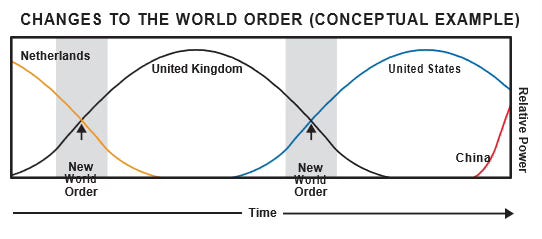
Dominant systems tend to weaken internally before their replacement becomes obvious externally. The transition can last decades. Britain remained a formidable financial power long after the United States had overtaken it economically. Sterling did not wake up one morning and cease to matter.
Reserve status eroded as economic gravity moved elsewhere.
Something similar may now be beginning with the dollar.
The monetary system that follows need not belong entirely to China. It could be messier: dollars, renminbi, regional settlement networks, bilateral trade agreements, digital infrastructure and gold existing alongside each other.
That fragmentation may be far more consequential for gold than a clean transfer of power from Washington to Beijing.
Gold requires no dominant empire.
It carries no flag, imposes no sanctions, pays no interest and makes no promises. Those characteristics looked antiquated during the decades when globalisation expanded, sovereign bonds were trusted and American financial dominance appeared permanent.
They look rather different when governments begin preparing for a world in which trust itself has become geopolitical.
Which takes us back to Nixon on that Sunday evening in 1971.
He was not announcing the death of the dollar. He was acknowledging that the previous monetary architecture could no longer survive the pressures building underneath it. The dollar adapted, the world moved forward, and gold was released from the price that had constrained it.
The next transition is unlikely to arrive through a presidential television address. It is appearing quietly in Treasury auctions, central-bank vaults, Chinese trade agreements and conversations between countries that would rather not keep all their savings inside somebody else’s monetary system.
The dollar may survive that transition too.
The more uncomfortable question is what a dollar will be worth when it does.
If you are thinking about how to protect your wealth in this environment, you can explore physical gold and silver through www.goldwise.com, where the focus is on ownership, security and transparency.
Goldwise are committed to producing educational content that helps investors better understand the macroeconomic forces shaping financial markets. If there are topics you would like us to explore in future editions, we welcome your feedback.
Disclosure: Mr. Matthew Oliver, Oliver Market Intelligence, is a shareholder in Goldwise. Any opinions, analysis and views expressed in this publication are solely those of Mr. Matthew Oliver and Oliver Market Intelligence and are provided independently unless expressly stated otherwise.
This publication is provided for informational and educational purposes only and does not constitute financial, investment or other professional advice. References to Goldwise are for informational purposes and should not be construed as a recommendation to purchase any product or service. Investments can fall as well as rise in value, and readers should conduct their own research and, where appropriate, seek advice from a qualified financial adviser before making any financial decisions.
This is the most sober version of the dilution thesis I have read, and "gold requires no dominant empire" captures it. Let me add the silver footnote it invites, because this is rightly a gold-reserve argument and silver does not sit in it the same way. The sovereign story you tell, central banks diversifying, UNIT baskets, the asset with no flag, is gold's alone. No one is building a silver reserve or a silver-backed settlement unit. So in this transition gold runs on two engines, the reserve-diversification bid and the debasement bid, while silver runs on one, the debasement weather, plus its own industrial demand. That two-versus-one is most of what the gold-to-silver ratio is actually pricing across a move like this: gold leads because it has the extra engine, and silver follows harder once the monetary tailwind is strong enough to overwhelm the industrial noise. The one place silver keeps full membership is the level your own CTA lives on, individual ownership. A silver coin is nobody's liability either, no promise, no counterparty, no flag, at the personal scale. It simply does not get the central-bank bid at the sovereign scale. Worth separating the two, because "no flag" is true for silver in the vault and not true for silver in the reserve system. Excellent essay.