



On the morning of 5 August 2024, one of the calmest assumptions in global finance suddenly became expensive.
Japan’s Nikkei fell more than 12 per cent in a single session, its worst day since 1987. Markets from New York to London followed it lower. Investors who had spent years borrowing cheaply in yen scrambled to unwind positions.
The Bank of Japan had raised interest rates by just 0.25 percentage points days earlier.
In almost any other economy, that move would have been unremarkable. In Japan, after decades of near-zero rates, it disturbed something much larger. The yen had become one of the world’s great funding currencies, financing positions in American stocks, bonds, emerging markets and almost anything offering a better return than Japanese cash.
August 2024 exposed how far Japan’s monetary experiment had travelled beyond its borders.
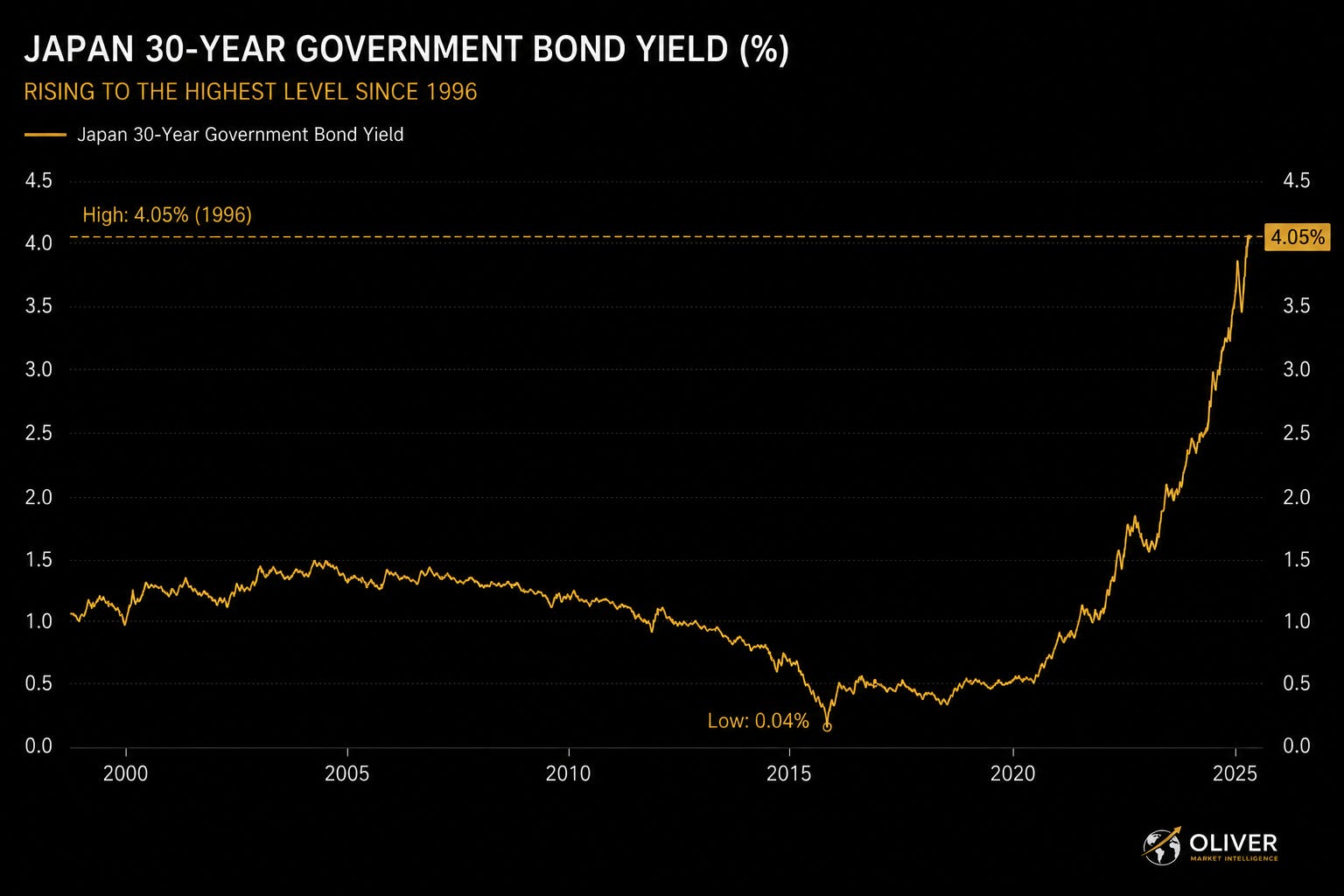
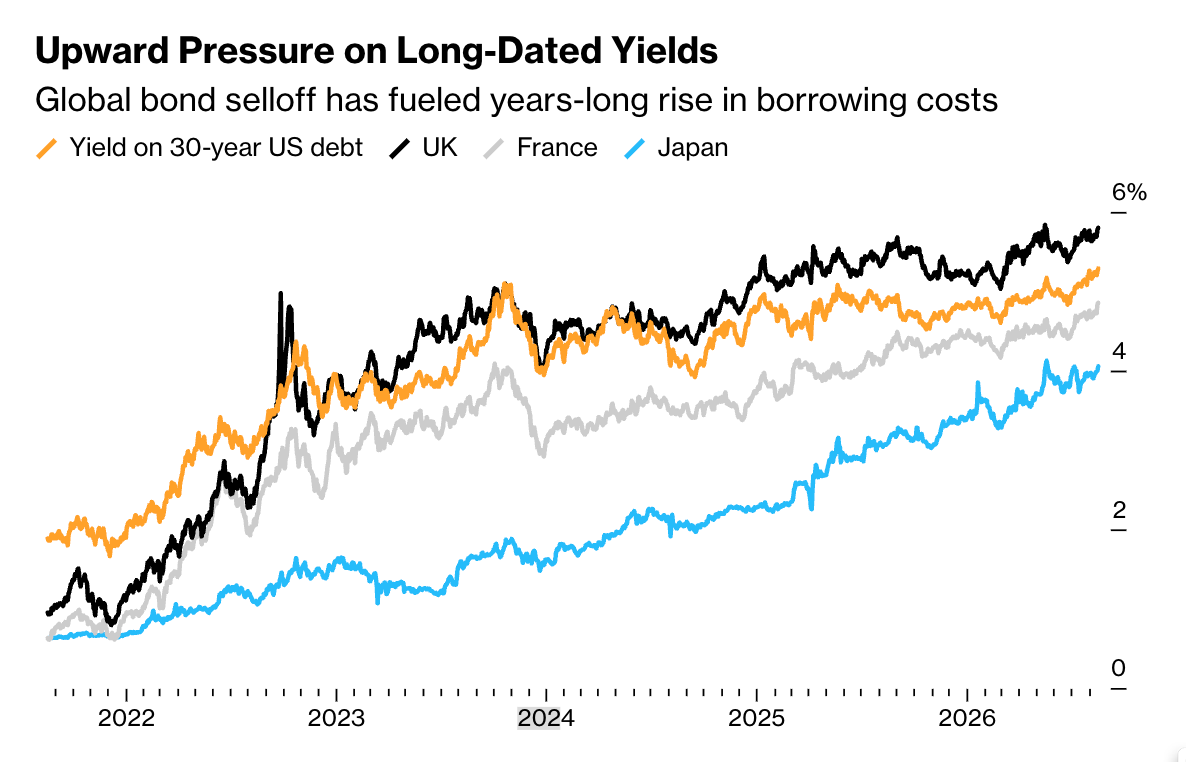
Two years later, the pressure has moved from currencies and equities into the bond market. Japan’s 10-year government bond yield has approached 3 per cent, its highest since 1996, while the 30-year yield has moved above 4 per cent. Across the Pacific, the US 30-year Treasury has traded above 5.3 per cent, around levels last seen before the financial crisis. British long-dated gilts are pushing towards 6 per cent, while France and Germany are confronting their own rise in long-term borrowing costs.
One country can be blamed on fiscal incompetence. Two can be dismissed as coincidence. It becomes harder to make that argument when the same pressure appears across most of the developed world.
Long-term money is becoming more expensive almost everywhere.
Japan Wakes From Its Monetary Experiment
Japan took cheap money further than any other major economy.
After its property and equity bubble collapsed in the early 1990s, the Bank of Japan progressively pushed rates towards zero, adopted zero-interest-rate policy in 1999, experimented with quantitative easing and eventually introduced negative rates. The BOJ accumulated an enormous share of the Japanese government bond market in the process.
The policy also pushed Japanese capital overseas.
When a pension fund, insurer or bank could earn almost nothing holding Japanese government bonds, owning American Treasuries or other foreign assets became considerably more attractive. Global traders went further. They borrowed cheaply in yen and invested the proceeds in higher-yielding currencies, bonds and risk assets.
The yen became one of global finance’s great funding currencies.
That works beautifully while Japanese rates remain pinned down and the yen behaves itself. The trouble begins when either assumption changes.
August 2024 showed how violent the reversal could become. After the Bank of Japan raised rates, the yen strengthened sharply and leveraged positions were unwound. On 5 August, the Nikkei suffered its worst session since 1987. The precise size of the global carry trade is unknowable, but its influence is easier to see: decades of extraordinarily cheap Japanese funding became embedded in portfolios far beyond Japan.
The Flow of Money Begins to Reverse
Japan is the largest foreign holder of US government debt, with more than $1 trillion in Treasuries. For decades that relationship suited everyone. America received a dependable buyer for its debt while Japanese institutions escaped miserable domestic yields.
Once Japanese bonds offer a respectable domestic return, the arithmetic changes.
A Japanese insurer comparing a Treasury with a JGB must account for currency risk and hedging costs. The yield printed on the American bond is therefore not the yield that ultimately matters. As domestic returns rise, repatriating money becomes increasingly defensible.
This does not require Japan to dump Treasuries dramatically. Slow changes at the margin are enough.
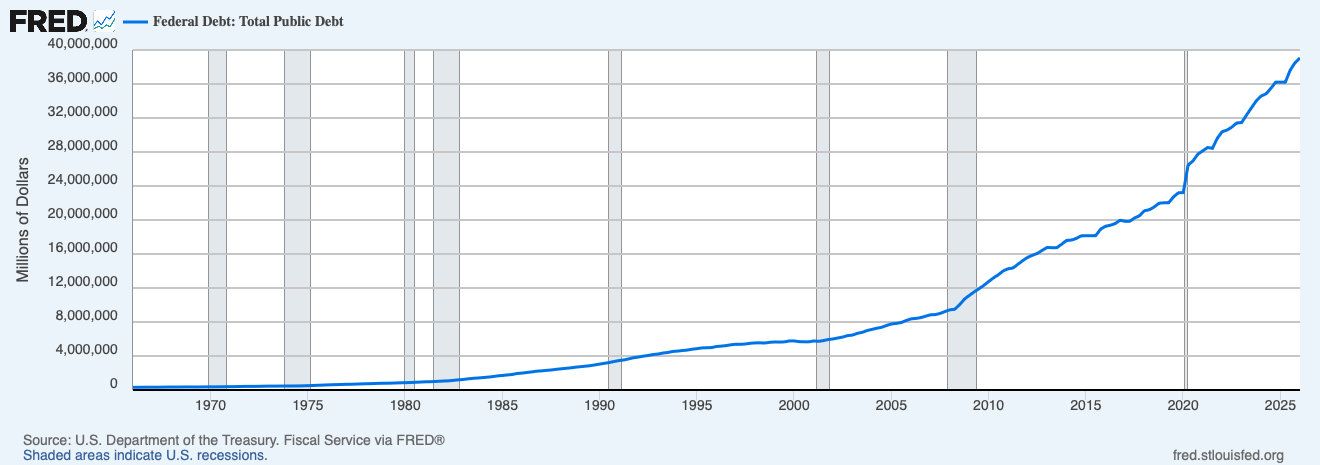
America is simultaneously asking investors to absorb an enormous quantity of government borrowing. Its national debt has passed $40 trillion, having stood around $34.5 trillion in March 2024. If one of its most reliable foreign creditors becomes less enthusiastic just as Treasury supply continues expanding, somebody else must absorb the bonds.
That buyer may demand a higher price for doing so.
Washington understands the danger. Scott Bessent’s Treasury intervened to support the yen, the first coordinated US-Japanese currency action since 2011. Rather than selling dollars to buy yen, the conventional approach, the Treasury sold euros. Japan had already been selling part of its enormous Treasury portfolio to defend its currency, and further pressure on the dollar risked pushing American yields higher. Washington needs stability in Japanese markets because turmoil in Tokyo can quickly become higher borrowing costs in America.
More revealing is what has happened while American economic data softened. Softer economic data would normally encourage investors towards bonds and pull long yields down. Instead, long-term Treasury yields have remained stubbornly high.
Investors appear to be charging governments more for uncertainty itself.
Britain Meets the New Price of Money
Britain has even less room for error.
Long-dated gilt yields pushing towards 6 per cent are particularly uncomfortable for a country already dealing with weak growth and constrained public finances. Britain does not possess America’s reserve-currency privilege, or Japan’s enormous domestic savings pool.
Higher gilt yields therefore travel quickly into political reality.
Mortgage pricing responds. Government interest expense rises. Fiscal room contracts. A Chancellor who wants to borrow more discovers that the market has its own opinion about the appropriate price.
The more unusual feature is that long bonds are rebelling almost everywhere at once.
Thirty-year yields have climbed towards multi-decade highs across the US, Britain, France, Germany and Japan. Analysis of the recent US move attributes much of it to a rising term premium, the additional compensation investors require for committing capital for decades, rather than simply to higher inflation expectations.
If that reading is correct, inflation is no longer sufficient to explain the sell-off.
Investors are becoming less comfortable lending governments money for thirty years.
The Economy Built on Yesterday’s Interest Rates
A 5 per cent Treasury yield can easily be dismissed as a return to normality after the absurdities of zero rates.
Historically, perhaps it is.
Financial systems, unfortunately, are not financed at historical averages. They are financed at the rates available when the borrowing occurred.
Governments accumulated debt when money was cheap. Companies refinanced at unusually low coupons. Commercial property changed hands using tiny capitalisation rates. Private equity loaded companies with leverage. Technology valuations expanded because distant earnings were worth considerably more when discounted at 1 or 2 per cent.
Those liabilities did not disappear when rates rose. They kept their old coupons until maturity, delaying the pain. Refinancing turns yesterday’s theoretical interest-rate problem into today’s cash expense. A company that borrowed at 3 per cent and refinances at 6 per cent discovers this immediately. Governments discover it more slowly, bond auction by bond auction.
The global economy has spent several years waiting for those maturity dates to arrive.
Gold and the Sovereign Debt Paradox
Gold should, by conventional logic, be struggling.
Normally, higher bond yields are hostile to gold. Gold pays no interest, so rising real yields increase the opportunity cost of owning it.
Yet gold has remained resilient through a period of elevated yields.
A Treasury yielding 5 per cent is attractive when investors believe that yield represents genuine compensation on an unquestionably safe asset. It becomes less reassuring when the yield is rising because investors require more compensation for fiscal uncertainty, currency risk and relentless debt issuance.
Gold asks investors to make no such judgement. It carries no sovereign liability and no promise of repayment.
The harder question comes when those yields become politically intolerable.
If long-term yields rise far enough to damage housing, credit markets, government finances and asset prices, policymakers face an unpleasant choice. They can tolerate the discipline imposed by expensive capital, or attempt to suppress borrowing costs through renewed bond purchases, liquidity programmes or some softer form of yield management.
Recent Treasury buybacks have already shown how sensitive markets are to even modest intervention. When the US Treasury announced larger long-duration buyback operations after the 30-year yield reached roughly 5.34 per cent, yields retreated, the dollar weakened and gold surged more than 3 per cent on the day.
The amounts involved were too small to constitute yield-curve control. The market understood the implication immediately.
Markets understand what happens if fiscal arithmetic eventually forces monetary accommodation.
When Cheap Money Stops Being Cheap
None of this requires a sovereign debt crisis tomorrow.
The more plausible danger is slower and less cinematic. Japan gradually normalises. Japanese capital becomes less willing to travel abroad. Carry trades become less attractive. Western governments continue issuing enormous quantities of debt. Long-term yields remain higher than policymakers and heavily leveraged economies would prefer.
Capital then becomes expensive through accumulation rather than shock.
That changes the hurdle rate for almost everything. Houses, infrastructure, private equity, government spending and speculative technology investments must compete against sovereign bonds offering returns that would have seemed extraordinary five years ago.
Eventually something gives. Perhaps growth weakens enough to pull yields lower naturally. Perhaps fiscal policy adjusts. Perhaps central banks intervene before markets force the issue.
Gold sits behind the third possibility.
For decades, governments became accustomed to borrowing at rates that placed little penalty on accumulating debt.
Markets, economies and asset prices adapted accordingly.
That era is ending.
If you are thinking about how to protect your wealth in this environment, you can explore physical gold and silver through www.goldwise.com, where the focus is on ownership, security and transparency.
Goldwise is committed to producing educational content that helps investors better understand the macroeconomic forces shaping financial markets. If there are topics you would like us to explore in future editions, we welcome your feedback.
Disclosure: Mr. Matthew Oliver, Oliver Market Intelligence, is a Goldwise shareholder. Any opinions, analysis and views expressed in this publication are solely those of Mr. Matthew Oliver, Oliver Market Intelligence and are provided independently unless expressly stated otherwise.
This publication is provided for informational and educational purposes only and does not constitute financial, investment or other professional advice. References to Goldwise are for informational purposes and should not be construed as a recommendation to purchase any product or service. Investments can fall as well as rise in value, and readers should conduct their own research and, where appropriate, seek advice from a qualified financial adviser before making any financial decisions.