



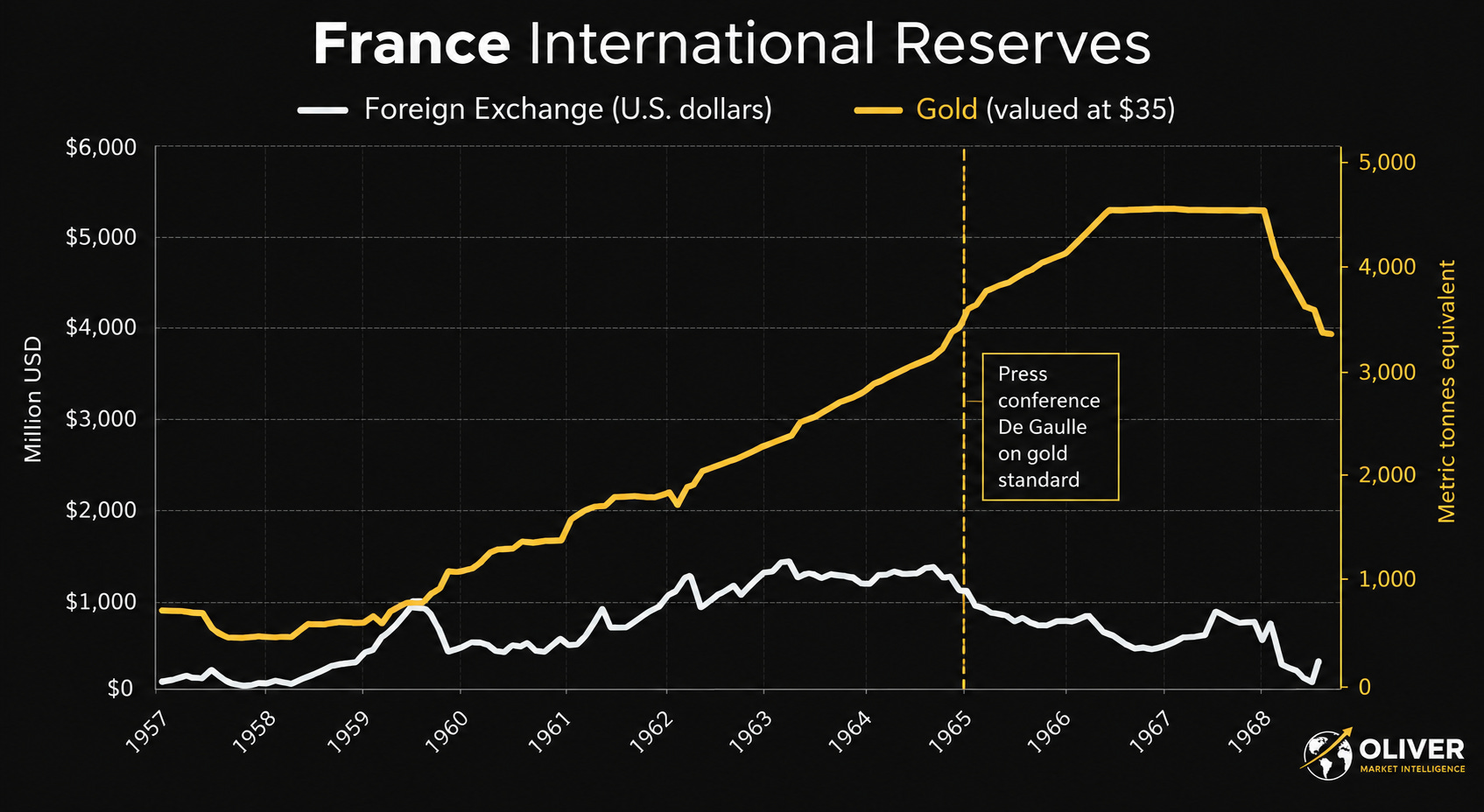
In 1963, France began quietly emptying its gold from foreign vaults.
The operation carried the appropriately French codename Vide-Gousset, roughly translated as “empty pockets”. Gold left New York aboard ocean liners. Bullion stored in London followed by aircraft. The operation stretched across several years because De Gaulle was doing more than moving metal between vaults.
He was reducing France’s dependence on a monetary system he no longer entirely trusted.
De Gaulle, guided by economist Jacques Rueff, had become suspicious of the arrangement created at Bretton Woods. The dollar was supposedly as good as gold, convertible by foreign central banks at $35 an ounce. Yet America could issue the reserve currency required by the rest of the world while running persistent deficits of its own.
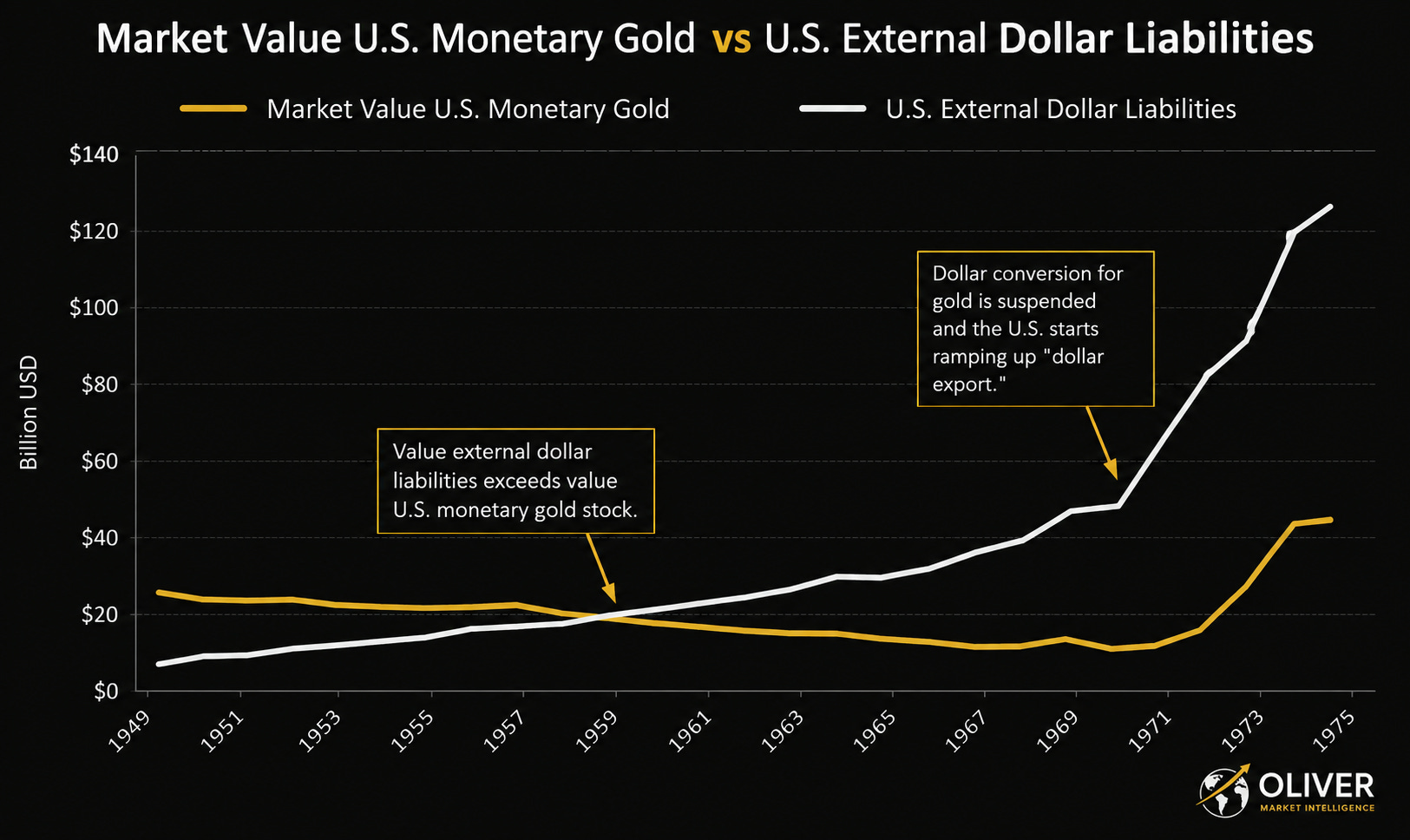
France accumulated dollars, converted them into gold and brought the metal under French control. By the end of 1966, some 3,313 tonnes had been repatriated. A few years later Bretton Woods began breaking apart. In 1971, Richard Nixon suspended the dollar’s convertibility into gold altogether.
Sixty years later, European central bankers are moving gold again.
The aircraft are less visible. The language is considerably more diplomatic. But the question sitting beneath these decisions would have been familiar to De Gaulle.
Where should a country keep the asset it expects to rely upon when everything else becomes unreliable?
Why the Dutch Moved 86 Tonnes
Between March and August this year, De Nederlandsche Bank quietly rearranged the geography of its reserves.
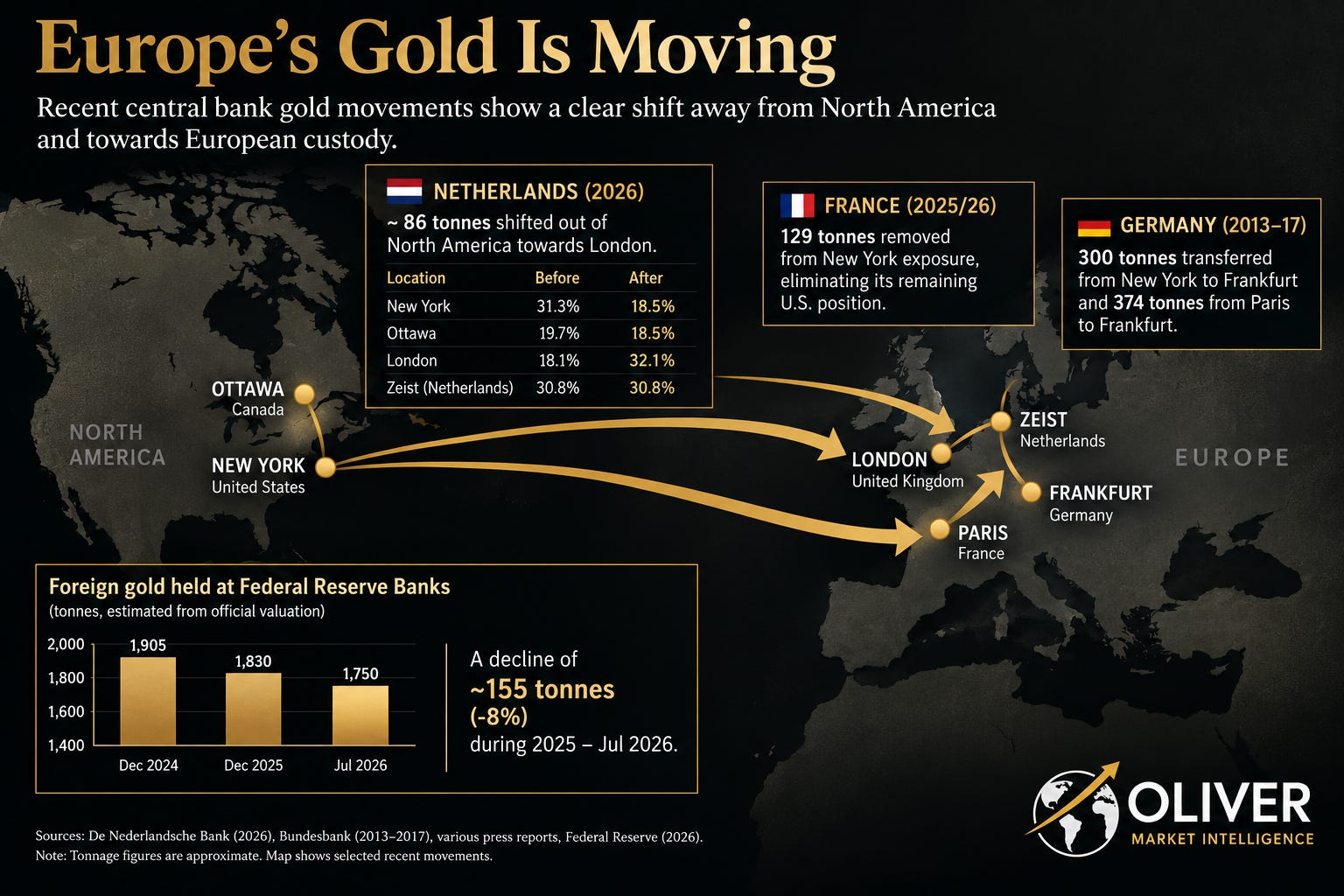
The Netherlands owns 612.4 tonnes of gold. Before the operation, 31.3% sat in New York, 19.7% in Ottawa, 18.1% in London and 30.8% at home in Zeist.
Afterwards, New York and Ottawa each held 18.5%. London had risen to 32.1%, becoming the largest single location.
The Dutch had effectively redirected approximately 86 tonnes away from North America towards London. The central bank cited “increasing geopolitical unrest”, diversification and crisis preparedness. London, it argued, offered gold that could be mobilised more rapidly during a severe crisis.
Yet surprisingly little of the gold travelled directly from New York to London.
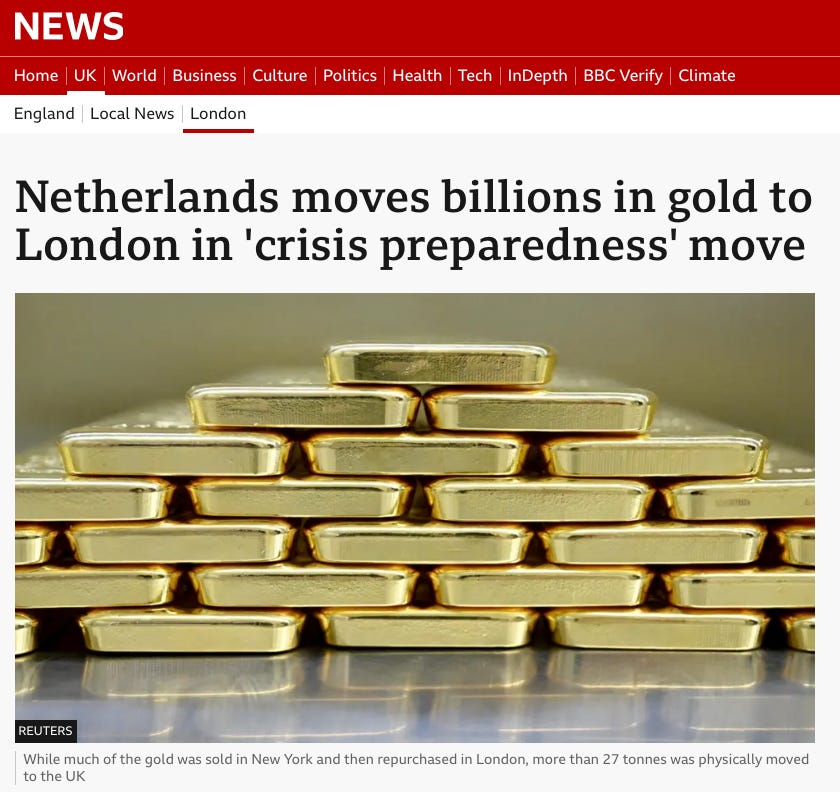
DNB sold roughly 59 tonnes in New York and purchased equivalent modern-standard bullion in London. Another 27 tonnes was physically transported from the United States and Canada to the Netherlands, while a similar amount of Dutch-held bullion travelled from Zeist to London. The Netherlands owned exactly as much gold afterwards. It had simply changed where that gold sat.
This was also not the Netherlands’ first reconsideration.
In 2014, it had already brought approximately 120 tonnes home from New York, increasing the domestic share of its reserves from around 11% to 31%. The stated reasoning then included geographical balance and public confidence.
The difference between 2014 and 2026 is revealing. In 2014, confidence mattered. In 2026, crisis access and geopolitics are explicitly part of the calculation.
Germany Keeps One Foot in New York
Germany faced the same problem on a much larger scale.
At the end of 2012, the Bundesbank owned approximately 3,391 tonnes of gold, but only 31% was stored in Frankfurt. Some 45% remained in New York, with another 13% in London and 11% in Paris.
In 2013, Germany announced that 300 tonnes would return from New York and the entire 374-tonne Paris holding would move to Frankfurt.
The transfers were completed in 2017, three years ahead of schedule. Incoming bars were tested for authenticity, fineness and weight, with the Bundesbank reporting no irregularities.
Yet Germany did something revealing afterwards.
It stopped.
More than 1,200 tonnes remained in New York. Another 432 tonnes stayed in London. Germany wanted enough gold at home to satisfy questions of sovereignty and public confidence, while retaining bullion close to the financial centres where it could rapidly be exchanged for foreign currency.
Germany’s decision complicates the idea that Europe simply wants its gold out of America.
Home provides control. London provides one of the deepest physical bullion markets in the world. New York provides proximity to dollar liquidity. The problem comes when too much of a supposedly sovereign reserve depends upon any single foreign jurisdiction.
The vulnerability appears when too much of a sovereign reserve sits beyond sovereign control.
France Quietly Closes the New York Account
France has now gone further.
During 2025 and early 2026, the Banque de France disposed of its remaining 129 tonnes of gold held in New York, representing around 5% of its 2,437-tonne reserve.
This was not a repatriation in the traditional sense. The old bars did not cross the Atlantic under armed guard. France sold them in New York and acquired equivalent higher-standard bullion in Europe.
The Banque de France presented the decision as a matter of reserve management. Its American-held bars did not meet the standards it wanted for modern reserve management, and selling them locally was safer and cheaper than transporting them to Europe for remelting. There is no primary-source evidence that fear of American confiscation drove the decision.
Still, the geographical result deserves attention.
France entered 2025 with gold in New York. It emerged from the transaction without it.
The last time France removed gold from New York, Charles de Gaulle was openly questioning the monetary order built around the dollar.
Your Gold, Their Jurisdiction
Something changed after February 2022.
Western governments froze or immobilised large parts of Russia’s foreign reserves following the invasion of Ukraine. For reserve managers elsewhere, the episode demonstrated something uncomfortable.
A reserve can belong to you legally while becoming inaccessible operationally.
Gold held abroad carries a risk that gold inside your own vault does not. The metal may carry no credit risk, but its custodian sits inside a legal system, and that legal system sits inside a geopolitical alliance.
This does not mean European central banks expect Washington or London suddenly to seize allied reserves. Their behaviour suggests something less dramatic. They are reducing dependence upon single jurisdictions while preserving access to the financial centres that make foreign-held bullion useful in the first place.
Federal Reserve custody data suggest the movement is visible in aggregate. Foreign and international earmarked gold at Federal Reserve Banks fell by an estimated net 91 tonnes during 2025 and another 64 tonnes through July 2026. Since the end of 2010, the estimated net reduction is around 378 tonnes. These figures cannot identify which countries moved particular bars, and New York still holds thousands of tonnes of foreign gold.
There is no run on the vault.
But central banks are reconsidering what possession actually means.
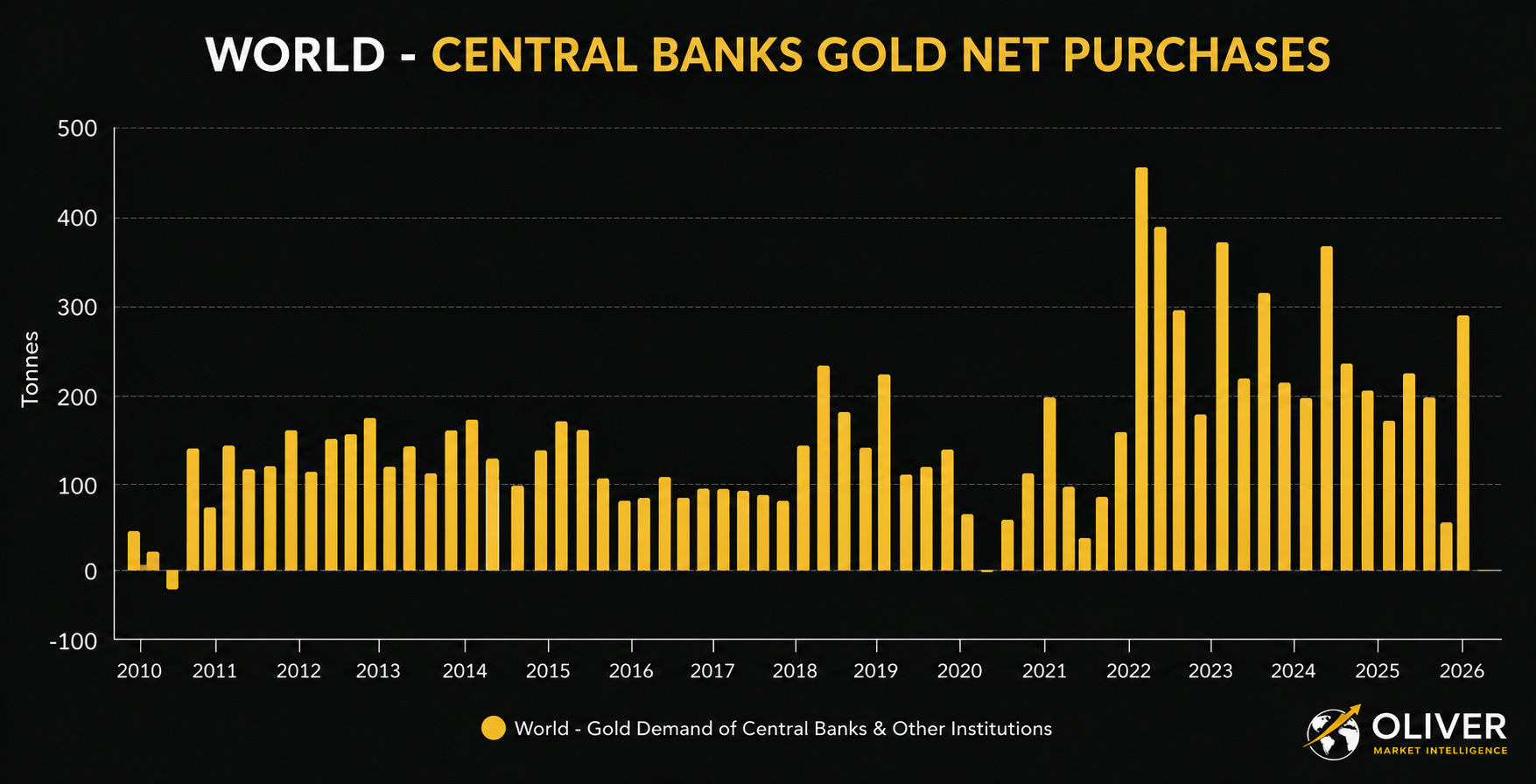
The Geography of Trust
Gold has always occupied an unusual place on a central bank balance sheet.
A government bond is somebody else’s obligation. A bank deposit is somebody else’s liability. A currency depends upon the issuing state. Gold requires none of them.
Store that gold abroad, however, and somebody else still controls the vault door.
That mattered less when relations between the major Western powers appeared permanent. It matters considerably more after sanctions, frozen reserves, trade disputes and increasingly explicit arguments about financial sovereignty.
The Netherlands may offer a glimpse of where reserve management is heading. Roughly 31% of its gold now sits at home, another 32% in London, with the remainder divided between New York and Ottawa. No single jurisdiction is indispensable. If access to one vault becomes difficult, another remains available.
The next wave of repatriation may therefore look nothing like De Gaulle’s. France and the Netherlands have demonstrated that central banks can now change jurisdiction simply by selling bars in one market and replacing them elsewhere. Future repatriations may happen on trading desks rather than airport runways.
Which brings us back to De Gaulle.
His ships carried French gold home because he doubted whether the monetary arrangement surrounding it would survive. Today’s European central bankers are less theatrical. They speak about tradability, standardisation, diversification and crisis preparedness.
Perhaps that language should be taken exactly as intended.
But once countries begin asking whether their gold will be accessible during the next crisis, the location of the bar stops being an administrative detail.
De Gaulle understood that sixty years ago.
Europe appears to be remembering it.
If you are thinking about how to protect your wealth in this environment, you can explore physical gold and silver through www.goldwise.com, where the focus is on ownership, security and transparency.
Goldwise are committed to producing educational content that helps investors better understand the macroeconomic forces shaping financial markets. If there are topics you would like us to explore in future editions, we welcome your feedback.
Disclosure: Mr. Matthew Oliver, Oliver Market Intelligence, is a shareholder in Goldwise. Any opinions, analysis and views expressed in this publication are solely those of Mr. Matthew Oliver and Oliver Market Intelligence and are provided independently unless expressly stated otherwise.
This publication is provided for informational and educational purposes only and does not constitute financial, investment or other professional advice. References to Goldwise are for informational purposes and should not be construed as a recommendation to purchase any product or service. Investments can fall as well as rise in value, and readers should conduct their own research and, where appropriate, seek advice from a qualified financial adviser before making any financial decisions.