



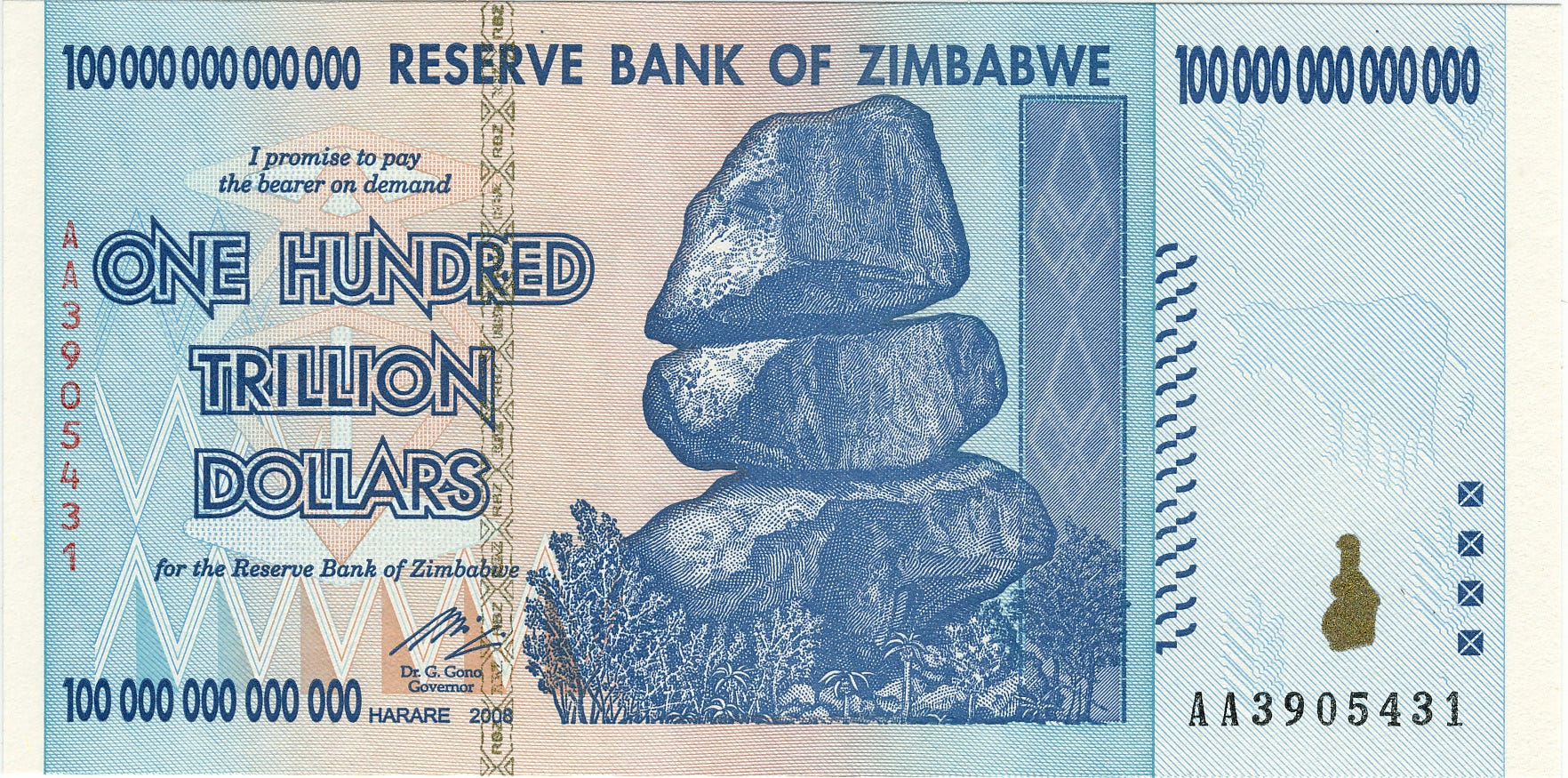
By the final months of 2008, Zimbabweans had stopped behaving as though their national currency was money.
The notes still existed. Prices were still quoted in Zimbabwe dollars. Salaries were still paid in them. Yet the useful life of those salaries was collapsing by the day. The IMF estimated twelve-month inflation at roughly 500 billion per cent by September. Businesses increasingly demanded US dollars or South African rand instead. Within months, much of the economy had abandoned the currency altogether.
Argentina took a longer route. Inflation averaged roughly 2,600% in 1989 and 1990, forcing a monetary reset in the early 1990s. Three decades later the problem returned, with inflation reaching 211.4% in 2023. Venezuela went further. By September 2018, annual inflation was approaching 489,000%, accompanied by collapsing production, shortages and a mass flight from the bolívar.
The circumstances differed, but the sequence kept recurring. Fiscal problems spilled into monetary ones. Monetary problems became crises of confidence. Once people began spending currency simply to get rid of it, the decline fed on itself.
Hyperinflation merely makes the mechanics impossible to ignore.
The uncomfortable part begins when those examples are placed beside what has happened in Britain and America since 2008. Central-bank balance sheets expanded, government borrowing surged, interest rates were held near zero for years, and the currencies themselves bought progressively less.
The Experiment That Never Really Ended
When the financial system began breaking in 2008, central banks crossed monetary boundaries that had previously been discussed more often than used.
The Federal Reserve began buying hundreds of billions of dollars of mortgage securities, agency debt and Treasuries. Britain followed. Between March 2009 and January 2010, the Bank of England purchased roughly £200 billion of assets, mainly gilts, financed through newly created central-bank reserves.
Under QE, central banks created reserves to purchase existing financial assets, suppress yields and push liquidity through the system. The mechanics were more complicated than handing newly printed notes to households, but the policy still represented deliberate monetary expansion. Yet the result is still a deliberate expansion of central-bank money designed to suppress yields, encourage lending, support asset prices and loosen financial conditions.
For most of the following decade, policymakers congratulated themselves on having discovered a relatively painless mechanism. Inflation remained subdued while equities, property and bonds appreciated.
Then 2020 removed whatever restraint remained.
Federal Reserve assets jumped from $4.17 trillion at the end of 2019 to $5.74 trillion by the end of March 2020. In Britain, the Bank of England’s Asset Purchase Facility was eventually authorised to hold £875 billion of gilts, plus another £20 billion of corporate bonds.
This time monetary intervention arrived alongside fiscal transfers, furlough schemes, stimulus cheques, broken supply chains and an economy operating with less productive capacity.
Prices surged.
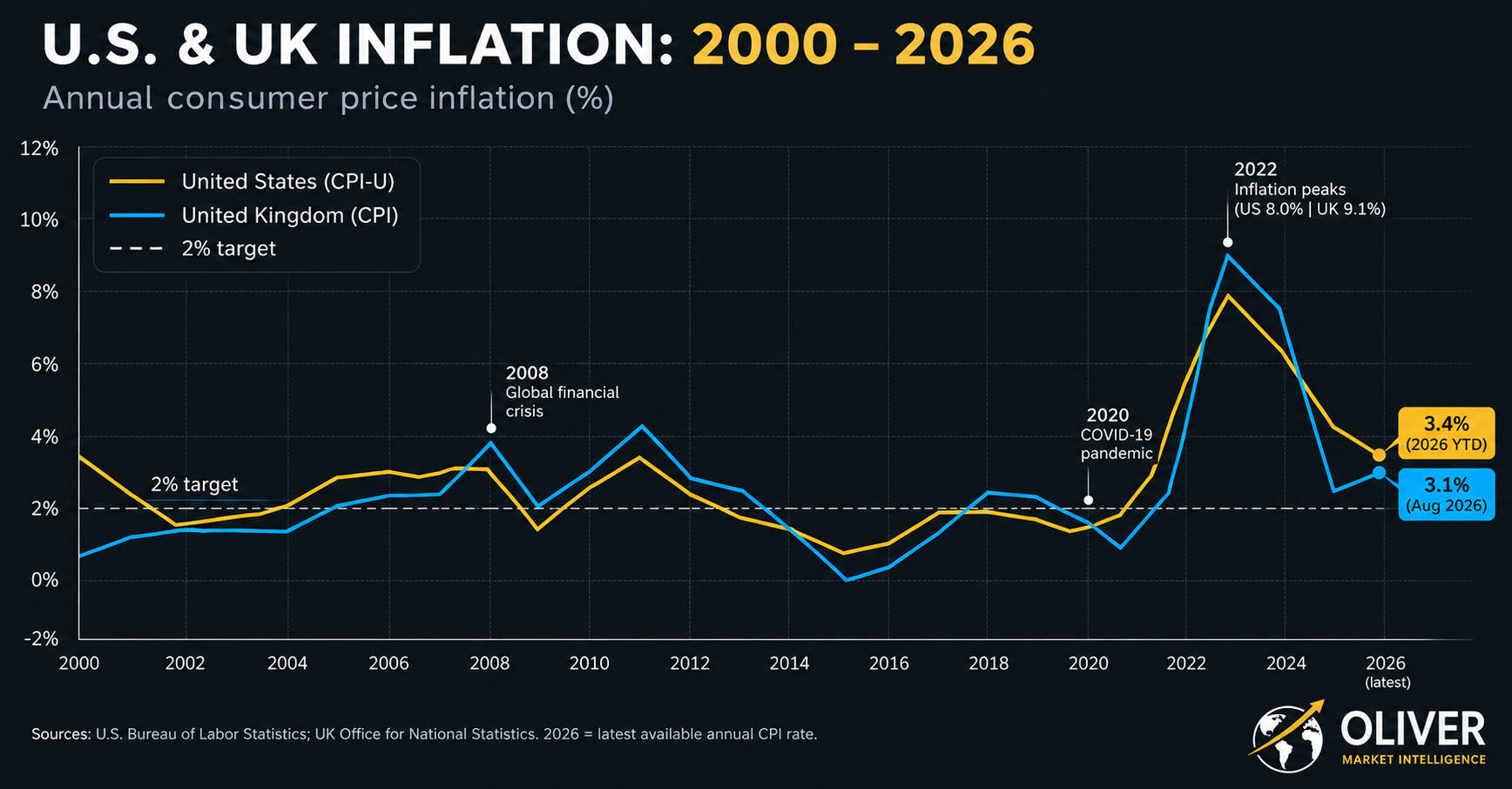
Inflation later fell back. The price level did not.
Lower inflation means prices are rising more slowly. It does not mean the increases of 2021, 2022 and 2023 have been reversed.
The Loss Nobody Puts on the Bank Statement
A basket of goods costing $100 in September 2008 now costs roughly $153.
In Britain, the same £100 basket now costs roughly £167.
Expressed as purchasing power, the dollar from the financial crisis has lost roughly 35% of what it could buy. Sterling has lost around 40%.
Even the pre-Covid comparison is striking. Since February 2020, the dollar has lost roughly 23% of its purchasing power and the pound about 24%.
There is rarely a moment when the saver feels this loss occur. The numbers in the bank account do not disappear. £100 remains £100.
It simply buys less.
At a permanent 2% inflation rate, money loses roughly half its purchasing power over about 35 years. At 3%, the halfway point arrives after roughly 23½ years.
That is one of the peculiar achievements of modern monetary systems: money can lose half its purchasing power across a working lifetime while appearing perfectly stable.
Now Look at the Debt
The emergency balance sheets of 2020 have begun shrinking. The debt accumulated around them has not.
US federal debt passed $40 trillion in September 2026. Roughly $32.4 trillion is held by the public. The Congressional Budget Office expects Washington to run a deficit of around $1.9 trillion this year, equal to 5.8% of GDP, with public debt projected to rise from around 101% of GDP to 120% by 2036.
Britain carries nearly £3 trillion of public-sector net debt excluding public-sector banks, approximately 94% of GDP.
Higher rates defend purchasing power, but make heavily indebted governments more expensive to finance. Lower rates reduce financing costs, but encourage credit creation and make inflation easier to tolerate. Inflation itself quietly reduces the real burden of fixed nominal debt.
For the debtor, a pound worth less tomorrow can be useful.
For the person saving that pound, it is the opposite.
Keynes Versus the Austrians
Much of this argument was being fought a century ago.
Keynes believed governments and central banks needed flexibility. When private demand collapses, allowing unemployment and unused productive capacity to persist can deepen a recession. Monetary easing and government spending can interrupt that process.
A gold standard limits that freedom. Money tied to a finite reserve cannot be expanded whenever policymakers decide the economy requires support.
The Austrian economists looked at precisely that constraint and saw gold’s great virtue.
Ludwig von Mises regarded sound money partly as an institutional defence against political discretion. Friedrich Hayek worried that artificially cheap credit distorted interest rates, encouraged bad investment and allowed one boom to contain the seeds of the next bust.
The Keynesian asks what happens when authorities cannot create money during a crisis.
The Austrian asks what eventually happens when they always can.
Since 2008, the second question has came to light.
Price Gold in Dinner
Stop measuring gold in pounds. Measure pounds in gold.
In August 1971, four days after Nixon closed the gold window, a comparable dinner at London’s Savoy Grill cost around £5.67 per person. An ounce of gold was worth approximately £16.66. It paid for dinner for almost three people.
In January 2026, the equivalent dinner cost roughly £236. An ounce of gold was worth around £3,303.
It now paid for dinner for almost fourteen.
The century-old suit comparison tells a similar story. In the 1920s, a quality suit cost around $20 to $30, while gold was fixed at $20.67 an ounce. One ounce bought roughly one good suit.
A century later, a high-quality or bespoke suit can cost several thousand dollars. So can an ounce of gold.
A suit is hardly a perfect inflation index, but the broader data is stronger than the anecdote.
UBS calculates that between 1900 and 2025, gold’s inflation-adjusted purchasing power increased approximately 5.2 times in US dollars and 12.2 times in sterling. Since the end of Bretton Woods, annualised real returns have been around 4.7% for American investors and 5.8% for British investors.
Since 2008 alone, the average dollar gold price has risen from roughly $872 to more than $4,200, producing an inflation-adjusted increase in purchasing power of a little over threefold.
Gold Does a Different Job
None of this means gold has historically produced the greatest return.
US equities have compounded at approximately 6.6% a year after inflation since 1900, far ahead of gold over the full period. Housing also generates an economic return through rent and the use of the property itself, which makes simple comparisons with a house-price index misleading. Long-run research suggests total housing returns have been surprisingly competitive with equities.
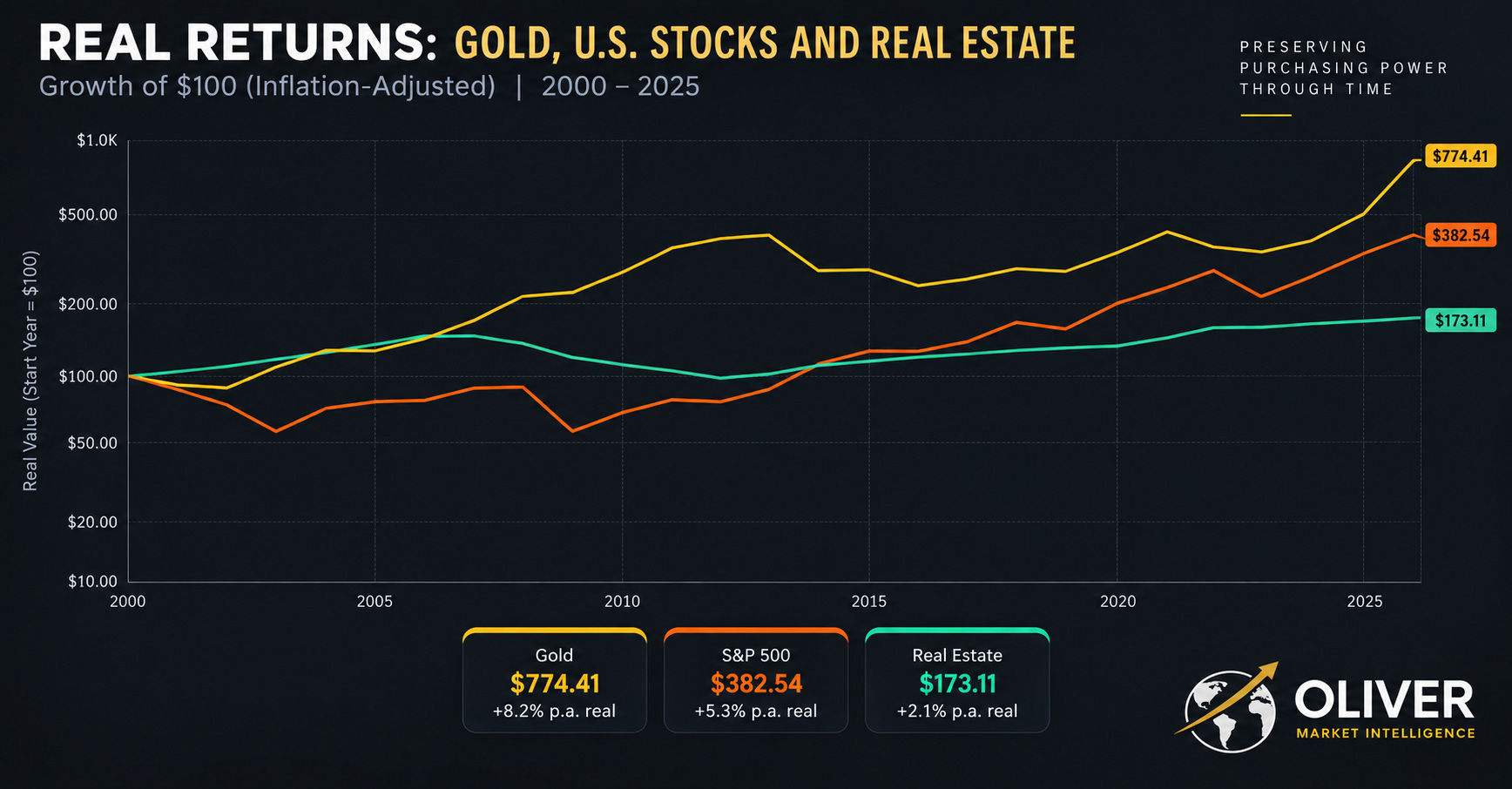
Equities are claims on productive businesses. Property provides land, buildings and rent.
It produces nothing. It pays nothing. It does not promise growth.
Its strength is that nobody can produce another trillion ounces because the Treasury has a deficit, a banking system needs rescuing or an economy needs stimulus. Global mine supply responds slowly because extracting new gold requires capital, discoveries, permitting, construction and years of work.
That scarcity is precisely what an elastic monetary system lacks.
Zimbabwe showed how quickly money can fail once confidence disappears. Argentina showed how difficult monetary credibility can be to rebuild. Venezuela combined fiscal stress, money creation and a collapsing productive economy with devastating results.
Britain and America now carry debts that would have looked extraordinary when quantitative easing began in 2008. The pandemic response added another layer: a permanently higher price level and currencies that buy materially less than they did six years ago.
The debt may remain serviceable. Stronger productivity could ease the burden, and policymakers may yet keep inflation contained while refinancing ever larger liabilities.
Nobody knows.
The saver does not need to resolve that debate to see the problem.
The currency being used to measure wealth keeps changing.
In Zimbabwe, people discovered that lesson in months. At the Savoy Grill, it took fifty-five years to become obvious.
The difference was only how long it took people to notice.
If you are thinking about how to protect your wealth in this environment, you can explore physical gold and silver through www.goldwise.com, where the focus is on ownership, security and transparency.
Goldwise is committed to producing educational content that helps investors better understand the macroeconomic forces shaping financial markets. If there are topics you would like us to explore in future editions, we welcome your feedback.
Disclosure: Mr. Matthew Oliver, Oliver Market Intelligence, is a Goldwise shareholder. Any opinions, analysis and views expressed in this publication are solely those of Mr. Matthew Oliver, Oliver Market Intelligence and are provided independently unless expressly stated otherwise.
This publication is provided for informational and educational purposes only and does not constitute financial, investment or other professional advice. References to Goldwise are for informational purposes and should not be construed as a recommendation to purchase any product or service. Investments can fall as well as rise in value, and readers should conduct their own research and, where appropriate, seek advice from a qualified financial adviser before making any financial decisions.