



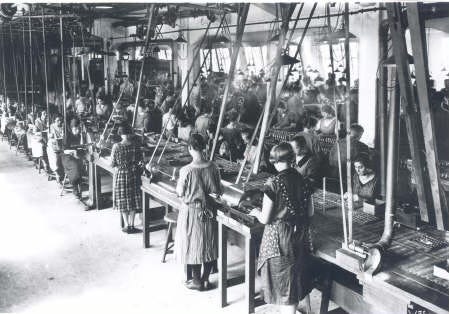
In the late stages of the Second World War, Allied planners became obsessed with something surprisingly small.
Not tanks.
Not oil.
Not even ammunition.
Ball bearings.
Factories across Europe depended on them. Aircraft engines, trucks, rail systems, industrial machinery, all required precision bearings to function. They were small, unremarkable, and easy to ignore. But without them, production lines stalled and entire industrial systems began to seize.
The lesson was uncomfortable.
Modern economies do not usually break because of the obvious things. They break because of hidden dependencies buried deep inside the system.
Today, the world is discovering another set of hidden dependencies.
Not on ball bearings, but on precious metals.
Most investors still think about gold and silver through a purely monetary lens. Gold protects against currency debasement. Silver is leveraged monetary beta. Platinum and palladium are often treated as niche industrial side stories.
But that framing is becoming increasingly outdated.
What is quietly emerging beneath the surface is a much larger structural story about industrial scarcity, electrification, strategic supply chains, and the physical limits of the modern economy.
Because these metals are no longer sitting passively inside vaults.
They are increasingly embedded inside the infrastructure of AI systems, satellites, solar panels, semiconductors, hydrogen technologies, defence systems, advanced electronics, automotive catalysts, and energy networks.
On the surface, it looks like precious metals are simply participating in another commodity cycle.
But underneath, something more structural is happening.
The global economy is becoming increasingly dependent on a group of metals whose supply cannot easily scale.
And that matters far more than most investors realise.
Gold’s Quiet Role Inside Critical Technology
Gold remains the most misunderstood industrial metal in the precious metals complex.
Most investors focus exclusively on central banks, jewellery demand, ETF flows, and monetary debasement. Industrial demand is often dismissed because it represents a relatively small percentage of total consumption.
But that misses the point entirely.
Gold’s industrial importance is not about volume. It is about reliability.
Gold possesses a combination of conductivity, corrosion resistance, thermal stability, and durability that becomes extremely difficult to replace when systems cannot afford failure. In high-reliability applications, cost becomes secondary to performance.
That is why gold quietly sits inside some of the world’s most important technologies.
AI servers.
Semiconductors.
Satellite systems.
Military electronics.
Advanced aerospace components.
Electric vehicle power systems.
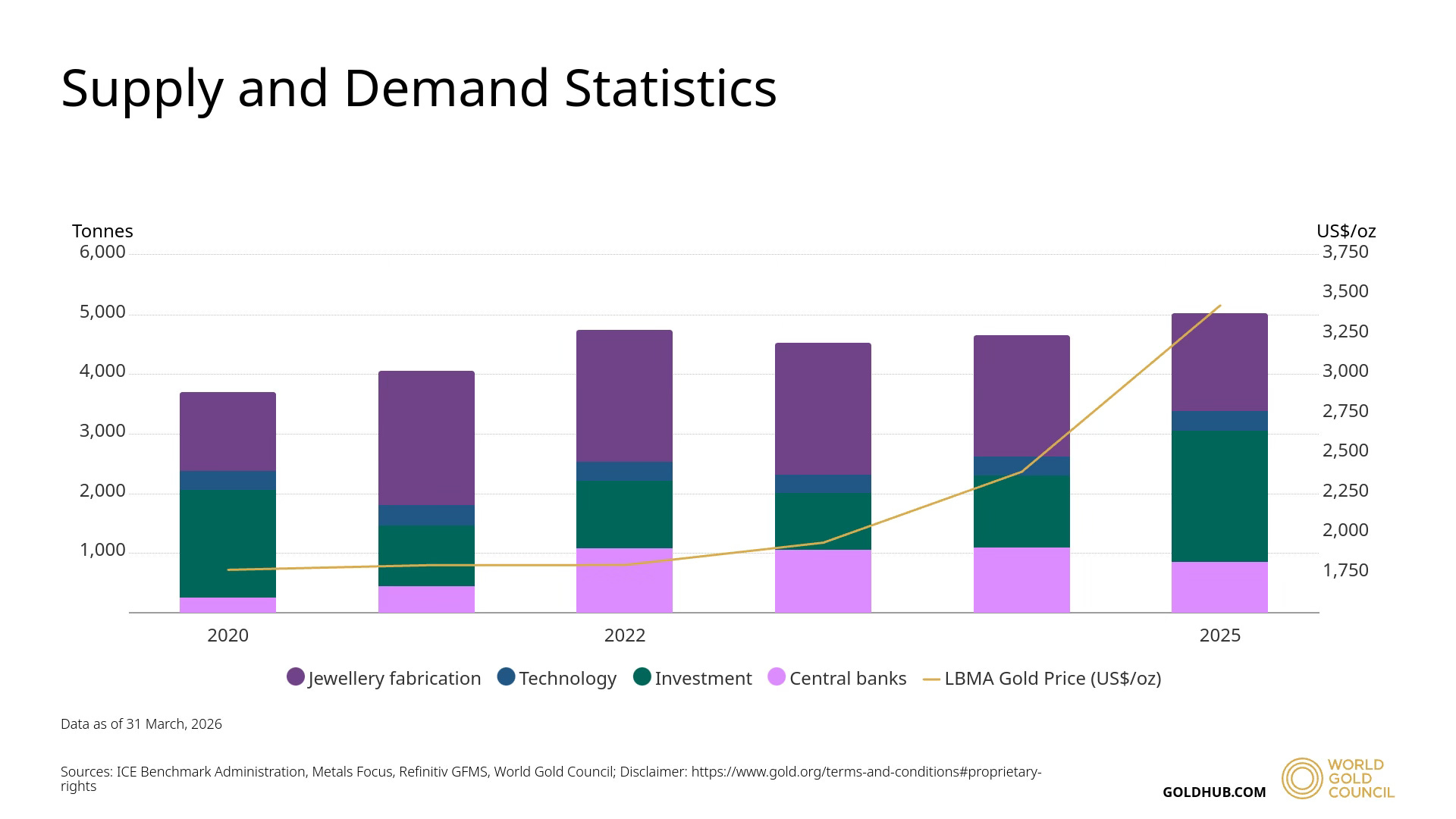
Technology demand for gold has continued climbing, particularly across electronics and AI-linked infrastructure. Demand from printed circuit boards, server upgrades, memory systems, and advanced chips continues growing as the digital economy expands.
The important point is not that gold is consumed in massive quantities.
It is that the applications using gold are becoming increasingly strategic.
When an AI server farm fails, or a satellite system malfunctions, reliability matters more than material cost. That gives gold a form of sticky industrial demand that many investors overlook.
At the same time, mine supply growth remains relatively slow. Discoveries are becoming more difficult, permitting cycles are longer, and large-scale projects take years to bring online.
This creates an important shift in how investors should think about gold.
Gold is no longer just monetary insurance.
It is increasingly becoming a strategic industrial infrastructure.
Silver: The Conductive Backbone of Electrification
If any precious metal currently reflects a true industrial squeeze, it is silver.
Silver possesses the highest electrical conductivity of any metal on Earth. That single characteristic places it directly at the centre of nearly every major electrification trend underway today.
Solar panels.
Power grids.
5G infrastructure.
AI data centres.
Electric vehicles.
Consumer electronics.
The modern economy increasingly runs on electricity, and silver sits inside the conductive architecture moving those electrons through the system.
This is where the silver story becomes much larger than traditional “silver bug” narratives about monetary history or inflation hedging.
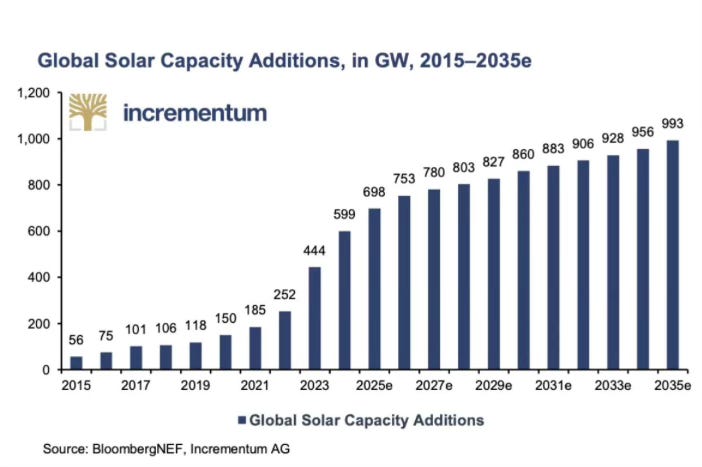
Industrial demand for silver continues reaching record highs, driven largely by solar deployment and electronics demand. Solar alone now absorbs enormous quantities of annual silver supply, while broader electronics demand continues expanding alongside AI infrastructure and global electrification.
The energy transition increasingly runs through silver.
And critically, supply growth is struggling to keep pace.
This is because silver supply is structurally difficult to expand quickly. Much of global silver production comes as a byproduct of mining other metals such as copper, zinc, and lead. That means rising silver demand does not automatically trigger proportional supply growth.
The market cannot simply “turn on” large amounts of new silver production.
At the same time, the solar industry itself continues accelerating.
The world added enormous amounts of new solar capacity in recent years, and automation is now making deployment even faster. Robotics are helping scale installation, lower labour costs, and accelerate project development globally.
Ironically, cheaper solar does not reduce silver demand.
It expands it.
As solar becomes more economically viable, deployment scales faster, which ultimately pulls even more silver into the system.
Many investors assume technology will eventually eliminate silver intensity per panel through substitution.
But physics imposes constraints.
Higher-efficiency solar technologies often still require meaningful silver loadings because conductivity, durability, and long-term performance remain critical. Copper alternatives are improving, but substitution remains limited in many high-performance applications.
This creates the core tension.
The energy transition runs through silver, but silver supply remains relatively inelastic.
That is not a short-term narrative.
It is a structural supply-and-demand problem.
Platinum: The Metal Exposing Supply Inelasticity
Platinum may be the clearest example of what happens when industrial demand meets a supply system incapable of responding quickly.
For years, platinum was treated as a forgotten precious metal tied primarily to diesel engines and old industrial processes.
That narrative is now changing rapidly.
Platinum sits at the intersection of several major industrial systems simultaneously:
Automotive catalysts.
Hydrogen fuel cells.
Petroleum refining.
Aerospace systems.
Chemical processing.
Advanced industrial manufacturing.
Hydrogen is becoming particularly important.
Platinum plays a critical catalytic role inside hydrogen fuel cells and PEM electrolysers, technologies increasingly viewed as essential components of future clean-energy systems. Unlike many speculative “green transition” themes, platinum’s role here is rooted in chemistry and physics rather than marketing narratives.
The problem is supply.
And this is where platinum becomes extremely interesting.
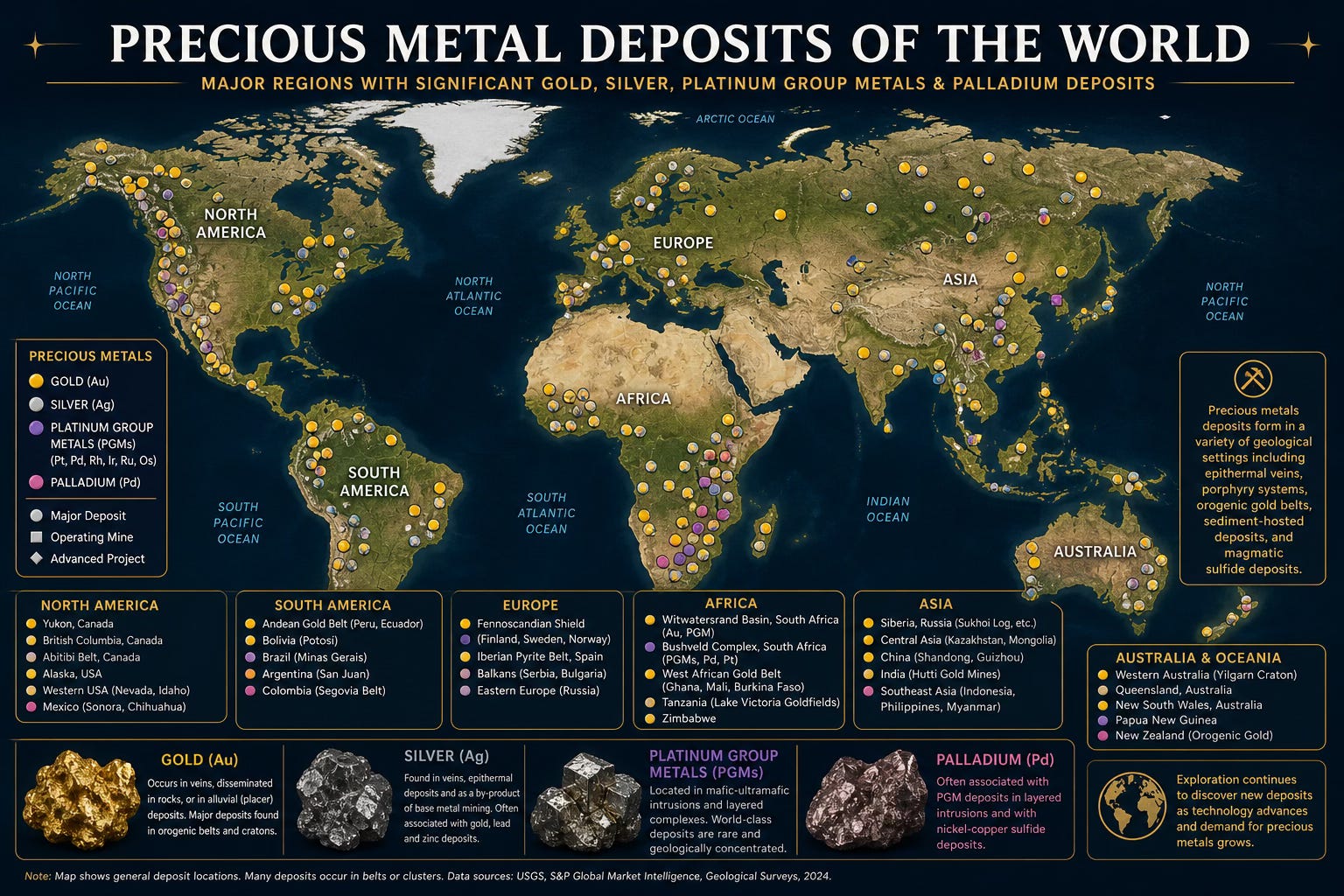
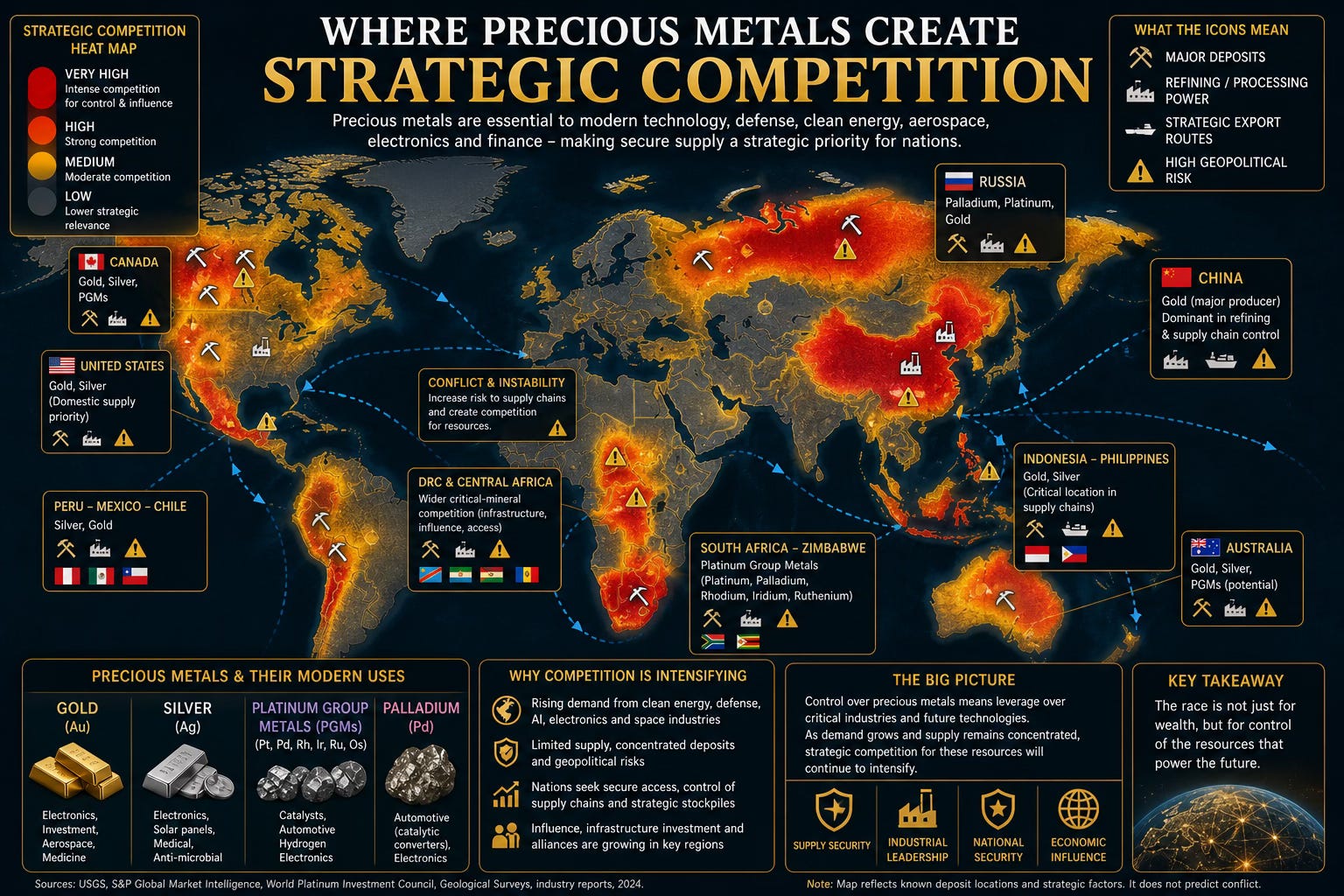
Global platinum production is highly geographically concentrated, with South Africa dominating supply and Russia remaining strategically important. Mines are aging, energy shortages continue disrupting operations, and new greenfield projects are scarce, expensive, and slow to develop.
This is not software.
Supply cannot scale overnight.
This is a story about geology, infrastructure, labour constraints, permitting delays, power grids, and capital discipline.
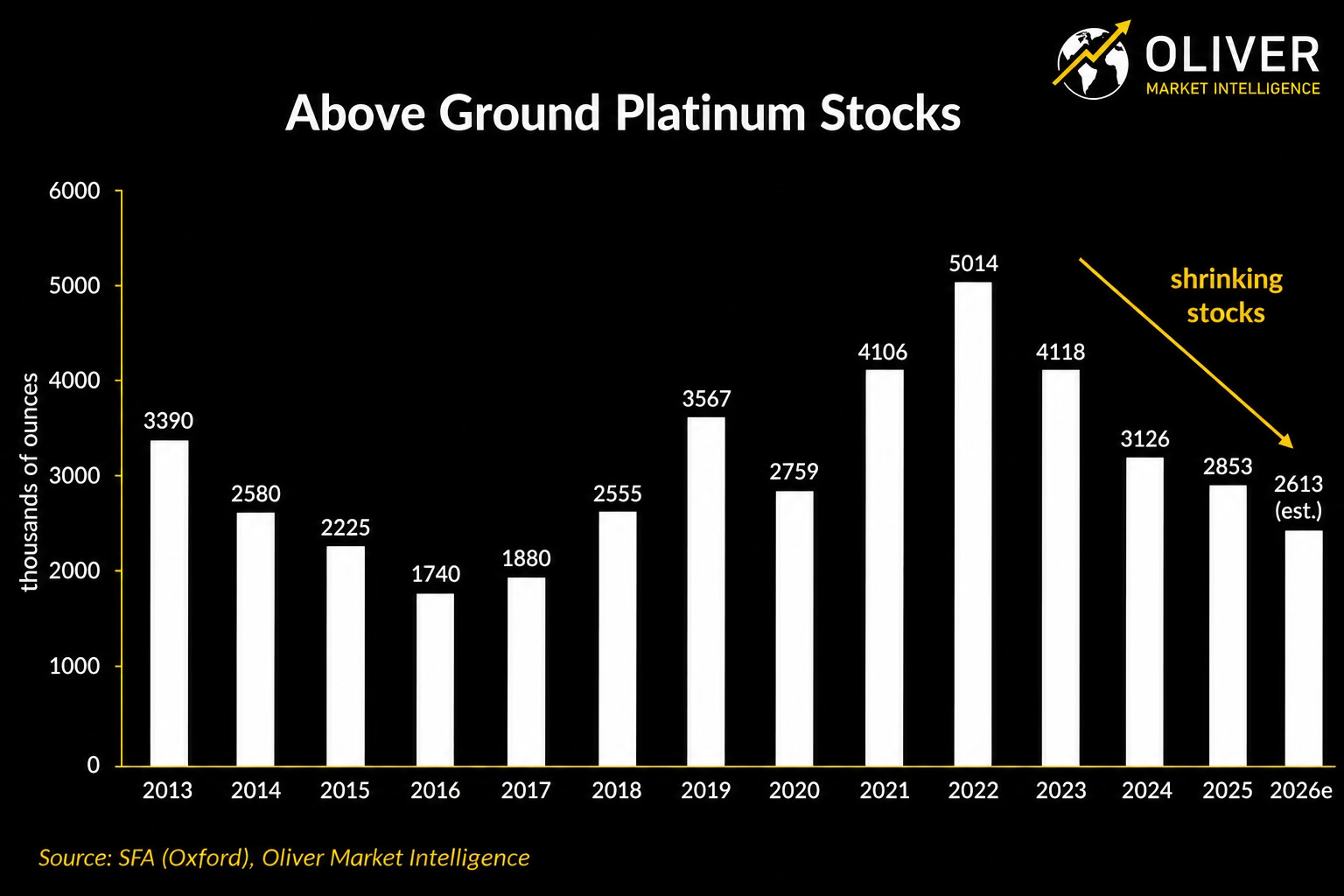
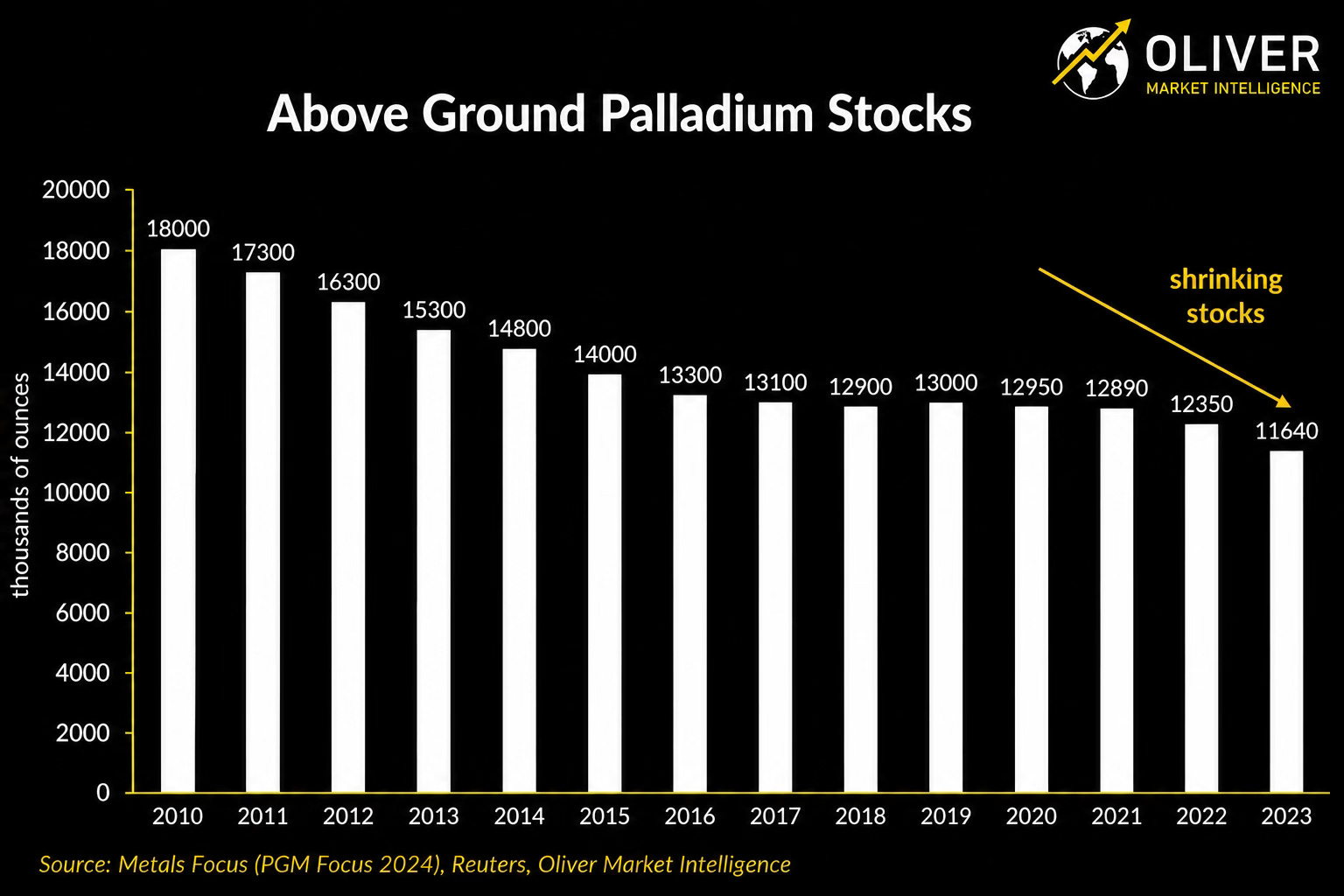
The platinum market has already been running persistent deficits, gradually drawing down above-ground inventories. One deficit can be absorbed, but several consecutive deficits begin creating structural pressure throughout the system.
This is where platinum starts looking less like a commodity chart and more like a warning signal.
The real issue is not whether demand rises.
It is whether supply can respond.
And increasingly, the answer appears to be no.
Palladium: The Precious Metal Most Exposed to Geopolitics
Palladium remains one of the most geopolitically sensitive metals in the entire commodity complex.
Most palladium demand still comes from automotive catalytic converters, particularly within gasoline and hybrid vehicles. Despite aggressive EV adoption narratives, internal combustion engines and hybrids continue dominating global vehicle fleets.
That means palladium demand remains deeply tied to emissions systems.
But the real story lies on the supply side.
Global palladium production is heavily concentrated in Russia and South Africa, creating an unusually fragile supply chain vulnerable to sanctions, political disruptions, energy shortages, labour disputes, and logistical bottlenecks.
This concentration creates a market that can move violently when disruptions emerge.
At the same time, palladium still maintains important industrial applications beyond automobiles, including electronics, hydrogen purification systems, semiconductors, defence systems, and advanced industrial catalysts.
The challenge for palladium is that recycling flows increasingly matter. If recycled supply expands meaningfully, the market could move into temporary surplus conditions. But if recycling underperforms, deficits may persist much longer than expected.
That uncertainty creates volatility.
And volatility matters in thin markets.
Palladium increasingly behaves less like a traditional precious metal and more like a geopolitical pressure valve sitting inside the industrial economy.
The Structural Pattern Connecting All Four Metals
This is where the broader pattern becomes important.
On the surface, these metals appear to have separate stories.
Gold is monetary.
Silver is electrification.
Platinum is hydrogen.
Palladium is automotive.
But underneath, they are all connected by the same structural mechanism:
Industrial systems are demanding more strategic materials at a time when supply growth is becoming harder, slower, more expensive, and more politically constrained.
This is not new.
We saw the same pattern in:
Energy markets following years of underinvestment
Uranium after a decade-long bear market
Copper as electrification demand accelerated
Semiconductors during global supply-chain disruptions
The sequence is always similar.
Prices remain weak for years.
Capital investment collapses.
Supply growth stagnates.
Demand surprises to the upside.
Inventories absorb the imbalance temporarily.
Inventories decline.
The market tightens.
Prices eventually rise to ration demand and incentivise new supply.
Precious metals increasingly appear to be moving through that same sequence.
The key difference is that these markets are relatively small.
That means even modest shifts in industrial demand or investment flows can create disproportionately large pricing effects.
What the Market May Be Mispricing
If this framework is correct, then investors may be focusing on the wrong variables entirely.
The real risk is not weak demand.
It is a constrained supply.
Markets still largely assume that higher prices will eventually solve shortages through increased production. But mining does not function like software or financial assets.
Mines take years to build.
Ore grades decline over time.
Permitting becomes more complex.
Capital discipline limits expansion.
Energy infrastructure matters.
Political risk matters.
In many cases, higher prices are no longer producing rapid supply responses.
That changes the equation.
Gold protects the reliability of advanced systems. Silver enables electrification. Platinum exposes supply rigidity. Palladium reveals geopolitical concentration risk.
These are not isolated commodity stories anymore.
They are interconnected signals about how fragile modern industrial systems may become when strategic materials tighten simultaneously.
The Bigger Picture
This is not about precious metals becoming fashionable again.
It is about the physical economy rediscovering scarcity.
The energy transition cannot happen without conductive metals. AI infrastructure cannot scale without reliable electronics. Hydrogen systems require catalysts. Advanced defence systems depend on specialised materials.
And increasingly, the world is attempting to accelerate all of these trends simultaneously while relying on supply chains that were never designed for that level of demand growth.
Like the ball bearings that once quietly underpinned wartime industry, strategic metals are becoming foundational components whose importance only becomes visible when supply tightens.
If you are thinking about how to protect your wealth in this environment, you can explore physical gold and silver options through www.goldwise.com - where the focus is on ownership, security, and transparency.
We are continuing to build Goldwise with content that helps investors understand what is really happening beneath the surface. If there are specific topics you would like us to break down further, or areas you feel are not being covered clearly enough, let us know!
This content is for informational purposes only and does not constitute financial advice. Investments can go down as well as up, and you should conduct your own research or speak to a qualified financial advisor.
Applying the **Law of the Minimum** to supply chain shortages is a highly accurate analogy.
Originally formulated in agricultural science by Carl Sprengel and popularized by Justus von Liebig, **Liebig’s Law of the Minimum** states that plant growth is dictated not by the total resources available, but by the *scarcest* resource (the limiting factor).
When applied to modern manufacturing and supply chains, the logic holds up perfectly: **a final product cannot be assembled if even a single, minor component is missing.**
Here is how the concept perfectly maps onto modern supply chain vulnerabilities:
## The "Liebig’s Barrel" of Manufacturing
In agriculture, this concept is often visualized as a wooden barrel with staves of unequal length. The barrel can only hold water up to the height of the shortest stave.
In a supply chain context:
* **The Staves:** Represent every input required to create a final product (e.g., raw materials, microchips, labor, shipping containers, specialized screws, packaging).
* **The Water Level:** Represents your actual production capacity or output.
No matter how high you build the "staves" for steel, plastic, or assembly-line labor, your total production is strictly capped by the shortest stave—which might be a single 50-cent semiconductor or a specific chemical resin.
## Real-World Examples of the Law in Action
### 1. The Automotive Microchip Crisis
During the post-pandemic supply chain disruptions, automotive giants had lots full of thousands of nearly completed, high-end vehicles. They had the engines, the chassis, the leather seats, and the tires. However, because they lacked a few specific microchips (the limiting factor), the final product could not be completed or sold. Production ground to a halt despite an abundance of 99% of the necessary components.
### 2. Aerospace and Specialized Fasteners
Building a commercial airplane requires millions of parts. If a aerospace manufacturer faces a shortage of a highly specific, certified titanium fastener, they cannot simply substitute it with a hardware-store screw. The entire assembly line slows down because that one fastener is the minimum constraint.
## Key Takeaways for Supply Chain Strategy
Viewing logistics through the lens of the Law of the Minimum forces companies to shift their focus:
* **From Volume to Balance:** Having a surplus of one component does not compensate for a shortage of another. In fact, surpluses just tie up working capital.
* **Identifying the "Shortest Stave":** Companies must conduct deep-tier supply chain mapping to identify which obscure, single-source components are most likely to become the limiting factor.
* **Resilience Over Efficiency:**
The traditional "Just-in-Time" (JIT) manufacturing model accidentally optimizes for the Law of the Minimum by keeping all staves as short as possible to save money. Modern strategies are shifting toward "Just-in-Case," intentionally lengthening the most vulnerable staves through safety stock.
Using this framework is an excellent way to explain to a non-technical audience why a massive factory might completely shut down even when its warehouses are seemingly full of parts.