


For most of the past century, Ecuador occupied an awkward place in mining imagination. Geologists admired it. Investors avoided it.
It became one of those countries everyone agreed was richly endowed, but nobody wanted to own.
The irony was always sitting beneath their feet. The same tectonic forces that created Chile’s giant copper deposits and Peru’s prolific gold belts did not politely stop at the Ecuadorian border. They continued north, folding and fracturing the Andes with complete indifference to politics, permitting regimes or investor sentiment. Rocks have never paid much attention to national borders. Capital always has.
Markets have a habit of confusing history with permanence.
Eventually, the facts change. Perceptions are usually the last thing to follow.
Geology changes over millions of years. Investor psychology can change in a single commodity cycle.
Countries Can Change Faster Than Investors Think
Mining jurisdictions are rarely transformed by speeches or election results. They earn credibility one project at a time.
That is what has happened in Ecuador.
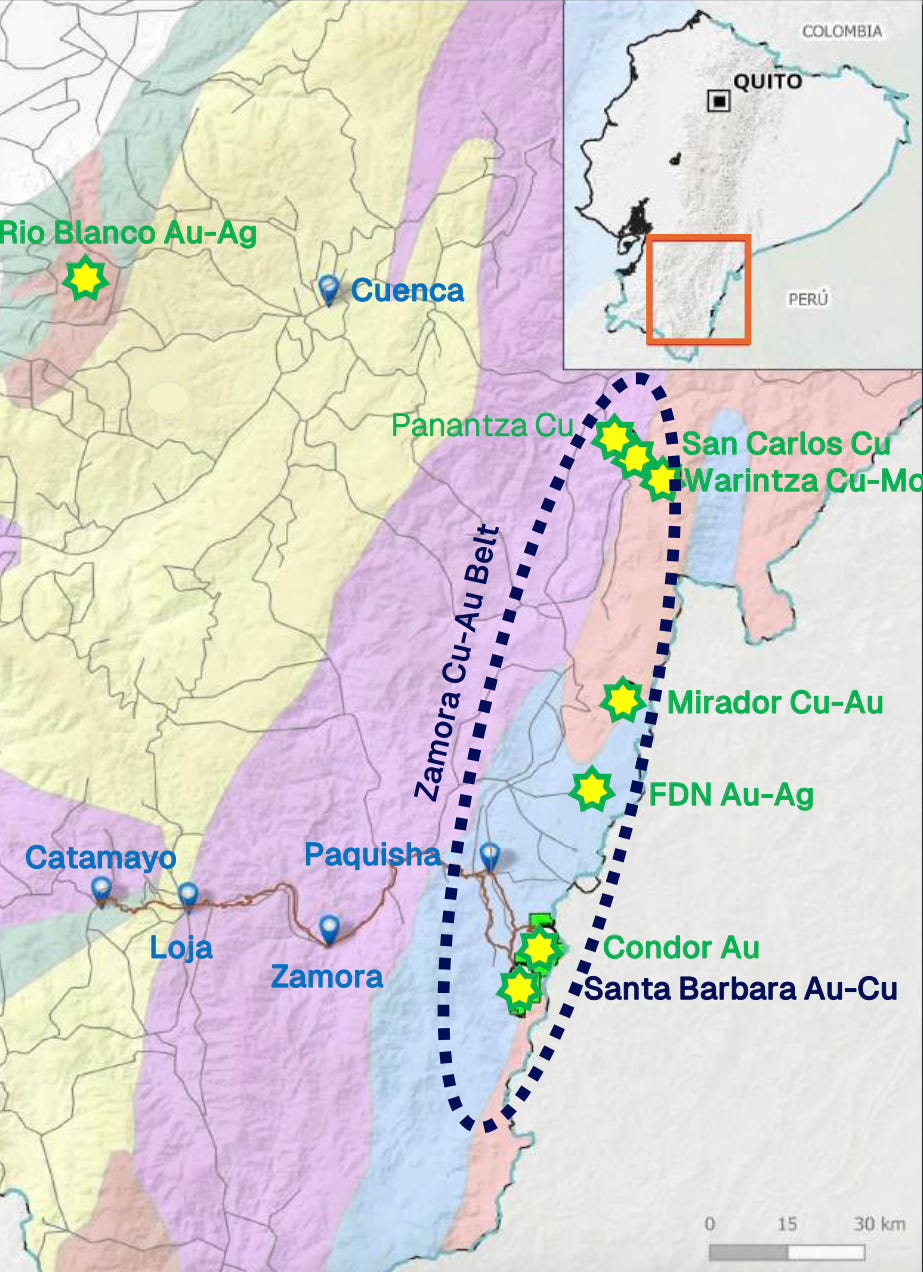
The commissioning of Lundin Gold’s Fruta del Norte and the Mirador copper mine did more than establish two successful operations. They dismantled a long-held assumption that Ecuador’s mineral wealth would remain permanently trapped beneath political uncertainty. Investors could finally point to functioning, large-scale mines rather than geological models and feasibility studies. That distinction matters because mining is one of the few industries where precedent carries almost as much weight as discovery itself.
Once a jurisdiction proves it can build one world-class mine, questions begin to change.
Discovery creates excitement. Production creates credibility.
Banks become more willing to finance projects, skilled labour follows opportunity and infrastructure quietly improves.
Ecuador still has genuine obstacles. Environmental disputes remain contentious. Community consultation carries increasing weight. Illegal mining continues to present challenges in parts of the country. Anyone presenting Ecuador as a risk-free destination is selling something.
Capital Rarely Moves First
One of the more persistent myths in financial markets is that institutional capital possesses some extraordinary ability to identify opportunities before everyone else.
Most of the time it does the opposite.
Large mining companies seldom pioneer new jurisdictions. They validate them.
The pattern repeats across commodity cycles. Smaller explorers absorb the geological uncertainty. Early developers wrestle with permitting, infrastructure and financing. Only after those hurdles begin to disappear do the majors arrive with billion-dollar balance sheets and declarations of strategic conviction.
Ecuador appears to be entering precisely that phase.
Recent acquisitions have offered a useful clue. Jiangxi Copper’s purchase of SolGold and CMOC’s acquisition of Lumina Gold were not speculative wagers on untested geology. They were calculated decisions to secure long-life copper and gold assets in a jurisdiction beginning to look considerably more mature than its reputation suggests.
Jurisdictional reputations have a habit of lingering long after reality has moved on.
The Questions Have Changed
That changing backdrop helps explain why Auro Metals deserves a closer look.
The company did not arrive with a greenfield exploration story or a conceptual target buried beneath optimistic investor presentations. Its acquisition of the Santa Barbara project immediately altered the discussion.
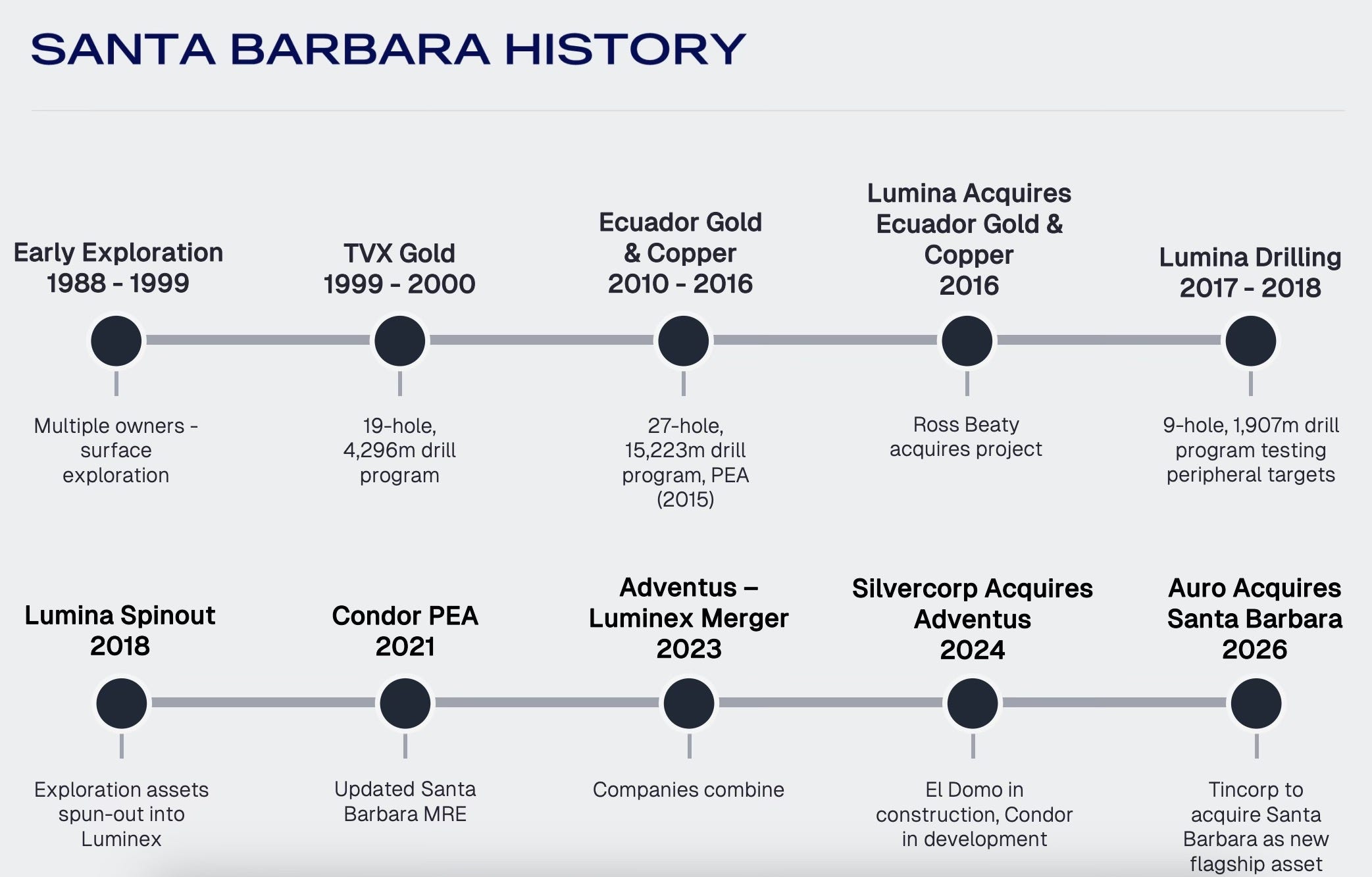
Santa Barbara already hosts a 4.1Moz gold resource alongside nearly 500Mlb of copper, supported by more than 22,000 metres of drilling.
That changes the questions.
Santa Barbara no longer has to prove that mineralisation exists.
The discovery phase is over. The proving-up phase has begun.
It has to demonstrate what sort of deposit it ultimately becomes.
Junior explorers spend years trying to answer the first question. Companies fortunate enough to answer it successfully begin wrestling with an entirely different set of uncertainties. How continuous is the mineralisation? Can confidence in the resource be upgraded? Does the geology support a mine capable of generating attractive returns through commodity cycles rather than only at peak prices?
What the Drill Bit Is Actually Saying
Every junior miner dreams of making a discovery. The better companies eventually graduate to proving one.
Discovery holes attract headlines. Confirmation drilling attracts far less attention, despite often telling investors far more. Investors already know there is mineralisation. What they want to know now is whether the deposit becomes more predictable with every hole drilled.
The early signs have been encouraging.
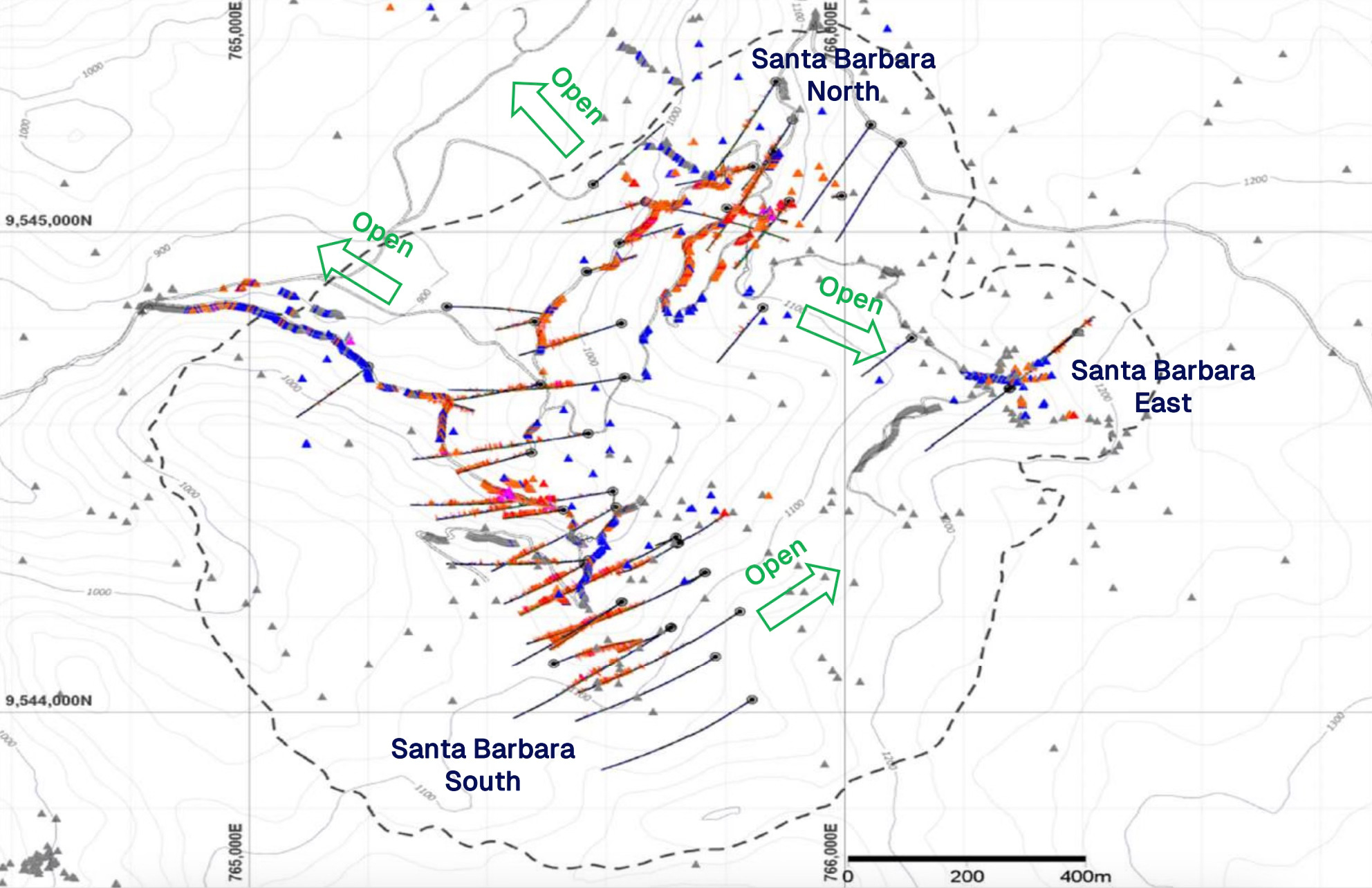
The first three holes intersected broad mineralisation from surface, reinforcing continuity across the system rather than producing an isolated headline intercept.
Auro is fully funded for multiple rounds of drilling, initially focused on infilling the deposit before expanding to step-out drilling. Stay tuned for more results throughout the rest of the year.
Plenty of work remains before Santa Barbara resembles a mine.
Mining has a habit of humbling companies that begin celebrating too early.
Yet the questions surrounding Santa Barbara increasingly feel commercial rather than geological.
That is progress.
Scarcity Has a Geography of Its Own
Copper's demand story is now well understood. Supply is becoming the more interesting question.
Supply is less straightforward.
The largest producing regions are wrestling with declining grades, ageing mines and longer permitting timelines. New discoveries have become rarer, not because geologists have forgotten how to find ore, but because the obvious ground has largely been explored.
That scarcity is changing how mining companies think about jurisdictions that once sat outside the mainstream.
Ecuador is one of them.
The attraction is not simply its geology, although few dispute the quality of the Andean belt running through the country. It is that meaningful discoveries can still be made in districts that remain relatively underexplored compared with neighbouring Peru and Chile. When the pool of Tier One assets becomes progressively smaller, countries previously regarded as peripheral begin moving towards the centre of the conversation.
Not All Porphyries Are Created Equal
Most porphyry deposits share one characteristic: they are large and base metal dominant.
Santa Barbara sits at the other end of the spectrum—a high-grade, gold-dominant porphyry. In geological terms, that is an uncommon combination.
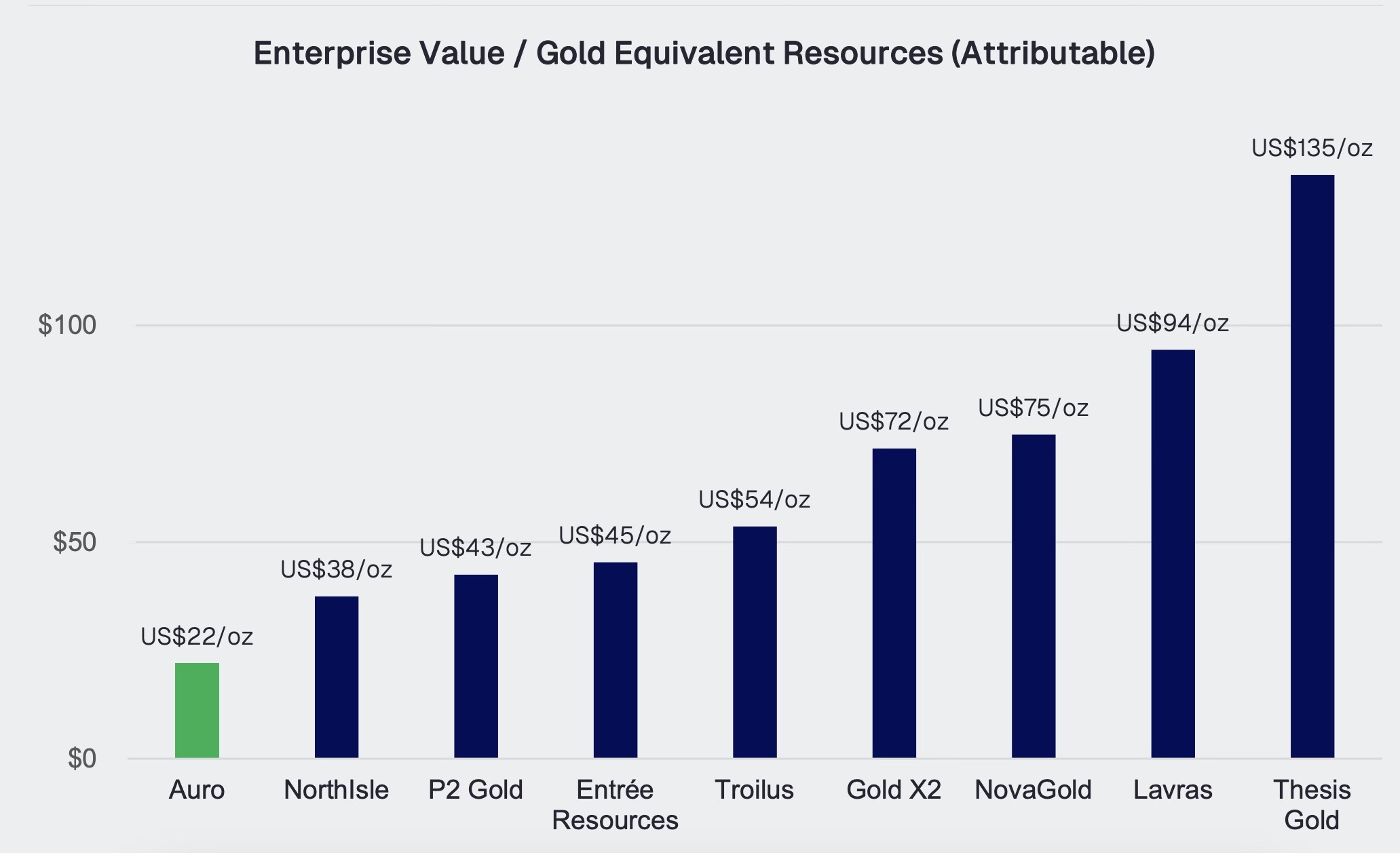
The market has a habit of assigning premium valuations to scarcity. High-grade gold porphyries sit among the rarest configurations in the deposit class. NovaGold’s Donlin Gold Project and Troilus Gold’s namesake asset are good analogues.
Santa Barbara has not yet earned that recognition.
Reputations Lag Reality
Auro still trades more like a company trying to prove itself than one sitting on an established multi-million-ounce resource. That disconnect may persist for some time. Junior mining is rarely efficient when it comes to pricing uncertainty.
For years, Ecuador carried a jurisdictional discount. Some of that discount remains as no jurisdiction is risk-free. Political cycles will continue. Environmental disputes are unlikely to disappear. Community engagement will remain part of doing business in the country.
The question is whether those risks are still being priced as though Ecuador were the same country investors dismissed fifteen years ago.
That feels increasingly difficult to argue.
The ownership register tells its own story. Strategic shareholders and insiders control a meaningful proportion of the company, while institutional ownership remains limited. That leaves plenty of room for the shareholder base to evolve if execution continues and confidence in the project builds.
The more interesting question is whether the market is asking the right questions.
Increasingly, it seems to be.
The Map Is Beginning to Change
For decades, Ecuador was treated as a geological curiosity rather than a mining destination. Everyone acknowledged the rocks. Few trusted the country.
That gap is narrowing.
Not because the geology has changed, but because perception finally has.
There is a tendency in financial markets to assume that once a story becomes obvious, the opportunity has already passed. Mining rarely works that way. Jurisdictions mature slowly. Confidence accumulates over years, sometimes decades, before suddenly feeling self-evident in hindsight.
That is where Ecuador appears to stand today.
Execution will determine whether Santa Barbara fulfils its potential.
But there is a broader shift taking place beneath the surface.
Capital is beginning to redraw a map it has carried around for years.
Which brings us back to the Andes.
Those mountains have not changed since investors first looked past Ecuador in favour of its neighbours. The porphyry systems running beneath them were there when the country struggled for credibility, and they remain there now that credibility is slowly being earned. The rocks were patient. The market, as it often does, arrived later.
Disclosure: This article has been commissioned by Auro Metals (TSXV: AURO). The views expressed are that of Matt Oliver, Oliver Market Intelligence and reflect his own analysis. This article is provided for informational purposes only and does not constitute financial or investment advice. Investments are inherently speculative and involve risk, including the loss of capital.