


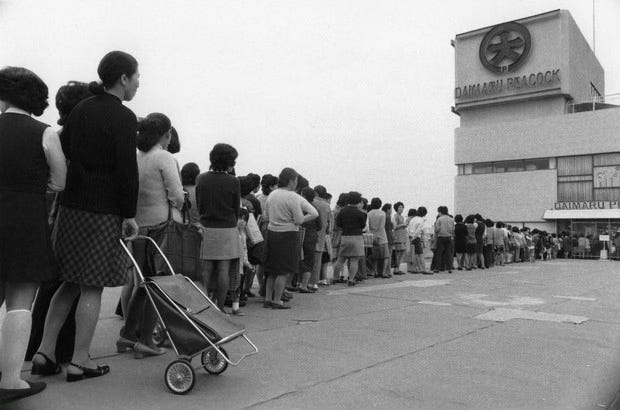
In the autumn of 1973, queues began forming outside supermarkets across Japan.
Not outside banks. Not outside petrol stations. Outside grocery stores.
The country had become gripped by panic buying after the Arab oil embargo sent shockwaves through the global economy. Toilet paper disappeared from shelves. Housewives bought in bulk. Rumours spread faster than facts. Japan’s post-war growth machine, which had been built on imported energy flowing smoothly through maritime trade routes, suddenly looked fragile in a way many people had never considered before.
The deeper anxiety was not really about toilet paper. It was about dependence.
Oil had to travel. Coal consumed enormous physical space. Gas required pipelines and political stability. Entire industrial economies rested on systems that only worked if shipping lanes remained open and geopolitics stayed cooperative.
Japan understood the implication earlier than most. An island nation with few domestic energy resources could not afford to assume global stability was permanent.
So it leaned harder into nuclear power.
Not because uranium was fashionable. Not because it was environmentally virtuous. And certainly not because the economics were universally loved at the time. Japan embraced nuclear because uranium possessed a strategic characteristic that almost no other fuel source could match.
It could be stored.
A relatively small quantity of fuel could power reactors for years. Utilities could hold inventory without requiring sprawling infrastructure or continuous logistical movement. In strategic terms, uranium created breathing room. Time became inventory.
The modern energy conversation often collapses into arguments about decarbonisation targets, renewable penetration rates or electricity demand forecasts. Those things matter, but they are not the entire story. Beneath the climate narrative sits something older and more instinctive: countries do not like feeling exposed.
Russia’s invasion of Ukraine reminded Europe what dependency can look like when pipelines become geopolitical leverage. Shipping disruptions in the Red Sea reminded markets how quickly maritime assumptions can deteriorate. The growth of AI infrastructure and data centres is now colliding with electricity grids that already strain under peak demand.
Reliability has returned to the conversation.
And reliability changes how governments think.
