
Factories Before Fighters
When the United States entered the Second World War, military planners quickly realised that air superiority would determine the shape of the conflict long before the war itself reached its conclusion. The country understood what needed to be built. Aircraft production targets were raised almost immediately. Political urgency arrived fast.
Industrial capacity did not.
America’s wartime advantage was never simply technological. It emerged from an extraordinary reorganisation of physical systems. Aluminium production had to scale aggressively. Rail infrastructure had to be redirected toward industrial transport. Entire manufacturing regions were rebuilt around machine tooling, assembly lines and component supply chains. Labour forces were trained at astonishing speed. New factories appeared across the country before the aircraft they were designed to produce had even left the drawing board.
Everything depended on throughput.
The bottleneck sat in the time required to transform industrial ambition into industrial reality.
That tension is beginning to surface in copper.
The world has already committed itself to electrification, AI infrastructure, renewable expansion and large-scale grid reconstruction. Governments understand the direction of travel. Corporations understand it. Capital markets understand it. Demand is no longer hypothetical.
The uncertainty now sits elsewhere. It sits inside the physical machinery required to support that demand.
And that machinery moves slowly.
A Market Still Looking Backwards
For most of the past two decades, copper traded inside a relatively familiar commodity framework. Demand strengthened during periods of industrial expansion, prices moved higher, producers increased investment, supply eventually arrived and balance returned. Investors became conditioned by that rhythm because, historically, it was broadly true.
But those assumptions were built during a very different phase of mining development.
Ore grades were materially higher. Deposits were easier to access. Political resistance was lower. Environmental permitting was less restrictive. Energy costs were cheaper. Large discoveries still emerged frequently enough to preserve confidence that shortages would eventually resolve themselves through investment and time.
That flexibility has been deteriorating for years.
The International Copper Study Group now projects a 150,000 tonne market deficit in 2026 after previous surpluses. Most commentary naturally focuses on the deficit itself because deficits create clean narratives. Prices rise. Inventories tighten. Traders reposition.
Yet the more revealing shift is structural rather than cyclical.
Supply is still expanding. Mine production continues rising modestly. Refined output is still growing as well. Nothing resembles the kind of dramatic collapse usually associated with commodity crises.
Instead, the entire system appears to be losing responsiveness.
That distinction matters because slow industrial systems behave differently from broken ones. They absorb stress poorly. Small disruptions begin carrying disproportionate consequences because spare capacity quietly disappears in the background.
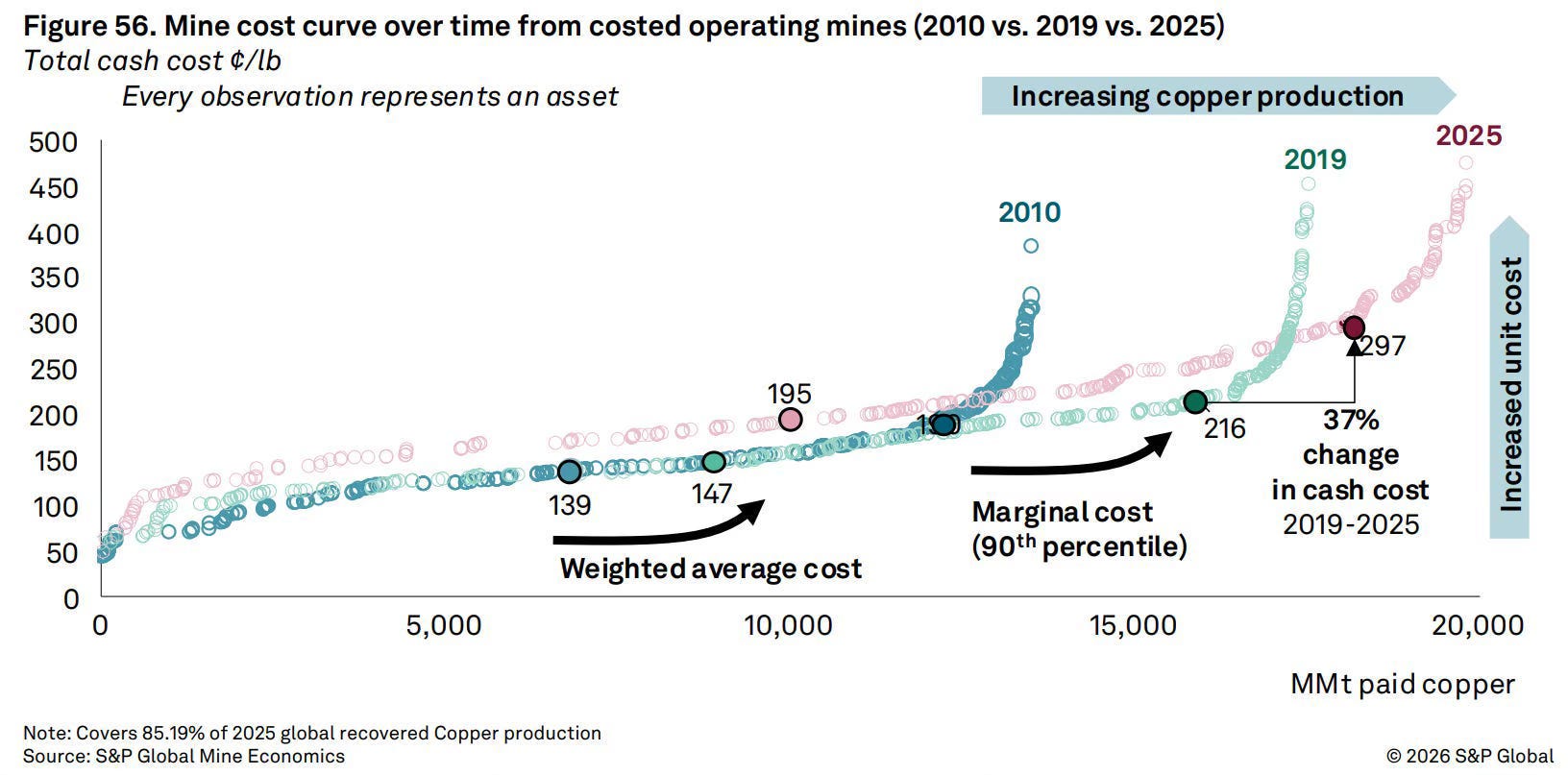
Copper mining increasingly resembles a battle against declining geological quality. Ore grades across major producing regions have drifted toward 0.6% or 0.7%, forcing companies to process vastly larger quantities of material for the same level of output. Energy requirements rise. Water requirements rise. Infrastructure requirements rise alongside them.
The copper remains underground.
Extracting it has become a far heavier industrial exercise than markets appear willing to acknowledge.
The Long Delay Between Discovery and Production
Mining executives often speak about new projects in language that sounds almost detached from financial markets entirely. Timelines stretch beyond election cycles, commodity cycles and, in some cases, management careers.
In parts of the developed world, permitting alone can consume more than a decade. Environmental reviews, indigenous negotiations, water access disputes, transmission infrastructure, local political opposition and financing uncertainty all create friction before construction even begins.
Then construction starts.
Then cost overruns emerge.
Then labour shortages appear.
Then comes commissioning, operational ramp-up and the inevitable technical setbacks that accompany large industrial projects.
Markets continue discussing copper supply as though higher prices can rapidly pull new material into existence. The physical world increasingly suggests otherwise.
This is one reason the comparison with oil during the early 2000s feels increasingly relevant. Energy markets during that period did not suffer from outright supply collapse. Production still expanded globally. But the nature of expansion changed. New projects became slower, more expensive and operationally fragile. The industry pushed further into deepwater extraction, tar sands and geopolitically unstable regions where disruptions became routine.
Flexibility disappeared first.
That was the beginning of the problem.
Copper now appears to be drifting into a similar phase where the system continues growing, but loses the elasticity required to respond comfortably to sustained demand pressure.