


When geologists evaluate an exploration project, they usually begin with the rocks. Investors tend to do the same. Drill results, geological maps and historic sampling dominate the conversation because they appear to offer the clearest indication of whether a discovery is taking shape.
The legal ownership of the project rarely receives the same attention.
Discoveries do not create value on their own. They reveal it. Whether shareholders ultimately benefit depends just as much on the agreements governing the ground as the geology beneath it. Royalties, option agreements and exploration commitments can all shape the economics of a project long before the first ounce is defined.
Some of the most important changes an exploration company can make never involve a drill rig. They happen in boardrooms, legal offices and land registries, quietly altering the quality of an asset without changing the rocks themselves.
Silver Spruce Resources’ recent transaction at its Pino de Plata project in Chihuahua falls squarely into that category.
Nothing beneath the mountains has changed. The mineral system is exactly where it was before. What has changed is the ownership structure sitting above it.
For investors, that may prove just as significant as the next drill result.
Looking Beyond the Rocks
Markets reward visible progress.
A drill intercept can be measured, compared and modelled. Investors immediately begin estimating grades, ounces and valuations. Ownership attracts no such excitement. It usually sits buried in the legal section of a news release.
Most experienced mining investors eventually reach the same conclusion.
Discoveries create opportunities.
Ownership determines whether those opportunities belong to shareholders.
Across the junior mining sector, the point has become increasingly relevant. Years of constrained financing forced many companies to acquire projects through staged option agreements rather than outright purchases. These arrangements allowed exploration to continue, but they also introduced obligations. Deadlines had to be met. Exploration expenditure became mandatory. Future royalties remained attached to any discovery. Management decisions were shaped not only by geology, but by contractual calendars.
Sometimes those compromises are unavoidable.
They are never free.
Silver Spruce has now removed many of those constraints.
In July, the company completed an assignment agreement transferring full ownership of the four Pino de Plata concessions directly to Silver Spruce. The previous option structure has been replaced with outright ownership. According to the company, the transaction removes the former time limits attached to the agreement, eliminates underlying claim royalties and brings an end to mandatory exploration commitments. Registration of the transfer with Mexico’s Ministry of Mining is under way, while discussions with local landowners have resumed ahead of the next exploration programme.
None of this changes the geology.
It changes the decisions management can make.
Exploration rarely follows a straight line. Commodity prices change, financing windows open and close, and geological models evolve as new information emerges. Companies working against contractual deadlines often end up drilling because agreements demand it rather than because the geology does.
Outright ownership allows management to be patient.
Management can allocate capital when conditions justify it rather than when legal obligations demand it. Additional mapping, sampling or target refinement become strategic decisions instead of contractual necessities. If stronger financing markets emerge or silver prices improve, the company retains the flexibility to respond accordingly.
Its value is difficult to quantify.
It is also one of the few advantages that cannot be replicated by a successful drill hole.
A District That Continues to Attract Capital
Ownership, however, only matters if the underlying asset warrants it.
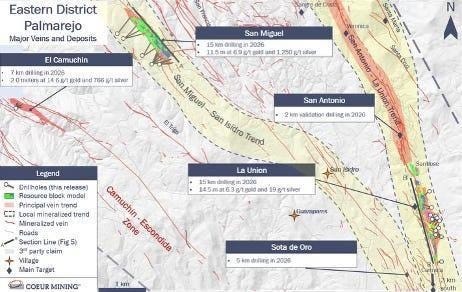
Pino de Plata lies within Mexico’s Sierra Madre Occidental, one of the world’s most productive precious metals provinces. More significantly, it sits roughly fifteen kilometres west of Coeur Mining’s Palmarejo operation, a mine that continues to attract substantial investment despite decades of production.
Earlier this year, Coeur announced the largest exploration budget in Palmarejo’s history, committing US$27 million and approximately 83 kilometres of drilling across the district. Palmarejo has been producing for nearly two decades, yet Coeur continues investing heavily in extending the mine’s life and exploring the wider district.
That does not make neighbouring projects valuable by association. Mining districts do not work through proximity. They work through fertility. Successful districts continue attracting capital because the geological conditions capable of producing major deposits rarely stop neatly at a property boundary.
Pino de Plata still has to prove its own economic potential, but it is operating within a district that continues to justify serious exploration spending by one of the industry’s established producers. That is a useful starting point.
What the Market Already Knows
Early-stage exploration is largely an exercise in eliminating uncertainty. The first question is whether a mineral system exists at all. Once that hurdle has been crossed, the challenge changes. Exploration becomes a search for where that system has concentrated enough metal, over sufficient scale and continuity, to create economic value.
Every round of geological work narrows that search.
The geological question at Pino de Plata is no longer whether the property hosts a mineral system. Years of mapping, sampling and interpretation have already answered that.
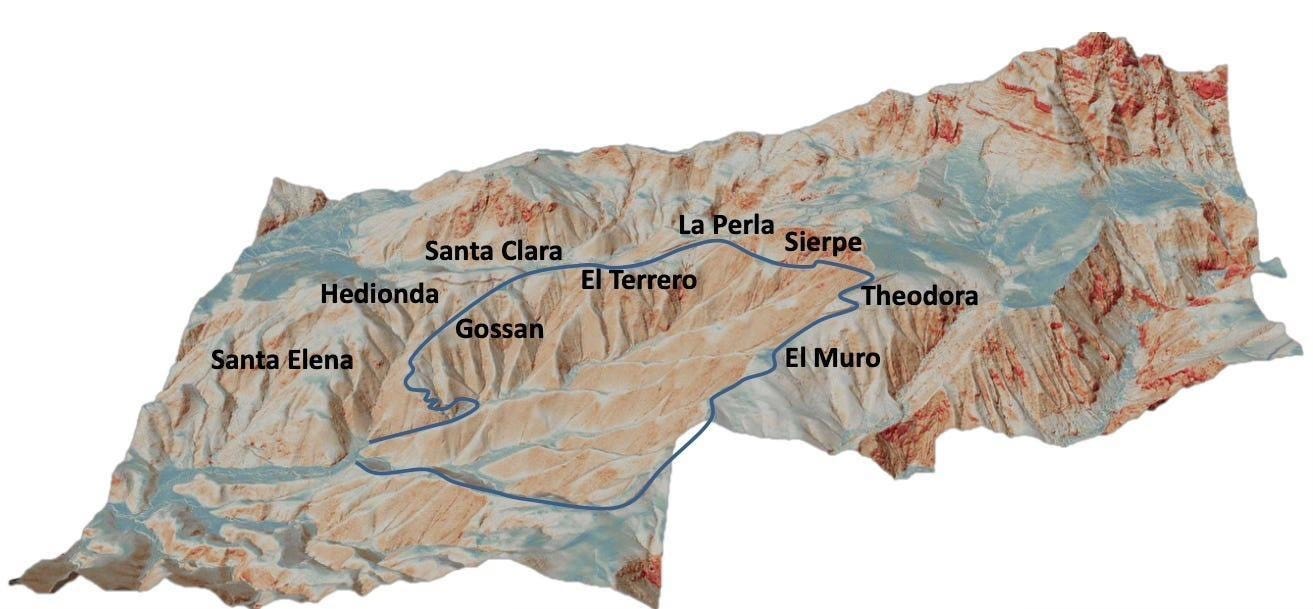
Surface work has outlined a mineralised footprint extending beyond one square kilometre. Historic sampling has identified high-grade silver accompanied by lead and zinc, while geological work has recognised multiple styles of mineralisation, including epithermal veins, carbonate replacement targets and skarn-style systems. The picture emerging is not of a single vein, but of a broader mineralising system capable of hosting multiple target styles.
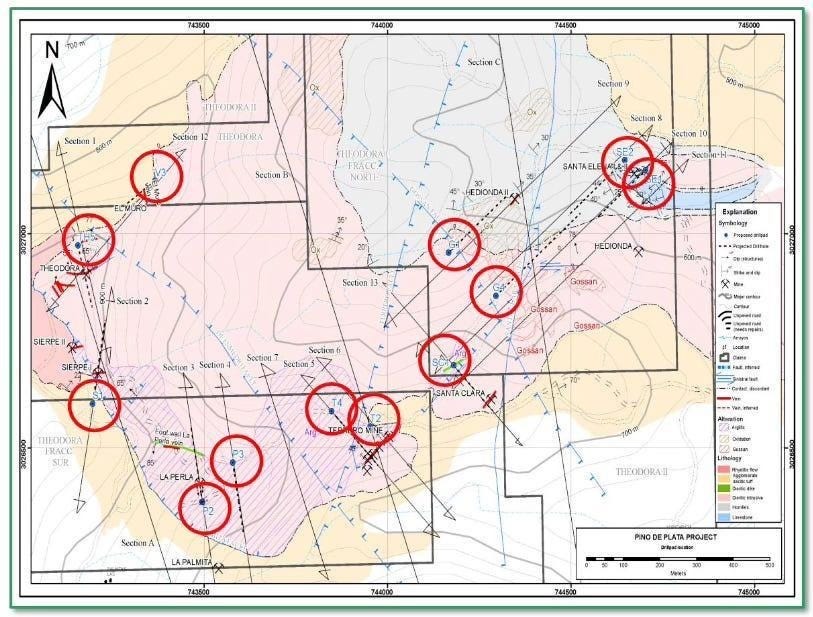
Silver Spruce has identified twelve targets for immediate Phase I drilling across the property, spanning epithermal, carbonate replacement, skarn and vein systems. Recent LiDAR interpretation, ArcGIS compilation and structural mapping have further refined those targets ahead of the planned drill programme. Environmental approval has already been secured for up to thirty drill pads.
By the time the first drill turns, much of the investment case has already been built.
Although investors often treat the first drill programme as the beginning of the story, in reality, that is usually the point where years of geological interpretation finally become testable.
Unsuccessful holes do not necessarily invalidate the geological model, just as successful ones rarely emerge by chance. They are the product of hundreds of decisions made long before the drill arrives on site.
Before the First Drill Turns
The next milestones at Pino de Plata are unlikely to generate the excitement associated with a major discovery.
Registration of the transferred concessions with Mexico’s Ministry of Mining remains under way. Discussions with local landowners have resumed, and the company is preparing for the next phase of field work before moving into Phase I drilling.
None of those developments will dominate market headlines.
They are precisely the kind of incremental steps that exploration companies must complete before discoveries become possible.
Investors naturally focus on the moment value appears to be created: the first significant intercept, the headline assay or the maiden resource estimate. Mining history suggests something different. Those moments rarely create value on their own. More often, they reveal value that has been quietly preserved through years of disciplined decision-making.
Silver Spruce’s recent transaction deserves more attention than it has received. They did not discover new geology. It improved the quality of the opportunity already sitting beneath it.
The silver beneath Pino de Plata is exactly where it has always been. What has changed is the company’s ability to decide how, when and under what conditions that opportunity is pursued.
Whether those rocks ultimately become a mine remains a question for the drill bit.
Whether shareholders fully participate if they do has already been influenced by decisions made above the ground.
Investors spend enormous amounts of time trying to identify the next discovery. Far fewer ask whether the company making that discovery will own it on the best possible terms.
In exploration, geology determines what is in the ground.
Ownership often determines what reaches shareholders.
Disclosure: This article has been commissioned by Silver Spruce Resources Inc. (TSXV: SSE). The views expressed are that of Matt Oliver, Oliver Market Intelligence and reflect his own analysis. This article is provided for informational purposes only and does not constitute financial or investment advice. Investments are inherently speculative and involve risk, including the loss of capital.
Such an excellent angle, and the perfect example. It's easy to look at grades and resources on drill results and get excited, but few investors bother to ask "who owns those ounces?". You can be diluted without share dilution, and not even know it if you don't do your research.