


Mining investors spend extraordinary amounts of time searching for new discoveries. The industry often creates more value by understanding old ones better.
Every major resource estimate begins life as an incomplete sketch. More drilling sharpens the picture. Engineering changes what can be mined. Metallurgy changes what can be recovered. The deposit itself has not moved an inch, yet the economics can look completely different a few years later.
Markets have always preferred stories that arrive suddenly. A major discovery. A takeover. A spectacular drill hole. The slower work of turning a geological idea into a financeable mine rarely attracts the same attention, even though it is often where the economics improve the most.
That slow reduction in uncertainty rarely attracts the excitement of a headline discovery. It is also where many successful developers quietly earn their re-rating.
CopAur’s Kinsley Mountain Project illustrates the point unusually well.
Why Developers Can Create More Value Than Producers
Producers offer exposure to current gold prices through operating cash flow. Developers offer something less settled. Their value depends on a sequence of future events: drilling, engineering, permitting, financing and construction. Each step can strengthen the project or expose a weakness that the earlier geological story concealed.
That uncertainty is why development companies can generate larger returns than established producers. It is also why so many destroy capital.
The mining industry has spent decades producing deposits that looked impressive in presentation decks and impossible in financing markets. A large resource can support a large mine plan, which supports a large capital estimate, which eventually requires a share count large enough to consume much of the upside. By the time construction begins, the original shareholders may own only a diluted memory of the discovery.
Investors have grown more sceptical of grand designs because they have watched ambition outrun balance sheets too many times. A smaller first operation can be less exciting on paper and more valuable in practice, particularly when it offers a realistic route through financing and permitting.
CopAur’s approach at Kinsley appears to reflect that discipline. Rather than attempting to develop every known ounce in a single operation, CopAur has concentrated initially on a smaller oxide heap-leach project. That reduces technical complexity and avoids prematurely incorporating the deeper sulphide resource, although the resulting capital requirement remains substantial relative to the company’s present size. The decision sacrifices headline scale. It may improve the odds of building something.
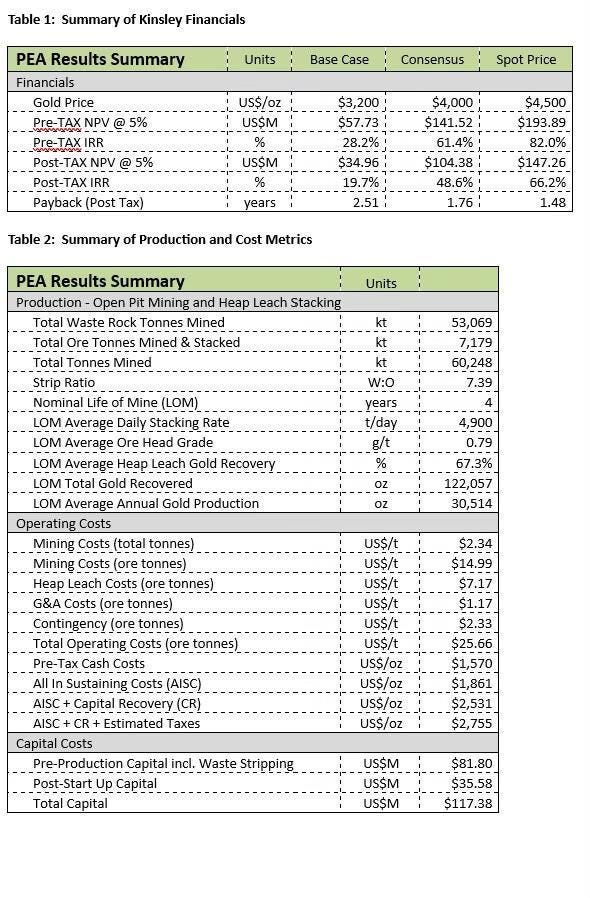
That trade-off sits at the centre of the investment case. The challenge is not a shortage of gold, but the capital required to build the first operation. The current mine plan must fund substantial infrastructure before recovering around 122,000 ounces, placing greater emphasis on future engineering, mine optimisation and efficient capital deployment than geology alone.
The Deposit Became Better Understood
Kinsley is not a speculative greenfield discovery waiting for the first proof that gold exists. The property previously produced approximately 138,000 ounces during the 1990s, giving it a mining history that many junior projects lack. Historical production does not remove the risks ahead, but it establishes that the mineralisation has already supported an operating mine.
The project has also become much better defined.
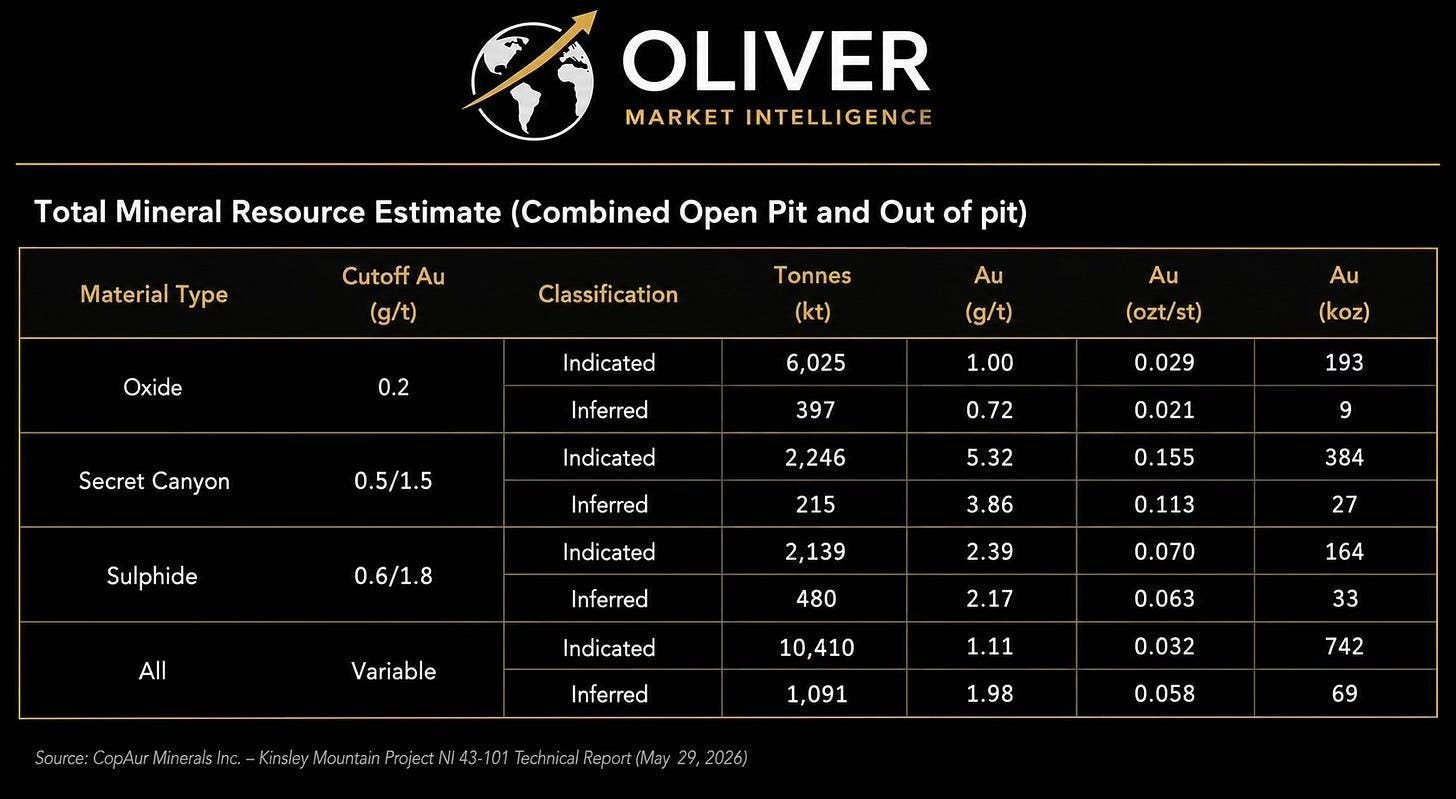
More than 20,000 metres of additional drilling, supported by updated geological interpretation, increased Kinsley’s reported mineral resource by 52%, bringing the project to roughly 742,000 indicated ounces and a further 69,000 inferred ounces. Within that total sits the Secret Canyon Zone, containing approximately 384,000 indicated ounces grading more than 5 grams per tonne.
The drill bit did not create those ounces. It reduced the fog around them.
A resource estimate is a map drawn from incomplete information. Early drilling gives geologists a rough outline. Further drilling fills in the blank spaces, changes the boundaries and occasionally reveals that the deposit is larger or more coherent than first thought. Engineers can then alter pit designs, mine sequencing and development priorities with greater confidence.
This is why the 52% increase matters beyond the promotional appeal of a larger number. A growing resource gives management more choices. Some ounces may extend the current plan. Others may support a later phase. Higher-grade zones may change the economics of processing routes that were previously difficult to justify.
The asset has not merely become larger. The range of possible mine plans has widened.
Nevada adds another layer to that argument. Mining projects fail for reasons that have nothing to do with geology, and jurisdiction often determines how many of those risks arrive at once. Nevada offers established infrastructure, experienced labour, a long operating history and a regulatory process that the industry understands. Permits are never automatic, but the rules are clearer than in many emerging jurisdictions where tax regimes, politics and ownership rights can move without warning.
Nevada does not eliminate permitting risk, particularly where federal land and environmental approvals are involved. It does, however, offer an established mining ecosystem, experienced service providers and a regulatory framework familiar with large-scale mine development.
Kinsley still has to earn its way through that system. It does not have to invent the system around it.
Why the First Ounces Carry the Heaviest Cost
The current PEA concentrates on near-surface oxide material suitable for heap-leach processing. That keeps the initial concept relatively straightforward and avoids forcing the deeper sulphide resource into a development plan before the engineering is ready.
A larger operation might have produced a more impressive annual output and a longer headline mine life. It would also have required more capital, more technical work and a greater tolerance for execution risk. The mining sector is full of projects that tried to solve the entire deposit in one study and discovered that financial markets were less patient than geologists.
The first mine carries the heaviest burden because it must pay for almost everything from scratch. Roads, power, processing infrastructure, permitting and operating teams all have to be established before the first ounce generates revenue. Later ounces can enter a very different economic environment.
Management has also indicated that existing significant shareholders have expressed interest in participating in future project financing. While those discussions do not constitute financing commitments, they provide additional context when considering how the company intends to advance beyond the preliminary study stage.
A discovery beside an operating mine is worth more than an identical discovery in the middle of nowhere. The plant is already built. The access roads already reach the site. Management understands the metallurgy and the workforce understands the orebody. Expansion is rarely easy, but it no longer begins from zero. Not every part of the initial development would transfer directly to a future sulphide operation, but roads, utilities and site infrastructure could still provide a foundation for later expansion.
This is where Kinsley’s resource growth becomes more than a geological achievement. If the first oxide operation reaches production, additional ounces may be developed against an existing base rather than through another complete financing exercise. The deeper sulphide material remains technically unresolved, and investors should resist treating it as future production before the engineering supports that conclusion. Its presence still matters because it gives CopAur something many short-life projects do not possess: a visible second question after the first mine is built.
What Is the Market Really Discounting?
Development companies should trade below the headline values in economic studies. A PEA is preliminary by definition. It includes assumptions that may change, resources that have not yet become reserves and cost estimates that will face the pressure of time, inflation and further engineering.
CopAur still has to advance permitting, refine the mine plan, secure financing and prove that the operation can be built within a budget that protects rather than punishes shareholders. Gold prices may weaken. Construction costs may rise. Metallurgical performance may disappoint. A small project can be easier to finance than a large one and still fail to attract acceptable terms.
The discount is therefore rational.
What remains open for debate is whether the market is applying that discount to the development risk or to the entire geological opportunity.
Kinsley’s current mine plan captures only part of the resource and reflects a deliberate starting point rather than the outer limit of the deposit. Additional oxide drilling could extend the initial operation. Engineering work could alter recoveries, costs or sequencing. The sulphide system could become more valuable under a different gold price or processing route. None of these outcomes is guaranteed, but they belong in the valuation conversation.
Markets are good at pricing what has already been published. They are less consistent at pricing what a project may become after several years of technical progress.
The Drill Bit Still Has Work to Do
The next phase will be less dramatic than the announcement of a 52% resource increase, but probably more informative.
Further drilling will show whether the near-surface oxide mineralisation can support a longer operation without materially changing the processing concept. Engineering work will test whether the assumptions in the PEA survive closer scrutiny. Permitting milestones will reveal whether Kinsley can move from an economic study into a financeable project.
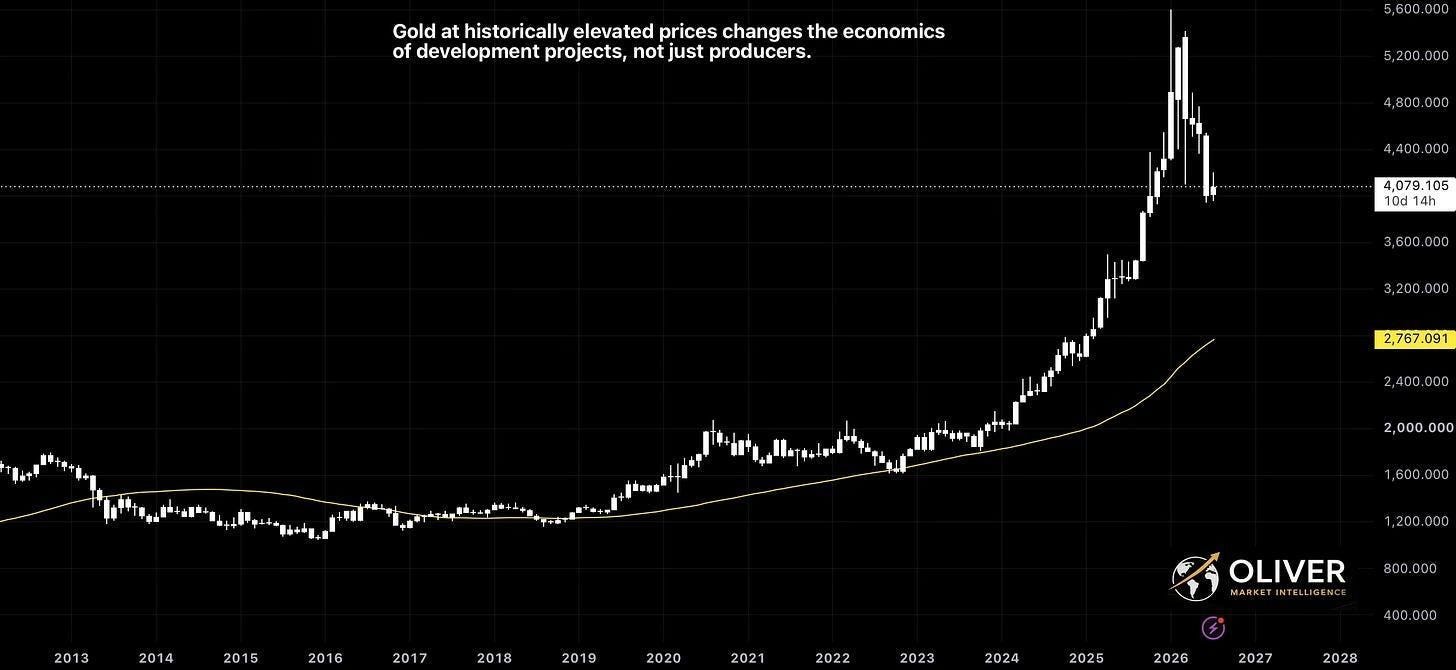
The gold price will sit above all of this, quietly changing the value of the same rock.
Developers often carry greater leverage to rising gold prices than mature producers because a higher price can alter the mine itself. Material that once sat below the economic cut-off may enter the plan. Marginal zones become more relevant. The resource does not physically expand, but the mineable portion can.
That leverage works in reverse as well. A lower gold price can expose how much of the investment case depended on favourable assumptions. Kinsley will have to prove that its development logic survives more than one commodity scenario.
A Mine Is Built in Stages, Then Judged All at Once
Markets will continue to quote the four-year mine life because it is simple and because simple numbers travel faster than technical nuance.
Kinsley will not be built in that shorthand. It will be built through permit applications, metallurgical testing, financing negotiations, revised pit shells and drill holes that slowly alter the map. The project will either improve through that process or reveal that the current plan already captures most of its value.
That uncertainty is the price of investing before production.
CopAur has not discovered a new deposit. It has spent the past several years reducing the uncertainty around one it already owned. Whether that work ultimately proves enough to justify a higher valuation remains for the market to decide. What seems harder to dispute is that Kinsley is better understood today than it was only a few years ago, and in mining that often marks the point where geology begins to give way to engineering, permitting and execution.
The first number tells us where CopAur intends to begin.
It does not yet tell us where Kinsley ends.
Disclosure: This article has been commissioned by CopAur Minerals Inc. (TSXV: CPAU). The views expressed are that of Matt Oliver, Oliver Market Intelligence and reflect his own analysis. This article is provided for informational purposes only and does not constitute financial or investment advice. Investments are inherently speculative and involve risk, including the loss of capital.
One of the most notable aspects of this publication, and one that stands out to me, is the detailed review of CopAur Minerals’ Kinsley Mountain project, where more than 20,000 meters of additional drilling increased the reported mineral resources by 52%, bringing the total to approximately 742,000 indicated ounces and 69,000 inferred ounces.
Thank you for this interesting publication.