


There is an advantage in buying a mine after somebody else has spent years doing the expensive work of understanding it.
The roads have been built. The rock has been drilled. Metallurgy has been tested. Engineers have produced studies, revised them and produced them again. Permits have been pursued. Tens of millions of dollars and thousands of hours have disappeared into turning a geological idea into something resembling a mine.
Then, occasionally, ownership changes before the mine itself is built.
Silvercorp Metals now finds itself in this position in Kyrgyzstan.
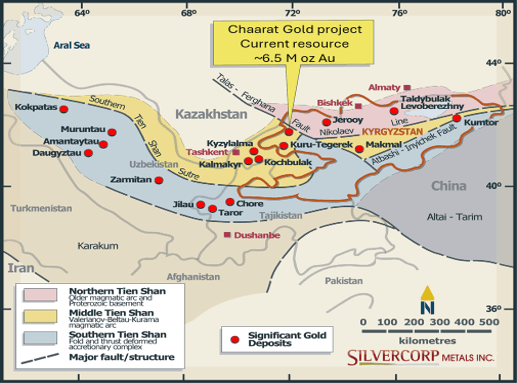
In January, Silvercorp completed the acquisition of Chaarat ZAAV after paying US$92 million to Chaarat Gold Holdings. ZAAV was subsequently converted into a joint venture, with Silvercorp holding 70% and acting as operator while state-owned Kyrgyzaltyn holds a 30% free-carried interest. The transaction gives Silvercorp control of the Tulkubash and Kyzyltash gold projects in the Tien Shan belt, together with surrounding exploration licences.
What it acquired was hardly untouched ground. Chaarat had spent roughly US$174 million on the projects since 2002, including US$77 million on drilling, US$36 million on independent studies and US$22 million on roads, camp facilities and other construction. Around 188,000 metres had already been drilled across Tulkubash and Kyzyltash.
As part of the acquisition Silvercorp was also able to reach an agreement with the Kyrgyz Government to extend the mining licence from 2032 to June 2062, following which Silvercorp made a US$60 million payment to the Kyrgyz government. Thirty additional years of tenure gives Silvercorp considerably more room to develop what it has acquired.
Silvercorp is arriving late in the geological story, but potentially at a much more interesting point in the economic one.
Tulkubash Comes First
The project makes more sense when viewed as a sequence rather than two standalone deposits. Tulkubash comes first: a permitted, relatively straightforward development capable of establishing production and potential cash flow. Behind it sits Kyzyltash, larger, technically more demanding and potentially far more consequential.
Tulkubash is the simpler proposition. It is a fully permitted oxide gold deposit designed around conventional open-pit mining and heap leaching. The planned operation would process roughly four million tonnes annually, with previous work indicating gold recoveries around 74 to 76%. Silvercorp envisages production of approximately 100,000 to 110,000 ounces per year.
Tulkubash therefore gives Silvercorp something mining acquisitions frequently lack: an actionable route towards production.
In June, the company announced a US$196.3 million budget covering construction at Tulkubash and initial work at Kyzyltash, with US$57 million forecast to be spent during 2026 and US$139 million in 2027. Construction at Tulkubash includes the open pit, crushing facilities, heap-leach system, ADR plant and supporting infrastructure.
Tulkubash, however, is only the opening act.

Where the Scale Changes
Kyzyltash changes the scale of the investment case.
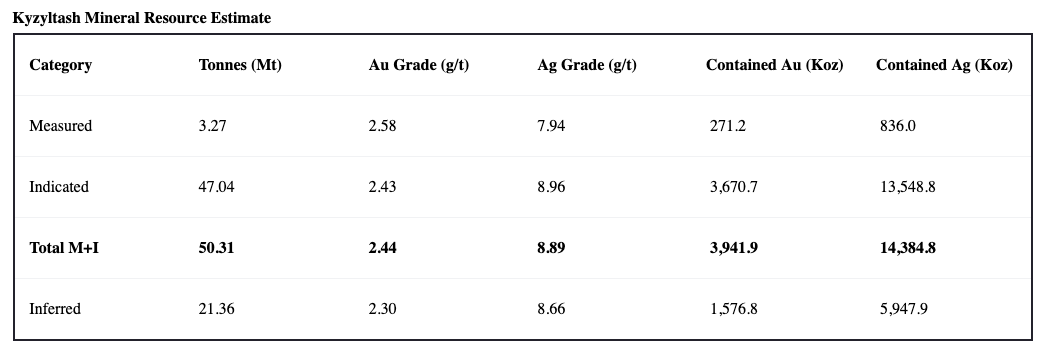
Silvercorp’s current mineral resource estimate contains 50.31 million tonnes of measured and indicated material grading 2.44 g/t gold, equivalent to approximately 3.94 million ounces. Another 21.36 million tonnes grading 2.30 g/t sits in the inferred category, containing approximately 1.58 million ounces.
Current plans envisage a three to four million tonne-per-year open-pit and underground operation using flotation, BIOX and CIL processing. Earlier work contemplated eventual production of roughly 190,000 to 230,000 ounces annually over approximately 18 years, although Kyzyltash remains at an earlier study stage and is not yet permitted for exploitation.
The two deposits therefore serve different purposes. Tulkubash provides the nearer-term development route. Kyzyltash provides scale.
Earlier development plans contemplated roughly US$400 million of investment at Kyzyltash, potentially funded by cash flow from Tulkubash. If Tulkubash performs as intended, the first mine could therefore help finance the development of the much larger resource sitting behind it.
Silvercorp is already drilling to find out how far that scale extends.
The First Test of Kyzyltash
The company’s first drilling at Kyzyltash has already produced a 212.5-metre intersection grading 1.68 g/t gold. Step-out drilling has returned further mineralised widths while identifying previously unknown parallel structures. The Main Zone remains open at depth and across more than 3.6 kilometres of strike.
Those initial results came entirely from within the existing mining licence, covering approximately seven square kilometres. Surrounding it are another 27.42 square kilometres of exploration licences hosting areas including Karator and Ishakuld. Silvercorp’s current Kyzyltash drilling programme has not yet tested that wider ground.
During 2026, the company plans between 50,000 and 60,000 metres of drilling at Kyzyltash, followed by another 60,000 metres in 2027 to support further economic and feasibility work.
This is where the chronology becomes more revealing than any single drill result.
Silvercorp completed the acquisition in January. Within months, it had secured a licence extension running to 2062, committed almost US$200 million towards development and initial Kyzyltash work, mobilised a substantial drilling campaign and begun reporting results from a resource that remains open.
The company did not buy Kyrgyzstan simply to spend another decade studying it.
Tulkubash gives Silvercorp a project it can begin turning into a mine. Kyzyltash gives it something that may take years of drilling and engineering to fully understand.
The roads have already been built and nearly 188 kilometres of drilling completed.
Silvercorp’s job now is to discover how much of the difficult work was already done, and how much more value there is to surface.
Disclosure: This article has been commissioned by Silvercorp Metals (NYSE/TSX: SVM). The views expressed are that of Matt Oliver, Oliver Market Intelligence and reflect his own analysis. This article is provided for informational purposes only and does not constitute financial or investment advice. Investments are inherently speculative and involve risk, including the loss of capital.