


Last month, we wrote that rocks don’t read borders.
The phrase was meant literally. The great Andean mineral belts running through Chile and Peru do not reach Ecuador, glance at a political map and turn around. The tectonic forces responsible for some of the world’s richest copper and gold deposits carried on north regardless of which government would eventually claim the ground above them.
Investors have always paid much closer attention to the border.
For years, that left Ecuador in an unusual position. Ecuador possessed geology that miners understood and a reputation investors distrusted. Our argument was that the gap had begun to narrow.
The rocks have remained exactly where they were. Ecuador has started changing the rules above them.
Ecuador Changes the Price of Exploration
In June, Ecuador materially rewrote its Mining Supervision and Control Fee, known locally as the Tasa de Supervisión y Control Minero.
The previous regime charged explorers according to concession hectares even while they were still searching for an economic deposit. Initial exploration, advanced exploration and economic evaluation could therefore attract fees before a project had generated a dollar of mining revenue.
Under ARCOM Resolution 006/26, initial exploration, advanced exploration and economic evaluation are exempt. The annual revenue requirement behind the broader fee regime was also cut from roughly US$221.75 million to around US$42-44 million.
Producing mines still face the fee. Fees remain and will be allocated according to ARCOM’s supervisory costs, while collection moves to Ecuador’s Internal Revenue Service. For explorers, the benefit is clear.
A hypothetical 20,000-hectare large-scale exploration portfolio could previously have faced roughly US$2.41 million annually under the old formula. While it remains in exploration, that liability is now zero.
Mining exploration consumes capital long before it produces revenue. Drilling, laboratories, geophysics, field crews and geological modelling all require cash years before investors know whether a mine will ever exist. Charging companies simply for holding exploration ground made that financing problem worse.
Ecuador has stopped doing it.
Santa Barbara Comes Into Focus
For Auro Metals, the change arrives during an increasingly active period at Santa Barbara.
Santa Barbara is no longer being drilled simply to establish whether a substantial mineralised system exists. That question was answered before Auro acquired the project. The work now concerns its shape, continuity and eventual quality.
Exploration at Santa Barbara stretches back to the late 1980s, with successive owners adding to the geological record. Before Auro’s current programme, 56 diamond holes and roughly 22,000 metres of drilling had contributed to the project database. The resulting 2026 resource contains 697,000 ounces of gold Indicated and another 3.418 million ounces Inferred, alongside meaningful copper.
Exploration at Santa Barbara stretches back to the late 1980s, with successive owners adding to the geological record. Before Auro’s current programme, 56 diamond holes and roughly 22,000 metres of drilling had contributed to the project database. The resulting 2026 resource contains 697,000 ounces of gold and 68 million pounds of copper in the Indicated category and another 3.418 million ounces of gold and 426 million pounds of copper in the Inferred category.
Mineralisation has already been defined across more than 1.2 kilometres north to south, around 600 metres east to west and to at least 900 metres depth. It remains open, while several targets across the wider property remain untested.
That changes how the latest assays should be read.
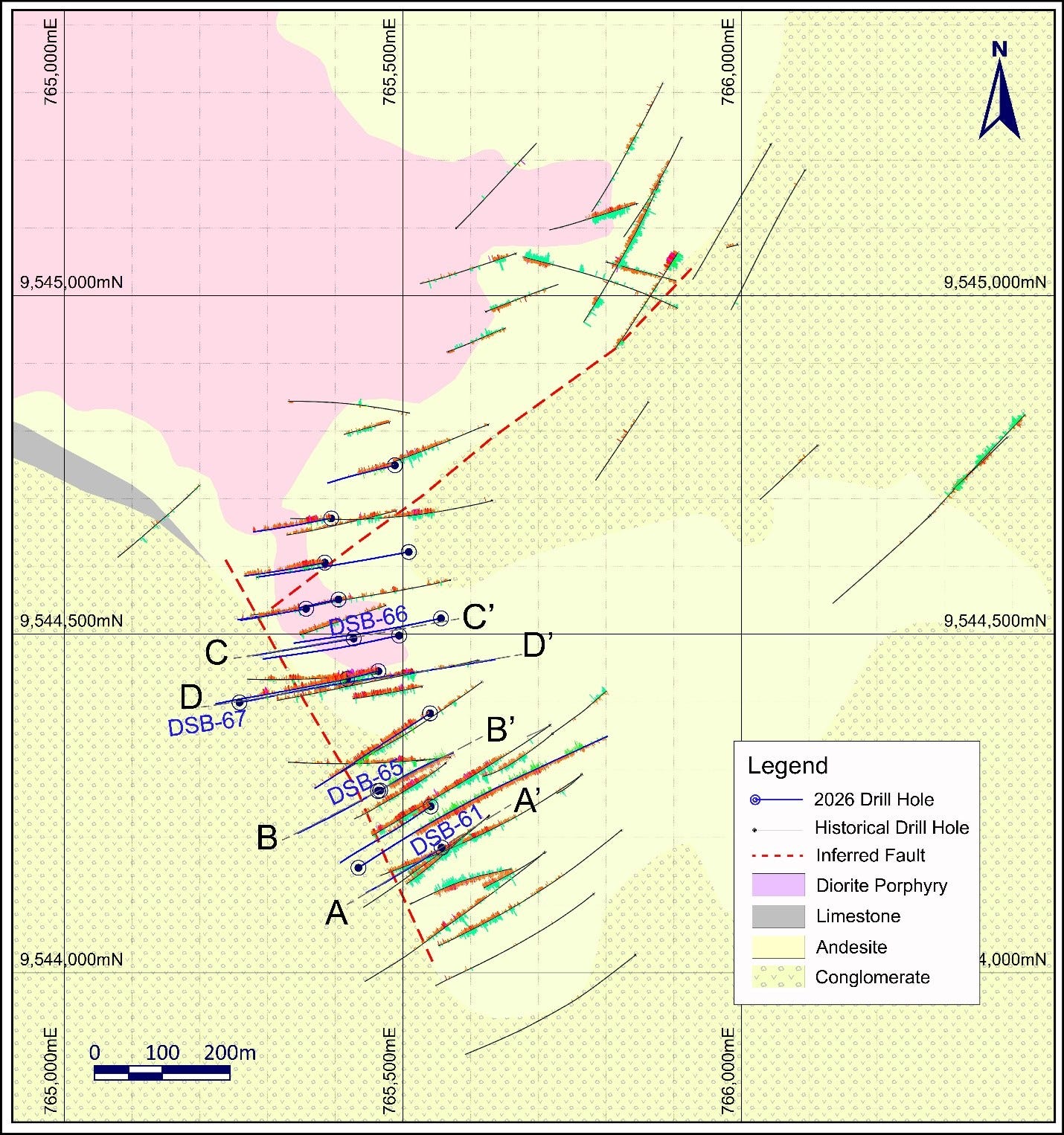
Auro’s Phase I programme is primarily infill drilling. Rather than chasing isolated spectacular holes beyond the existing resource, the company has been drilling between previous intercepts to test continuity across the deposit and lay the foundation to upgrade resources in an eventual resource update. Fresh material is also being collected for metallurgical work, with subsequent campaigns intended to test the system’s outer limits.
The fourth batch did exactly that. Three of four holes encountered broad mineralisation from surface or near surface, with DSB-61 returning grades above the existing Inferred resource across a substantial interval. Results also continued to show mineralisation extending up-dip, down-dip and at depth.

Santa Barbara is a large porphyry system whose current resource was constructed from comparatively modest historical drilling. Auro is filling gaps in that record before drilling more aggressively towards its edges.
For a project already containing more than four million ounces of gold across its Indicated and Inferred categories, successful drilling does not need to manufacture a new story every few weeks. It needs to make the existing one harder to dismiss.
When Discovery Is No Longer Enough
The questions investors ask change as an exploration project matures. Investors stop asking whether there is something underground and begin asking what can eventually be built from it.
The existing resource is already large enough that another isolated discovery hole would tell us less than it once might have. Continuity, grade, geometry and the ability to expand or improve confidence in the resource now carry greater weight. Phase I has begun providing that evidence. A future Phase II programme could show whether that pattern survives the next phase of drilling as Auro wraps up the Phase I programme.
The company has also moved from the OTC Pink Market to OTCQB, effective 29 July 2026, retaining AURFF as its US ticker alongside AURO on the TSX Venture Exchange. It does nothing to change the orebody. It does make Auro easier for US investors to access if Santa Barbara continues moving towards development.
When we first wrote about Auro, Ecuador’s attraction rested on a geological fact that politics could never change. The same Andean architecture responsible for enormous mineral systems elsewhere in South America also runs beneath Ecuador.
Since then, much of the movement has been above ground. Exploration costs imposed by the state have been reduced, while drilling has continued filling gaps in Santa Barbara.
The rocks still don’t read borders.
Investors, however, read regulations, assay tables and balance sheets.
Ecuador is giving them something different to read.
Disclosure: This article has been commissioned by Auro Metals (TSXV: AURO). The views expressed are that of Matt Oliver, Oliver Market Intelligence and reflect his own analysis. This article is provided for informational purposes only and does not constitute financial or investment advice. Investments are inherently speculative and involve risk, including the loss of capital.