


In 2025, BHP and Lundin Mining completed the acquisition of Filo Corp. for approximately C$4 billion.
The attraction was not a producing copper mine. Filo del Sol was still a development project high in the Andes along the Chile-Argentina border. What BHP and Lundin were buying was something increasingly difficult to manufacture inside a mining company: a large copper system that somebody else had already spent years finding.
They subsequently combined Filo del Sol with Lundin’s nearby Josemaria project, creating a district-scale development controlled through a 50:50 partnership.
The logic behind the transaction matters more than the headline price.
For most of mining history, growth began with exploration. Geologists searched, companies drilled and discoveries eventually became mines. That model still works. What has changed is the time required, and the scarcity of genuinely significant discoveries.
Copper miners have a geological problem.
They increasingly have a time problem as well.
Readers of The California Discount will already be familiar with U.S. Copper Corp. and its Moonlight-Superior project. Nearly three billion pounds of copper have already been identified there, placing the company on the other side of the exploration equation. The question now is not whether the copper exists, but what an existing discovery is worth in a world where finding and advancing new ones can take decades.

The Seventeen-Year Clock
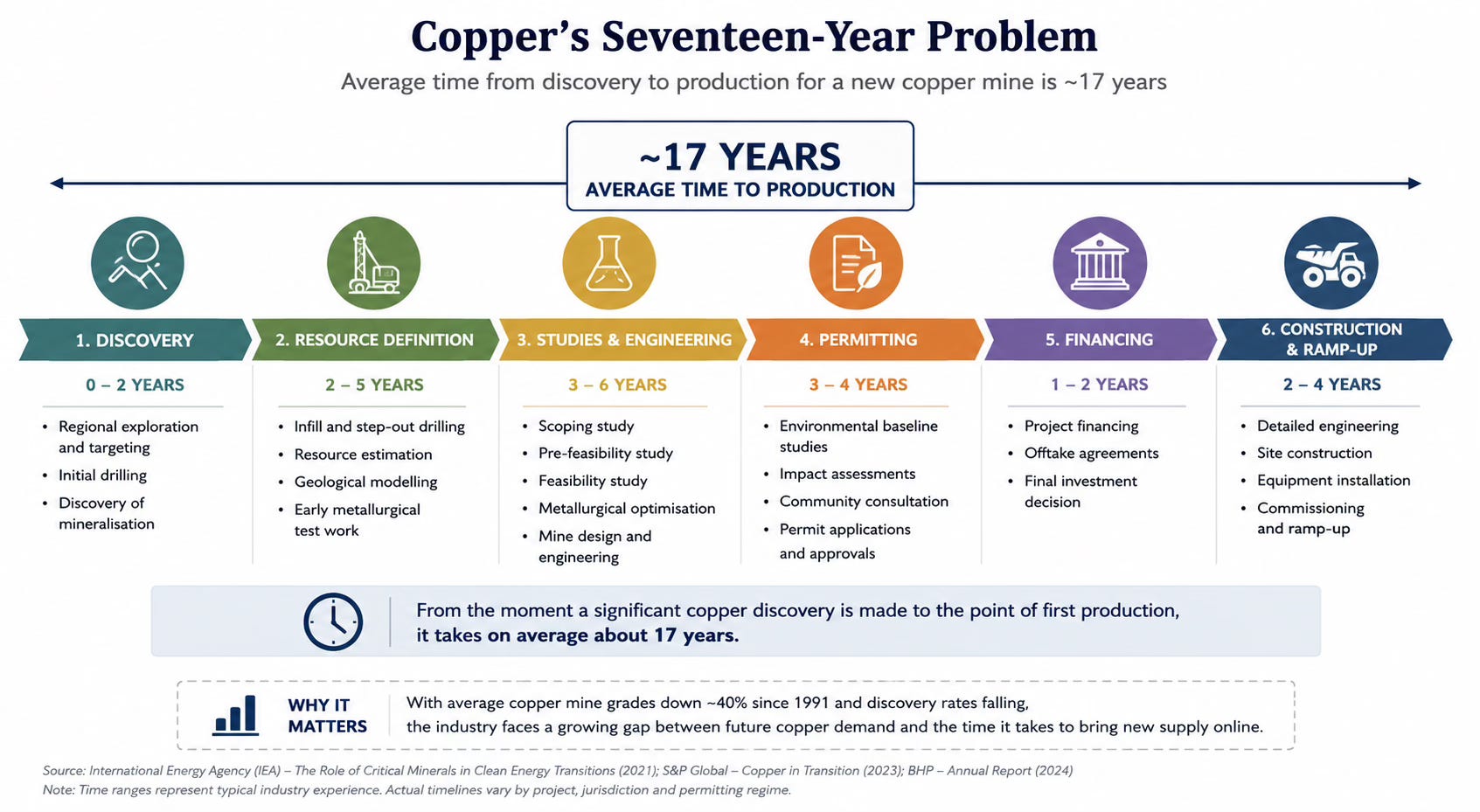
The International Energy Agency estimates that average copper mine grades have fallen by roughly 40% since 1991. Lower grades mean miners must move and process more rock to recover the same quantity of metal, requiring larger operations, more energy and greater capital investment.
Finding replacements has not become easier.
According to the IEA, only around 5% of copper deposits discovered during the past 35 years were found in the most recent decade. A newly discovered deposit now takes roughly 17 years, on average, to reach production.
Seventeen years is difficult to reconcile with the industry’s 2030s supply requirements.
A mining executive looking for new production next decade cannot simply double the exploration budget and expect new mines to appear on schedule. A discovery made today could still be moving through engineering studies and permitting well into the 2040s.
The arithmetic looks worse from inside a large mining company.
Every tonne extracted reduces the remaining inventory of an existing mine. Eventually that copper has to be replaced. Exploration can do it, but exploration spending buys probability rather than production. Companies can spend hundreds of millions searching without discovering anything capable of replacing a large ageing operation.
Acquisitions offer something different.
They buy time already spent.
Why Majors Buy Other People’s Geology
Filo is hardly an isolated example of the industry’s appetite for copper.
BHP attempted a £39 billion takeover of Anglo American in 2024, with Anglo’s copper portfolio sitting near the centre of the strategic logic. Glencore has pursued combinations involving major copper assets. Rio Tinto has continued expanding its exposure to the metal, while Lundin has repeatedly built copper positions through transactions, partnerships and district consolidation.
Large miners need assets capable of moving the needle.
A small discovery may be economically attractive and still be largely irrelevant to a company producing hundreds of thousands of tonnes each year. Replacing major mines requires scale, long operating lives and enough expansion potential to justify years of management attention and billions of dollars of capital.
A buyer is not simply purchasing tonnes and grade. It may be purchasing hundreds of completed drill holes, geological models, metallurgical testing, engineering studies, land consolidation and years removed from the development clock. The seller or its predecessors absorbed much of the uncertainty when the project was still little more than an exploration thesis.
By the time a major arrives, the question is often no longer whether copper exists.
It is whether the known copper can become a mine.
Few projects can answer that question at sufficient scale. Moonlight-Superior is one worth testing against those criteria.
The Projects That Become Difficult to Replace
Scale comes first, but scale alone rarely settles the argument.
Major miners also care about mine life, metallurgy, infrastructure, expansion potential and whether a project has a credible route through engineering and permitting. Geography increasingly matters too. A large copper resource close to roads and power in a country seeking more domestic mineral production presents a different development problem from an equivalent resource stranded hundreds of kilometres from infrastructure.
Work already completed has value too. Every drill programme, engineering study and metallurgical test represents money spent and uncertainty removed. When the development clock can run for nearly two decades, time becomes part of the asset.
Not because somebody must acquire it.
Because much of the work required to establish whether a substantial copper system exists has already been done.
Three Billion Pounds Already Found
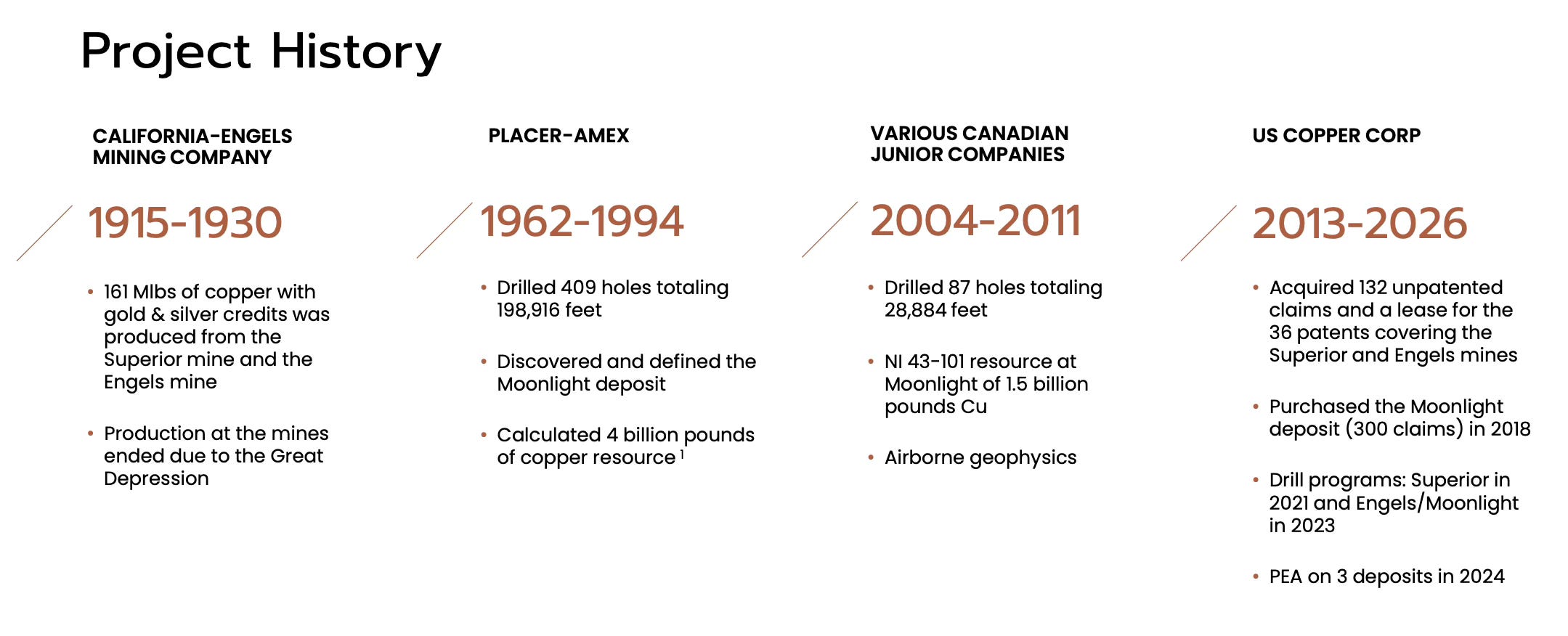
Moonlight-Superior sits in California’s historic Lights Creek copper district, where the Engels and Superior mines produced more than 161 million pounds of copper from material averaging approximately 2.2% copper between roughly 1915 and 1930.
Modern exploration revealed a much larger system.
The December 2024 resource estimate contains approximately 402 million short tons of indicated material grading 0.31% copper, representing around 2.5 billion pounds of contained copper. Another 64 million tons sits in the inferred category, containing approximately 394 million pounds.
Nearly three billion pounds of copper have therefore already been identified.
That does not make Moonlight-Superior a mine.
It makes it a known problem rather than an unknown one.
More than 500 drill holes contribute to the geological database, three deposits sit within the wider project and mineralisation remains open in several directions. Road, rail and power infrastructure already exists nearby.
The 2024 Preliminary Economic Assessment then provides an early indication of what developing the resource might involve. Using US$4.15 copper, the study produced an estimated after-tax NPV at a 7% discount rate of US$1.075 billion, a 23% internal rate of return and a 14-year mine life.
Initial capital was estimated at US$956 million.
That number may tell investors more about the next stage of the story than the billion-dollar NPV.
The Billion-Dollar Gap
U.S. Copper is a junior mining company. It cannot finance a project approaching US$1 billion in initial capital from its existing balance sheet.
Nor is Moonlight-Superior ready for construction. The project remains at PEA stage. No mineral reserve has been declared. Engineering, metallurgy, environmental work, drilling and permitting still have to progress considerably before a construction decision becomes realistic.
The company has indicated that it is seeking a joint-venture partner to help move the project towards pre-feasibility.
That financing gap is hardly unusual in mining. Junior companies often perform the work of discovery and early development before larger pools of capital become involved.
The question is when bringing in larger capital becomes economically rational.
For a junior miner, US$956 million is an enormous capital requirement. For a major producer accustomed to building multi-billion-dollar mines, the calculation is different. The concern is less whether the cheque is large than whether the asset deserves the cheque.
Moonlight-Superior still has to prove that.
What Happens After the Discovery
Investors following U.S. Copper from here should probably spend less time imagining takeover premiums and more time watching whether Moonlight-Superior becomes progressively easier for serious mining capital to evaluate.
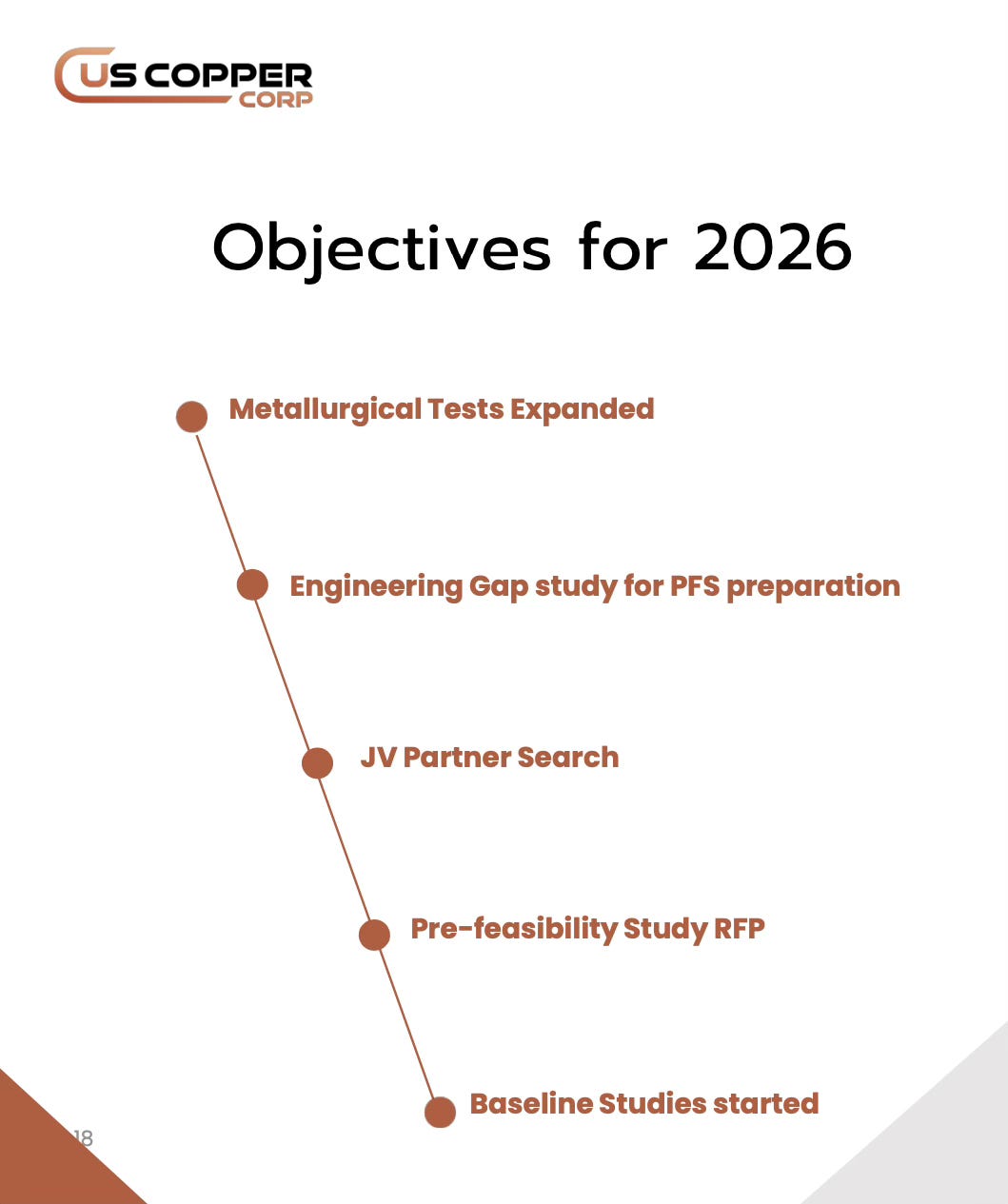
A pre-feasibility study would matter. So would further resource conversion, metallurgical work, environmental baseline studies and greater clarity around permitting. Resource expansion could alter the scale of the project. A credible strategic or joint-venture partner willing to commit its own capital would provide another form of validation.
Each step removes uncertainty from an asset whose copper has already been discovered.
The IEA estimates that expected copper mine supply from existing and announced projects could fall roughly 25% short of primary supply requirements in 2035.
It can explore more aggressively. It can expand existing mines. It can improve recoveries. It can attempt to substitute copper where technically possible.
Or it can buy.
Which brings the argument back to Filo.
BHP and Lundin were not buying copper flowing from an operating mine. They were buying access to a large copper system that years of exploration had already revealed, then combining it with another known deposit to create something larger.
Nobody knows whether Moonlight-Superior will ever enter a similar corporate conversation. Assuming it will would turn an interesting investment question into a takeover story that the evidence does not support.
Filo tells us something more useful about the industry itself.
The next generation of major copper assets may not begin with discoveries made tomorrow. Some have already been drilled, modelled and studied by companies too small to build them alone.
In a business where a new discovery can take seventeen years to reach production, the most valuable thing a larger miner buys may eventually be the years somebody else has already spent finding it.
Disclosure: This article has been commissioned by U.S. Copper Corp (TSXV: USCU). The views expressed are that of Matt Oliver, Oliver Market Intelligence and reflect his own analysis. This article is provided for informational purposes only and does not constitute financial or investment advice. Investments are inherently speculative and involve risk, including the loss of capital.
This is a brilliant breakdown of the structural realities facing copper. The 17-year timeline from discovery to production really highlights why M&A isn't just a choice for majors anymore, but an absolute necessity.
Matt, given how much time majors save by acquiring pre-feasibility assets like Filo or Moonlight-Superior, are you seeing majors pay a higher premium specifically for the years saved on permitting/drilling, or is valuation still mostly anchored strictly to contained copper in the ground?
Curious to get your take on this!